
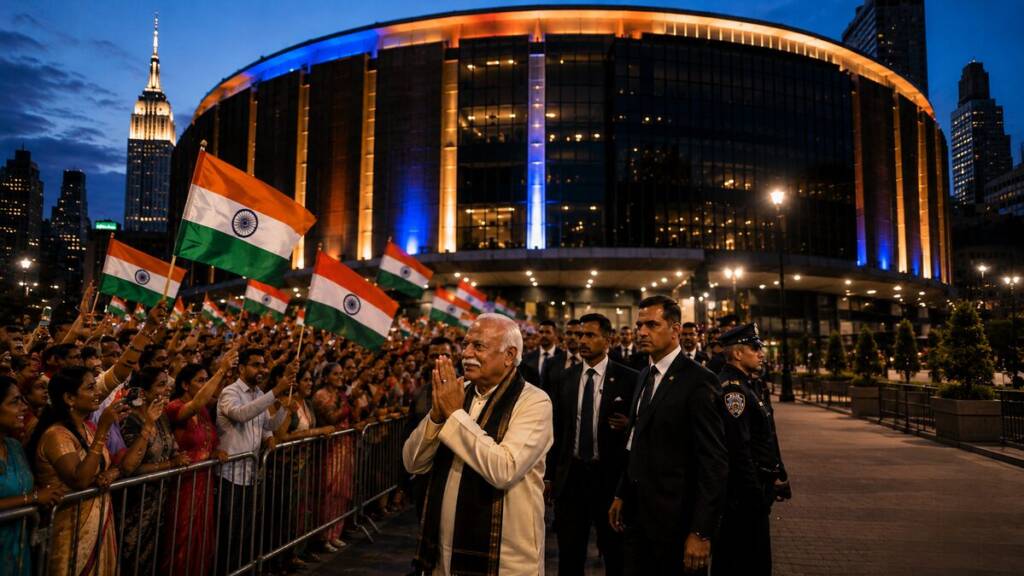
Rashtriya Swayamsevak Sangh chief Mohan Bhagwat is set to address roughly 5,000 Indian-Americans at Madison Square Garden in New York on Saturday, August 29, in a program organizers have billed as a celebration of universal oneness.
Bhagwat landed in New York on August 25, where he was welcomed with a tilak on arrival. The city marks the first leg of a three-nation tour covering the United States, Canada, and the United Kingdom. RSS Akhil Bharatiya Prachar Pramukh Sunil Ambekar announced the itinerary on X, saying overseas associations issued the invitations and that the tour marks the Sangh’s centenary year.
What the Visit Is Trying to Do
American Hindus for Engagement and Dialogue (AHEAD) is organizing the centerpiece event at the Garden’s theater. Ambekar described it as an interfaith gathering in which Bhagwat would address a “diverse, multicultural, and multi-faith audience,” framing the program as an extension of the Sangh’s engagement with varied communities back home.
The trip extends beyond the community hall, though. On August 28, the US-India Strategic Partnership Forum hosted a dinner in Bhagwat’s honor, which New York-based author Al Mason attended and later described for ANI — writing that Bhagwat framed the US-India relationship in long historical terms rather than around any single administration.
Nor is this the Sangh’s first outreach effort abroad. RSS general secretary Dattatreya Hosabale toured the US, UK, and Germany in April, meaning Bhagwat’s trip extends a push senior Sangh functionaries began months earlier. His American itinerary has so far involved diaspora, cultural, and community bodies rather than government meetings.
Why a Section of America Opposes the Visit
Opposition built quickly, arriving from three directions.
Washington moved first. The US Commission on International Religious Freedom (USCIRF) urged the administration to consider targeted sanctions against RSS members and to revoke Bhagwat’s visa, with Vice Chair Cece Heil saying Washington had a chance to hold India accountable on religious freedom.
Advocacy groups followed. The Indian American Muslim Council said more than 1,000 people had written to Secretary of State Marco Rubio asking him to deny or revoke the visa, with IAMC president Mohammed Jawad arguing that Bhagwat does not represent Indian-Americans. A coalition of 61 organizations, including Hindus for Human Rights and the Interfaith Center of New York, then pressed the venue directly to cancel the event.
Elected officials came third. Congressional nominee Brad Lander and city councilmembers Shahana Hanif and Lincoln Restler spoke at a City Hall press conference on August 25, where Lander declared, “There is no room for Mohan Bhagwat and RSS hatred in our city,” invoking the German American Bund rally held at the same arena in 1939. Mayor Zohran Mamdani also opposed the event, though he questioned whether the city had any power to halt a private booking.
New Delhi Calls the Critics Biased
India responded bluntly. At an August 21 briefing, Ministry of External Affairs spokesperson Randhir Jaiswal dismissed USCIRF as biased and lacking credibility, saying the commission had made incorrect and provocative statements for years.
Supporters of the visit point to a longer record: USCIRF has recommended a “country of particular concern” designation for India in successive years, a recommendation the State Department has repeatedly declined to act on. The Hindu American Foundation has separately challenged the commission’s composition and methodology for well over a decade — a procedural objection as much as a political one, since a body whose India findings the executive branch keeps setting aside is now asking that same executive to strip a visitor of his visa.
The 1939 analogy carries an awkward tail of its own. Mayor Fiorello LaGuardia permitted the Bund rally on free-speech grounds, backed by the American Jewish Committee, arguing that free speech had to cover people he personally detested.
In any case, the outcome was never seriously in doubt. Madison Square Garden is privately run and faced no obligation to cancel a paid booking, a limit Mamdani himself acknowledged — making his statement a moral position rather than an administrative one.
Safety Advisories, Then Canada and Britain
The Hindu American Foundation issued a community advisory ahead of the event, asking attendees to stay alert, remain civil, and report anything suspicious, while also urging Mamdani to guarantee their safety and civil rights.
The controversy is already traveling with Bhagwat. On August 5, more than 40 Canadian civil society, labor, and faith organizations asked Ottawa to bar him from entry. Two Canadian MPs also called for a complete ban on the RSS, though governments routinely ignore such recommendations.
For now, the visit has produced a familiar split screen: thousands cheering inside a private arena, hundreds objecting on the pavement outside. Neither side changed the other’s mind, and neither expected to.