
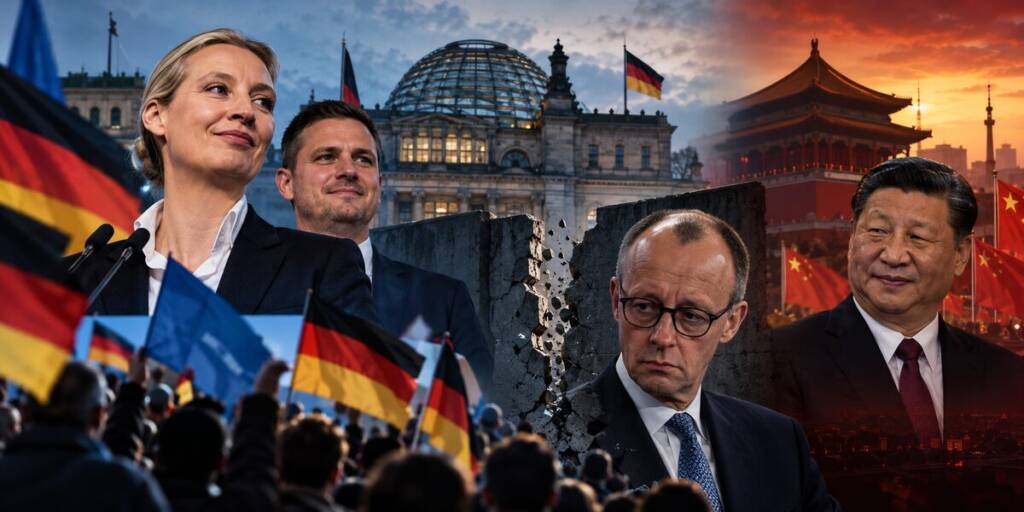
Germany’s far-right Alternative für Deutschland (AfD) won the Saxony-Anhalt state election on Sunday, September 6, taking 43.8 per cent of the vote. Preliminary official results put the party almost 27 points clear of Chancellor Friedrich Merz’s Christian Democrats — the AfD’s strongest state result ever. Yet the party finished three seats short of a majority, leaving Germany to confront a question it has dodged since the war: what happens when a party its own intelligence services call extremist wins outright?
AFD’s Numbers That Shook Berlin
The AfD holds 39 of the 83 seats in the Magdeburg parliament; it needs 42. The CDU crashed to 17.2 per cent and 15 seats, down from 37.1 per cent in 2021, official figures show. The SPD took 9.3 per cent, the Greens 8.9 per cent, the Left 8.6 per cent and the newly elected BSW 5.3 per cent.
Turnout tells the real story. It climbed to almost 78 per cent from 60.3 per cent five years ago, and analysis suggests most of the AfD’s new support came from people who had stopped voting altogether, joined by CDU defectors.
Merz did not hide the damage. He called it the worst CDU defeat in decades but insisted that “giving up is not an option for me.”
AFD is Three Seats Short, and a Scramble has Begun
Ulrich Siegmund, 35, fronted the AfD campaign and wants the minister-president’s chair. “We have made history in this state,” he told reporters.
Arithmetic still blocks him, however. Rival parties maintain the “firewall” — their decades-old refusal to govern with the AfD. Even so, the wall is wobbling. There are reports that the BSW could abstain in a third round of voting, where a simple majority suffices. Alternatively, three defectors from other benches would carry Siegmund over the line.
One complication looms large: the state’s Office for the Protection of the Constitution classified the Saxony-Anhalt AfD as confirmed right-wing extremist in 2023. The party rejects the label as politically motivated.
The China Question Nobody in Magdeburg Asked
Attention has also swung to Alice Weidel, the AfD’s national co-leader, who joined Siegmund on stage on election night.
Weidel does not fit the far-right template. She spent six years in China, speaks Mandarin and wrote her doctorate on the Chinese pension system. She worked for the Bank of China, then Goldman Sachs in Frankfurt. In China, by contrast, she is an internet celebrity, nicknamed the “Iron Lady.”
Her party’s trade policy runs the same way. The AfD’s Bundestag group openly opposes EU punitive tariffs on Chinese goods. In a statement dated August 20, 2025, its economic affairs spokesman Malte Kaufmann argued that special duties on Chinese electric cars are, as a rule, unsuitable for helping German carmakers grow. His colleague Peter Felser complained that German dairy farmers were paying the price of Brussels’ tariff row through Chinese retaliation.
That puts the AfD against the drift of German policy. The EU imposed duties of up to 45 per cent on Chinese electric vehicles in October 2024; Berlin voted against them at the time. Now Merz’s SPD coalition partner wants tariffs extended to Chinese hybrids.
Critics see more than economics here. Bonn University’s Gu Xuewu has described the AfD as Germany’s friendliest party toward Beijing. Weidel led a party delegation to Beijing and Shanghai in 2023. Separately, former AfD MEP Maximilian Krah faced scrutiny over his Chinese connections. The party denies acting in any foreign interest.
So What Does the AfD’s Rise Really Mean?
Migration matters, but it is not the whole answer. Exit polling found 91 per cent of AfD voters worried that too many foreigners live in Germany. Yet Infratest dimap ranked collapsing trust in the established parties first among the issues that decided the vote, ahead of social security, the economy and migration.
The class pattern is stark. The AfD took 59 per cent among working-class voters and 65 per cent among those who rate their finances as poor. Even so, it won roughly 30 per cent of graduates.
Two readings compete. The first treats the result as a revolt against open-ended immigration, green rules and support for Ukraine. The second reads it as an eastern German verdict on 36 years of unmet promises, delivered against every establishment party at once. Both find evidence — but only the second explains why the CDU lost half its vote.
Europe Is Watching
The far right already leads coalitions in Italy and the Czech Republic, and governs as a junior partner in Finland, Croatia, Slovakia and Sweden. Three hard-right groups hold 196 European Parliament seats between them. Marine Le Pen, meanwhile, leads French presidential polling for 2027.
French Foreign Minister Jean-Noël Barrot called the German result a victory for the “neo-Nazi, anti-European and pro-Putin far right.”