
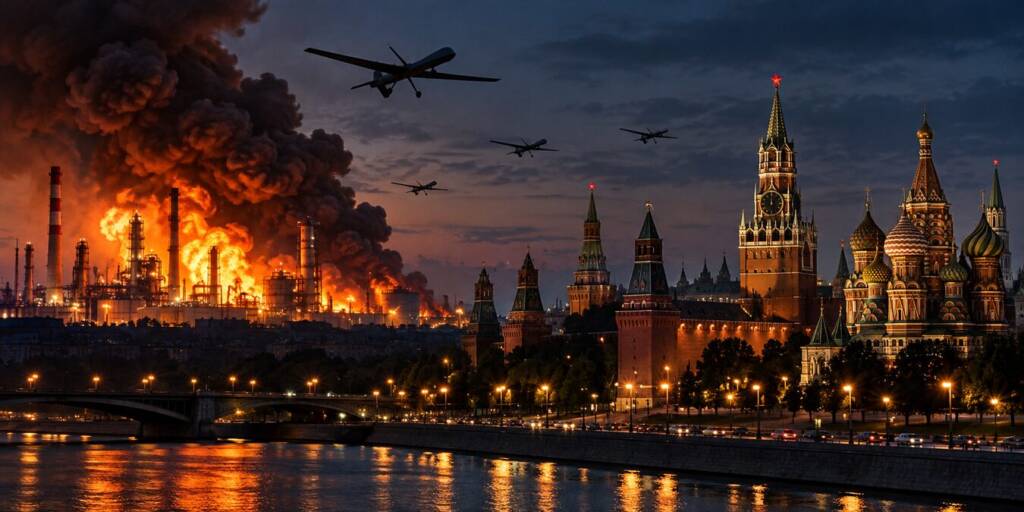
Ukraine launched its largest drone attack of the war against Moscow on September 20, timed to the final day of Russia’s parliamentary election. Drones set a major oil refinery burning just 15 km from the Kremlin.
Andrey Vorobiev, governor of the Moscow region, said the strikes killed three people and injured 20 others, including three children.
Moscow Mayor Sergei Sobyanin called it the largest attack the capital has faced, saying air defenses had downed more than 1,600 drones across Russia since Saturday — roughly 450 of them near Moscow. “This unprecedented attack was clearly planned with the aim of disrupting the elections,” Sobyanin said. “The enemy did not succeed.”
The Refinery 15 km from the Kremlin
Ukraine’s General Staff openly identified its main target: long-range drones struck the Gazpromneft-Moscow Oil Refinery in the Kapotnya district, damaging its AVT-6 primary refining unit, its integrated refining unit, and its isomerization unit. The plant processes about 12 million tonnes of crude a year and supplies 40 percent of Moscow’s fuel market.
President Volodymyr Zelensky confirmed the operation on Telegram, though he made no mention of the election. “Our long-range responses had a very significant impact in the Moscow region last night,” he said, adding that such targets bring in “billions of dollars that sustain the war machine.” Russia’s defense ministry, for its part, reported downing more than 1,900 drones, eight guided bombs and eight cruise missiles.
The Truce Nobody Signed
The timing is awkward for Washington. On September 14, US President Donald Trump posted that both sides had agreed to stop hitting energy targets — a claim neither Moscow nor Kyiv confirmed. Zelensky said he was “not sure” Russia would comply, and Ukraine struck the Syzran refinery just a day later, on September 15. The Kremlin welcomed the American proposal the following week without actually signing anything.
Moscow now argues Kyiv torched a deal at its most delicate moment; Kyiv argues no deal existed to break in the first place.
United Russia Wins the Election, and Moscow Promises Payback
United Russia took 57.5 percent of the vote after 71 percent of ballots were counted, with turnout reaching 56.66 percent — enough to keep the party’s two-thirds Duma majority and its ability to push through constitutional amendments.
The contest carried obvious limits: Russia’s Supreme Court struck the anti-war Yabloko party from the ballot weeks earlier, and voting also took place in occupied and annexed Ukrainian territory. Russia’s defense ministry accused Ukraine of attacking “the democratic will of Russian citizens” and vowed to intensify strikes on Kyiv — a threat layered atop an already relentless campaign. Zelensky said Russia fired more than 2,000 drones, 1,700 aerial bombs and 19 missiles at Ukraine in the past week alone.
Zelensky’s Own Election Problem
Putin has framed the vote as a referendum on support for the war — a framing that sharpens a familiar Kremlin talking point aimed at Kyiv, since Ukraine has held no national election since 2019. Zelensky’s term expired in May 2024, and martial law has suspended voting since February 2022. Washington has pushed for elections in 2026, which would require legal and constitutional changes, but Zelensky has resisted, telling journalists in August that a wartime election would “destroy” the country.
His critics point to the polling. A Kyiv International Institute of Sociology survey conducted between August 21 and September 10 found 54 percent of Ukrainians trust Zelensky, against 41 percent who do not; earlier KIIS polling had ranked him fourth, behind Valerii Zaluzhny, Mykhailo Fedorov and Kyrylo Budanov. A separate poll found 67 percent of Ukrainians expect a different president once the war ends. A corruption investigation touching Zelensky’s office has added further strain.
The Winter Ahead
Russia’s promise to escalate points toward one obvious target: Ukraine’s power grid, which enters autumn badly weakened. Available generating capacity had fallen to roughly 11.5 GW by February 2026, down from about 55 GW before 2022, and January frosts near minus 20°C already triggered an energy emergency. UN human rights chief Volker Türk called the strikes “cruel” and a breach of the rules of war.
UN officials warn the coming winter could prove Ukraine’s hardest yet — meaning the refinery fires in Kapotnya may ultimately prove just as costly in Kyiv as they were in Moscow.