
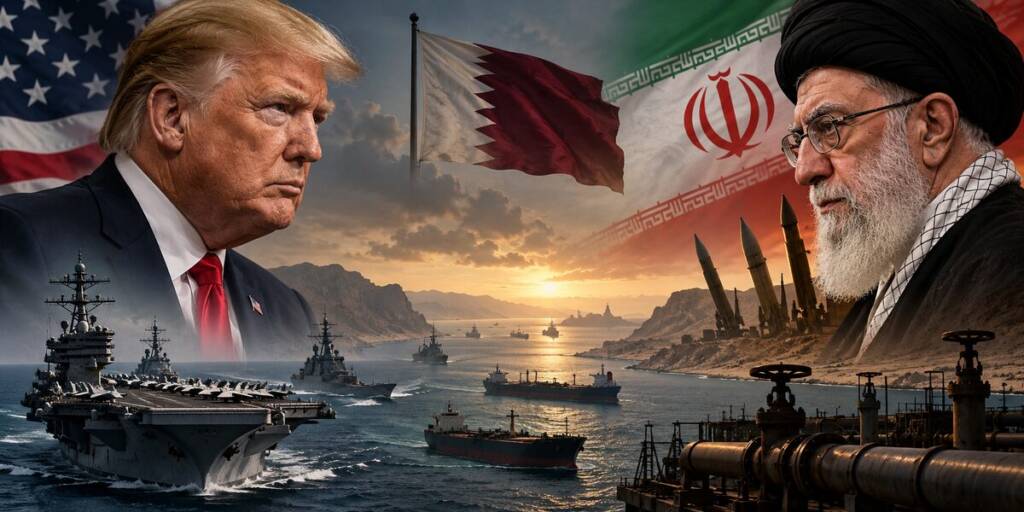
Iran has handed Washington seven conditions for ending the war, delivered through Qatar as an intermediary. Mohsen Rezaei, secretary of Iran’s Supreme National Security Council, disclosed the move on Saturday, saying Tehran now awaits a reply from President Donald Trump. He attached a warning: reject the terms, and Iran will fight a “decisive war.”
What Iran Is Asking For
Rezaei disclosed only three of the seven demands: a halt to fighting on every front, the release of Iranian funds frozen under US sanctions, and an end to the US Navy’s blockade of Iranian ports. The remaining four conditions stay undisclosed — a silence that gives Tehran room to add, drop or redefine terms later. “We are prepared for a decisive war,” Rezaei said.
Qatar is an awkward choice of messenger. Iranian missiles struck its Ras Laffan gas complex in March, prompting Doha to expel Iran’s military attachés — yet it has resumed mediating regardless.
Rezaei also quietly softened one earlier position, according to David Des Roches, a former Pentagon official focused on Arabian Peninsula affairs: Iran has dropped its demand for war reparations. Even so, Des Roches predicted Washington will still read the package as a call for surrender.
Is America About to Invade?
The State Department hardened its language on September 19, urging Americans outside the region to “seriously reconsider travel to and through the region” and warning that the conflict could escalate rapidly. Iran and Iraq now sit at Level 4 on the travel advisory scale; Israel, Jordan, Kuwait, Bahrain, the UAE, Qatar and Saudi Arabia sit at Level 3.
An advisory, however, is not an invasion order. Reports indicate the Pentagon drafted weeks of ground operations back in March, but those plans involved special forces raids rather than a march on Tehran. Secretary of State Marco Rubio maintained at the time that America needed no ground troops.
Trump Keeps Three Options Open against Iran
Trump called Fox News correspondent Trey Yingst on Sunday, describing himself as being in “deciding mode.” He laid out three paths: wiping Iran out, letting it rot economically, or striking a deal. “My question is if and when do I blow the entire nation up?” he said.
He also indicated he would likely meet Iranian President Masoud Pezeshkian in New York. Trump sits down with six Gulf leaders on September 22 to gauge their views on a postwar plan his team has yet to finish; Pezeshkian addresses the same UN assembly days later.
Two Straits, One Trap
Iran closed the Strait of Hormuz when the war began on February 28 — a chokepoint through which roughly a quarter of the world’s seaborne oil once flowed. The southern exit has since closed too: Houthi fighters seized the port of Mocha on September 10, then took Perim Island and the Hanish Islands, handing them control of Yemen’s Red Sea coastline.
The squeeze cuts both ways, and that’s Washington’s dilemma. America blockades Iranian ports while Iran and its allies blockade the Gulf’s exits. Brent crude climbed $3.21 to $107.82 a barrel in mid-September, Middle East crude exports fell 39 percent in August, and drones knocked out Saudi Arabia’s East-West pipeline on September 11.
Escalation, then, carries a price at the pump — yet accepting Iran’s terms would look like capitulation ahead of November’s midterms. Trump told Yingst the Houthis had agreed not to engage American forces; Crown Prince Mohammed bin Salman has twice urged strikes on the group, and Trump has twice declined. He cannot shield Saudi oil without breaking his own understanding with the very group throttling it.
The Pressure at Home
Congress has grown restless. The House voted 220–204 to end the war — its third such attempt — with seven Republicans crossing the floor, including two Iowa members facing tight races. The Senate will almost certainly let the measure die.
Strain is showing at sea, too. The USS Abraham Lincoln reached Guam on September 19 after 302 days deployed, its crew not having touched American soil in nine months.
What to Watch Next
Rezaei says Iran and Oman came within a short step of a Hormuz shipping deal, though the framework still awaits regional endorsement. China has backed the plan, and Foreign Minister Wang Yi is pushing for a broader new Gulf security architecture. Rezaei separately denied any Iranian plan to close the Bab el-Mandeb strait, calling that a matter for Yemen alone.
One threat remains unspoken but visible: Iran has not withdrawn from the Nuclear Non-Proliferation Treaty, though Rezaei warned that American conduct could yet push Tehran to do so. Trump meets the Gulf monarchs tomorrow — and Iran’s seven conditions will sit in the room, still unanswered.