
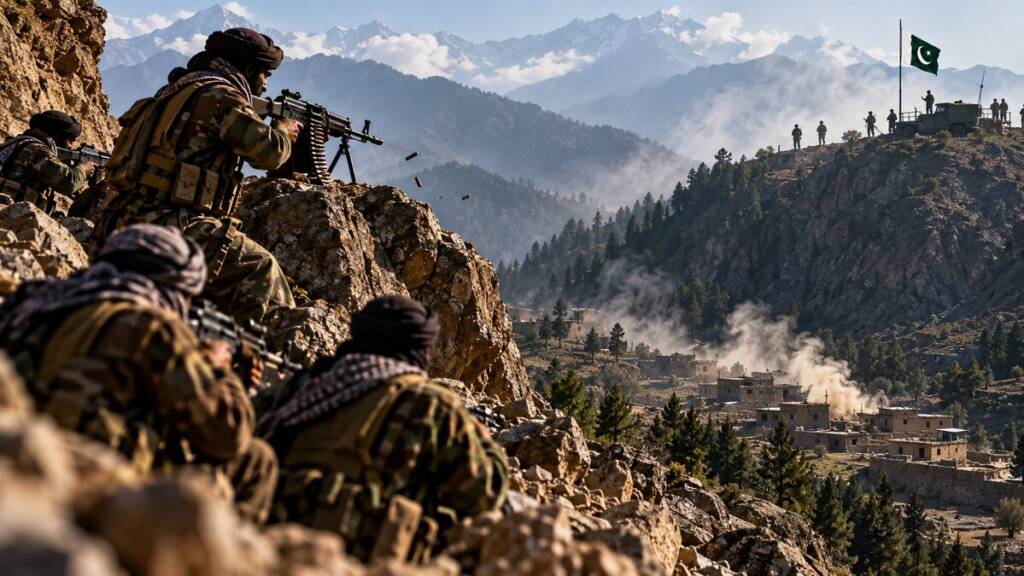
Afghan forces killed 28 militants in the eastern province of Nuristan on Saturday, Afghanistan’s defence ministry said, and the Taliban government accused Pakistan of backing the group. The ministry said the attackers included Islamic State militants and that most were former Afghan government security personnel, whom it accused Pakistani intelligence of training and sending across the border. Pakistan has not been heard on the specific charge in the material available so far.
Accounts of the toll differ. Some reports say Afghan forces wounded 32 more fighters, while others say 32 were captured alive. The claims have not been independently verified.
The defence ministry posted its statement on X on September 27. It said the group entered Kamdesh, a district near the Pakistani border, intending to carry out attacks. Afghan troops launched an operation, it said, and the survivors fled back towards Pakistani militia positions.
The ministry named Daesh, the regional Islamic State branch known as ISKP, as the main force, and described the fighters as “elements of evil and corruption.”
According to the ministry, Pakistani intelligence lured former Afghan soldiers with promises of asylum and well-paid jobs abroad. Pakistani military and intelligence camps then gave them short training before sending them to Nuristan, it alleged. It also claimed that Pakistani armed personnel and militia members coordinated with the fighters and pulled out as soon as the fighting began.
Six days after Pakistani airstrikes
The clash came six days after Pakistani airstrikes inside Afghanistan on September 21. Islamabad said those strikes killed 28 militants, while Afghan officials said they killed civilians. The UN mission in Afghanistan confirmed three civilian deaths.
Pakistan, for its part, blames Kabul for sheltering the Pakistani Taliban, or TTP. The UN puts the group’s strength in Afghanistan at 6,000 to 6,500 fighters. The Nuristan fighting is the second deadly border incident in a week.
A rival claim from the ground
An anti-Taliban armed group gave its own account of the weekend fighting. The Afghanistan Freedom Front said Taliban forces attacked its positions in Kamdesh with ground troops and drones, and that its fighters resisted, counter-attacked and seized several Taliban checkpoints. That version differs sharply from the ministry’s, and neither could be independently confirmed.
Not the first such accusation against Pakistan
The Taliban’s allegation echoes charges that other neighbours have made against Pakistan. India has long alleged that Pakistan’s security establishment recruited, financed and trained groups such as Lashkar-e-Taiba and Jaish-e-Mohammed. Pakistan has consistently denied this.
Lashkar-e-Taiba gunmen killed 166 people in Mumbai in November 2008. Indian documents reported by The Guardian in 2010 described dozens of meetings between ISI officers and Lashkar leaders, which the Pakistani-American militant David Headley disclosed under interrogation. In February 2019, a Jaish-e-Mohammed suicide bomber killed 40 Indian paramilitary personnel at Pulwama in Kashmir. Bruce Riedel, a former CIA analyst, said the group’s claim of responsibility raised serious questions about the ISI’s role, and the White House urged Islamabad to end support for all terror groups. In April 2025, 26 people were killed in an attack at Pahalgam in Kashmir, which India blamed on Pakistan-backed terrorists.
Iran has made similar complaints about Jaish al-Adl, a Sunni Baloch militant group. Tehran has long said anti-Iran militants use hideouts in Pakistan’s Balochistan province to plan attacks. In February 2019, a Jaish al-Adl bombing of a bus carrying Revolutionary Guards killed 27 people, after which the Guards warned Islamabad to act against the group or face retaliation. On January 16, 2024, Iran fired missiles and drones at alleged Jaish al-Adl bases in Balochistan, and Pakistan struck back two days later inside Iran’s Sistan and Baluchestan province.