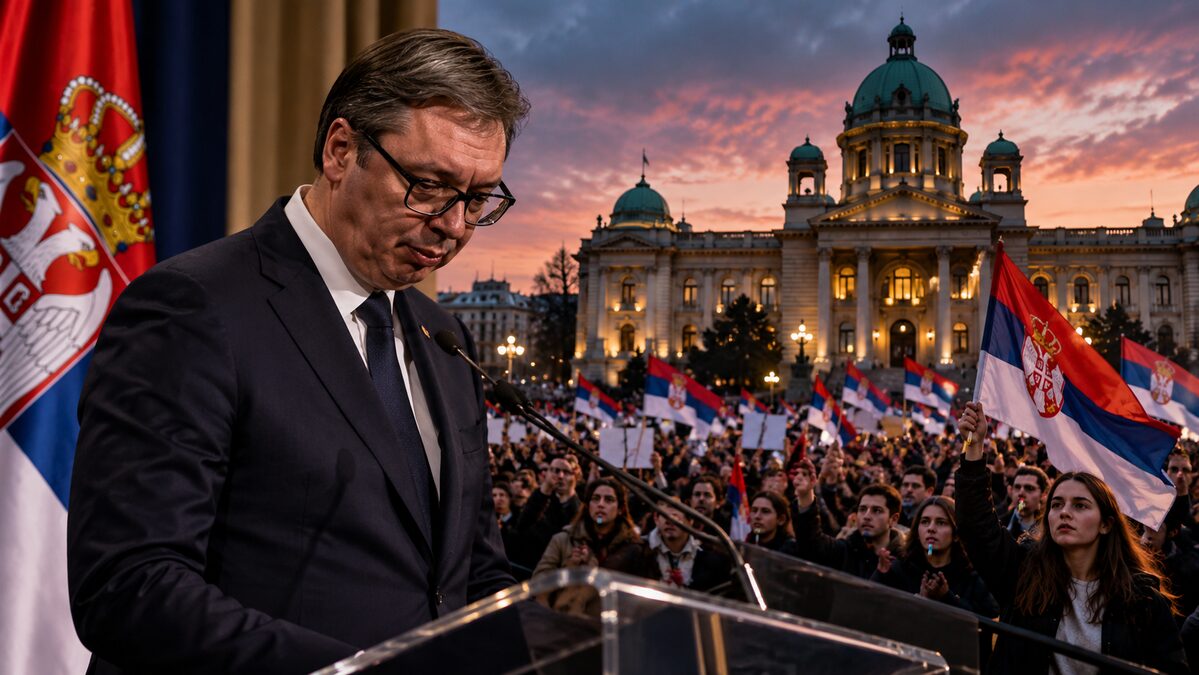
Serbian President Aleksandar Vučić resigned in Belgrade on Sunday, September 27, ending his second and final term to run for prime minister in a snap parliamentary election on October 25. He does so as a student-led movement mounts the biggest challenge to his rule in more than a decade.
Serbia’s constitution bars a president from serving a third term. Vučić quit seven months before his term was due to end, a move that clears his path to the prime minister’s office, provided his Serbian Progressive Party (SNS) can form the next government. He has led Serbia as president or prime minister since 2014. SNS leaders named him head of the party’s “United Serbia” list in September, and he first signalled his plan to step down in August 2025.
“This is the last evening for me in this building,” Vučić told flag-waving supporters on Sunday. “I have faithfully served you and my fatherland, Serbia,” he added.
Minutes before resigning, Vučić pardoned 49 people. The list included 23 people linked to the protests, as well as some loyalists from his own party. Parliament Speaker Ana Brnabić, a close ally, is now acting president. Vučić said the first round of a presidential vote will be held by the end of December.
The crisis began on November 1, 2024, when a concrete canopy at the railway station in the northern city of Novi Sad collapsed, killing 16 people. Students then led some of Serbia’s largest demonstrations in decades, drawing hundreds of thousands onto the streets. Protesters accuse the government of corruption, secrecy and political interference in state institutions. Vučić and his allies reject the allegations.
Early elections were a central student demand. Belgrade editor Dejan Ilić said the public, not Vučić, deserves credit for the vote. “They demanded elections and they forced elections,” Ilić said.
The SNS and its allies face two main rivals. Students Win is a student-led anti-corruption movement fielding 250 candidates, most of them university professors and professionals. Its platform promises investigations into allegedly ill-gotten property and tougher action against corruption. The Democratic Party, once led by former president Boris Tadić, backs the students. The second challenger, European Serbia, brings together pro-Western opposition parties. Some polls suggest the student list could pose a serious threat to the SNS.
Hours before resigning, Vučić promised to accept an opposition win and said he would congratulate his rivals the same evening. Critics remain sceptical. Former MP and rights activist Aida Ćorović said the real crisis could begin after polling day. She accused the government of capturing state institutions and alleged links between the government and organised crime. The government has not accepted such claims.
Four days before quitting, Vučić addressed the UN General Assembly in New York. He praised US President Donald Trump, cast Serbia as a bridge between rival powers and criticised what he called the selective application of international law on Kosovo. He has courted Trump before, joining him in the Oval Office in September 2020 for a Serbia-Kosovo economic normalisation deal.
Vučić keeps ties open with Washington, Moscow and Beijing at the same time, and US pressure on Russian energy has tested that balancing act. American sanctions on NIS, Serbia’s Russian-owned oil company, took effect in October 2025, and in August Serbia’s energy minister said Russian shareholders were negotiating their exit. Belgrade has also moved closer to Israel. On September 17, Vučić opened a factory to assemble drones from the Israeli firm Elbit Systems.
Serbia, with about six million people, has the largest population in the Western Balkans, though its workers still earn less than those in neighbouring EU states. Official figures put the average net monthly salary at 1,032 euros in April, against 1,555 euros in Croatia, a gap of roughly 51 per cent. Students Win, European Serbia and other parties have yet to name presidential candidates.
The result will be watched closely in neighbouring states, as Belgrade has strong ties with Serb communities in Bosnia and Herzegovina, Montenegro and Kosovo. Tanja Topić of the Friedrich Ebert Foundation said a change in Belgrade could bring relief to the whole region.
On October 25, Serbs will decide whether Vučić keeps power under a new title.