
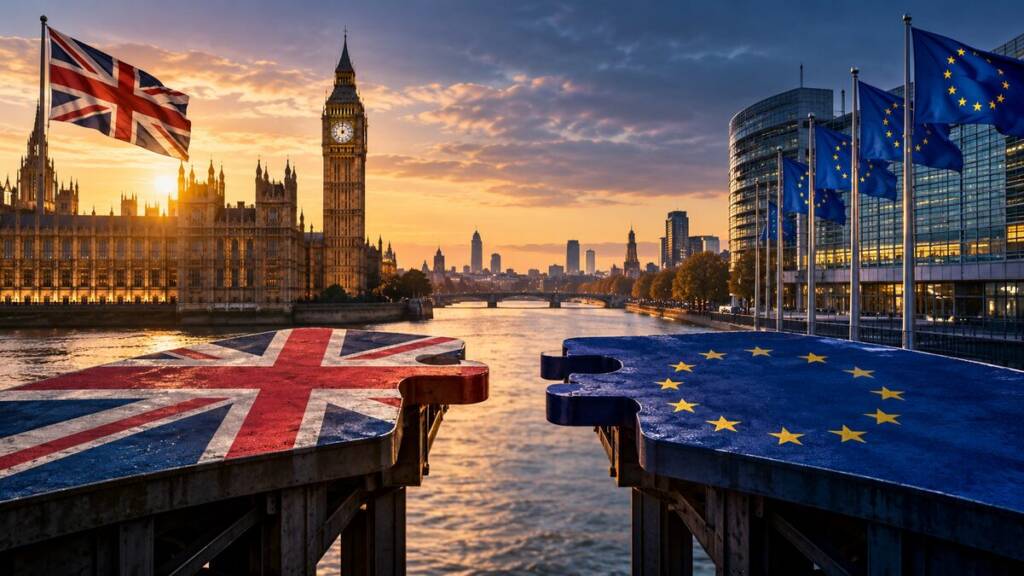
Prime Minister Andy Burnham has reopened Britain’s oldest political argument. Speaking to the BBC on 29 September, he said Britain should weigh every option for its European future. Those options run from the present deal to a customs union, the single market, or “all the way” back into the European Union. He had told the Labour conference in Liverpool a day earlier that Brexit had done “more harm than good”. Burnham promised to set out the choices around a UK-EU summit later this year. He has filed no application and set no timetable. Even so, he has moved membership from a closed question to an open one.
Why Britain Left in the First Place
Britain voted to leave on 23 June 2016, by 52 per cent to 48. David Cameron had called the referendum under pressure from his own backbenchers and from UKIP.
The Leave campaign ran on three promises: control of borders, control of laws, control of money. Free movement let any EU citizen live and work in Britain without a visa. Net migration had run above 300,000 a year for most of the previous decade. Leave voters also objected to the European Court of Justice and to Brussels budget payments.
Boris Johnson then won a landslide in December 2019 on a pledge to “get Brexit done”. Britain left on 31 January 2020 and quit the single market a year later.
What Brexit Has Cost
The Office for Budget Responsibility estimates that Brexit will cut long-run productivity by about 4 per cent. It also expects UK trade volumes to settle roughly 15 per cent lower. New Economy Brief translates that into about £100 billions of lost output a year.
Goods trade shows the damage most plainly. UK goods exports to the EU stood at £184 billion in 2025, down 14 per cent on 2019. Goldman Sachs, marking ten years since the vote, put the shortfall in output near 6 per cent.
Services tell a different story. Britain is now the third-fastest growing services exporter in the G7. Finance, insurance and professional services all expanded. Economists still dispute the totals, with estimates ranging from 4 to 10 per cent of GDP.
Did Britain Get What it Voted For?
On immigration, the answer is complicated. Net migration climbed to a record 906,000 in mid-2023, well above pre-referendum levels. It then fell to 171,000 in the year to December 2025, according to the Office for National Statistics.
The mix changed completely. EU net migration turned negative after 2022, while non-EU arrivals surged. Migration Watch UK blames ministerial choices in 2021, not Brussels, for that surge. Leave voters got control of the dial. Successive governments simply turned it the other way for several years.
On trade, Britain signed deals with Australia, New Zealand and India, and joined the CPTPP bloc. Their combined gain amounts to roughly a tenth of the lost EU trade. On law-making, Britain did recover its statute book. Yet the 2025 reset deal grants EU fishing fleets access to British waters until 2038.
How Brussels Answered
National leaders responded warmly. French President Emmanuel Macron said “welcome back” at a news conference in Madrid. Spain’s Pedro Sánchez said Britain would return “with open arms”.
The European Commission was far more guarded. Its spokesperson described Britain as a close and valued partner. The Commission then placed the burden back on London to define what it wants. EU officials have also pointed to a simpler route. Britain could join the customs union or single market through the European Economic Area.
Macron added one warning. Outsiders face a problem, he said, because nobody may pick and choose among the Union’s freedoms. Brussels officials have meanwhile signalled reluctance to open detailed talks while London lacks a settled policy.
What Rejoining Would Actually Involve
Britain cannot simply undo Brexit. It would apply afresh under Article 49 of the Treaty on European Union. Article 50(5) sends every departed state down that same road.
All 27 governments must agree. The European Parliament must consent, and every national parliament must ratify the accession treaty. France vetoed British applications twice, in 1963 and 1967.
The terms would also bite harder. The Institute for Government notes that new members must commit to the euro and to Schengen. Margaret Thatcher’s rebate, worth about two-thirds of Britain’s net contribution, would not return automatically. Nor would the old opt-outs. Most analysts therefore measure any accession in decades, not years.
The Fight at Home
The backlash arrived within hours. Richard Tice, Reform UK’s deputy leader, accused Burnham of sneaking Britain back to Brussels through the back door. Conservative deputy leader Alex Burghart said the prime minister wanted to restart the Brexit battles.
Polling gives Burnham room, though not a mandate. A YouGov survey in June 2026 found 55 per cent backed rejoining and 34 per cent opposed. Support falls once pollsters mention budget payments and the euro. A Public First poll for Politico found half of Reform voters want closer EU ties.
Burnham has ruled out neither a referendum nor a manifesto pledge. His nearer task is smaller and harder. Negotiators must still settle food standards, carbon markets and a youth mobility scheme before the delayed summit.