
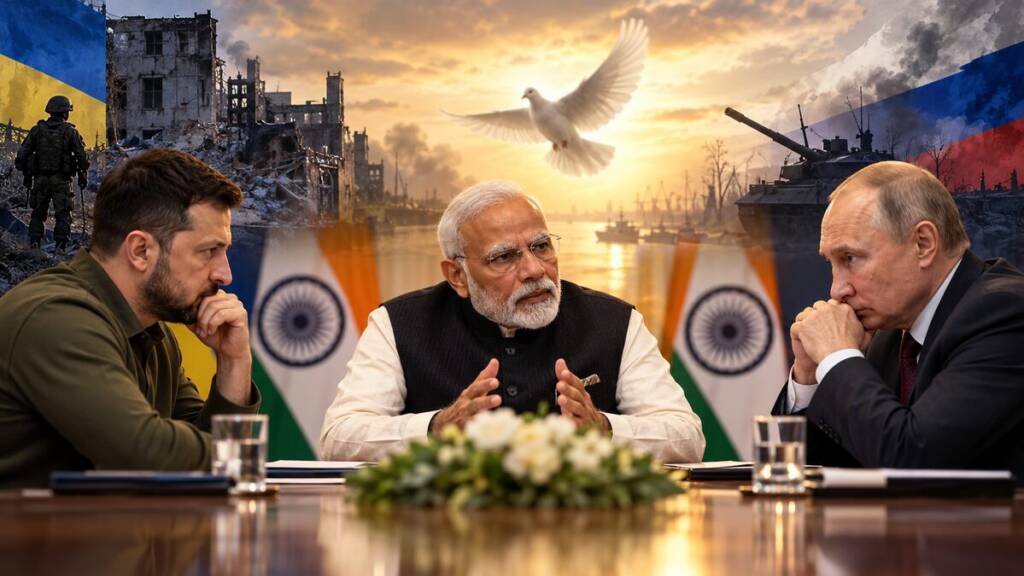
Ukraine has named India’s ceasefire proposal the “most comprehensive” of four plans now before Kyiv. Foreign Minister Andrii Sybiha said this at a press briefing on 1 October.
The same day, Russian President Vladimir Putin praised Prime Minister Narendra Modi’s ideas for ending the war. He spoke at the Valdai Discussion Club near Moscow.
Both warring capitals have now welcomed New Delhi’s role in public. The timing has put India at the centre of a crowded peace effort. Yet nobody has released the plan’s full details.
What is India’s Ceasefire Proposal?
The public record offers only an outline. Sybiha said India has signalled, for the first time, its readiness to play a role. Indian reports go further. According to reports, the plan joins an energy ceasefire with a truce in the Black Sea. Ukrainian President Volodymyr Zelenskyy said earlier that Egypt, India and Türkiye had offered maritime truce options.
Ukrainian media, however, presents the energy and Black Sea package as Kyiv’s own position. Kyiv’s position is clearer. It has already shared that vision with its partners. Ukraine will accept an energy truce and a Black Sea truce only as one linked package. The energy part means a full stop to strikes on energy sites, including ports.
Sybiha added that Ukraine is ready for an unconditional ceasefire along the front line. Such a ceasefire could follow a meeting between Zelenskyy and Putin, he said.
What Are The Other Three Plans?
RBC-Ukraine’s account shows that each rival plan targets one area.
Türkiye and Egypt have proposed a truce for grain and farm shipments in the Black Sea. The issue matters to Cairo. Egypt gets about a third of its grain from Ukraine. The United States has proposed an energy truce. Zelenskyy discussed that idea with US President Donald Trump. Kyiv says India’s plan covers more ground than these three. The idea has a history. In March 2025, Washington announced separate deals with Kyiv and Moscow on shipping and energy strikes. The fighting did not stop.
What did Putin Say at Valdai?
Putin addressed the club’s 23rd annual meeting on 1 October. The club is a Moscow-based think tank and discussion forum. Its research director, Fyodor Lukyanov, moderated the session. During the session, Putin turned to Modi’s stance on ending wars. Modi raises the Ukraine conflict at every meeting, Putin said. He does so despite the warm personal ties between the two leaders.
Putin said Modi has “very good ideas” for solutions that both sides can accept. The Kremlin’s English transcript renders the phrase as “excellent ideas”. Putin stressed that any solution must work for both sides. He described Modi’s position as neutral, yet committed to ending the conflict. He also thanked Modi for his ideas. Putin did not repeat Kyiv’s ranking.
Why is India in this Position?
India has kept ties with both capitals through more than four years of war. It has urged both sides to choose dialogue and diplomacy. External Affairs Minister S Jaishankar visited Kyiv on 3 September. “If India can be of any help in any manner, we are ready,” he said.
No Indian foreign minister had made a standalone visit to Ukraine before. Zelenskyy met Jaishankar and thanked India for its efforts. Jaishankar also pointed to India’s relief supplies for Ukraine. Jaishankar later met the foreign ministers of Ukraine and Russia in New York. Modi met Putin in Bishkek. “Endless war must now give way to an end of war,” Modi said there.
The external affairs ministry’s consultative committee reviewed these contacts on 3 October. The panel noted both Putin’s remarks and Sybiha’s assessment. Modi earlier told Japan’s Yomiuri Shimbun that India would support meaningful peace efforts.
What Happens Next?
Russia’s reply will decide the fate of India’s ceasefire proposal. It remains unclear how Moscow has responded to the specific plan, India.com reported.
Doubts persist in Europe. German Chancellor Friedrich Merz said recently that Russia shows no interest in real peace talks, RBC-Ukraine reported. German Foreign Minister Johann Wadephul, by contrast, expects talks soon and wants Berlin involved.
Washington is working on the track that includes a possible Zelenskyy–Putin meeting. For now, New Delhi holds something few mediators have. Both sides have praised it in public. A signed truce would turn that praise into a result.