
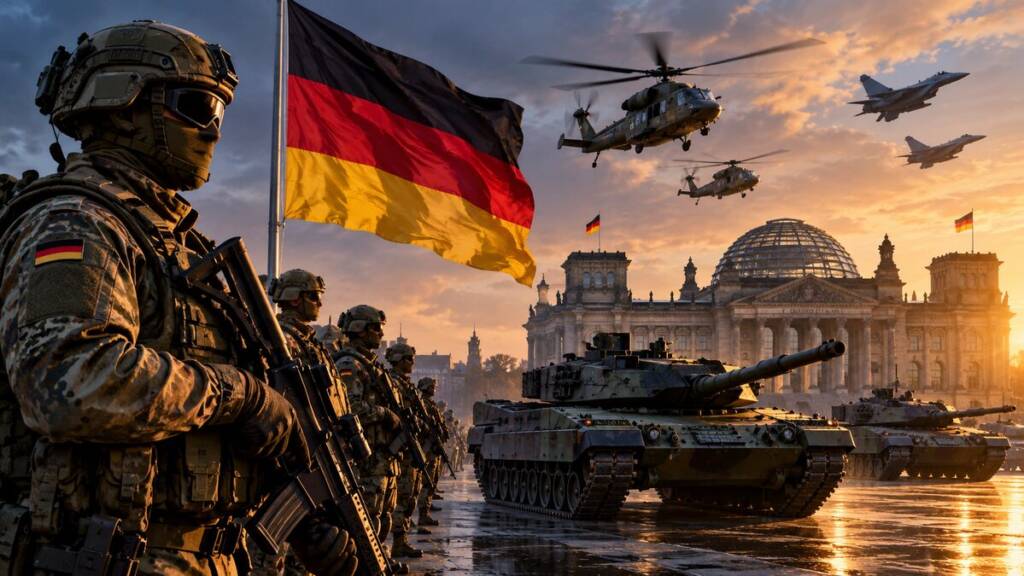
Germany shunned military power for decades after 1945. Today it is Europe’s largest defence spender. Chancellor Friedrich Merz’s cabinet adopted a 2027 budget draft on 6 July. It gives the Defence Ministry €109.7 billion, up from €82.7 billion in 2026. The fiscal plan lifts that figure to €183.7 billion by 2030.
Merz wants the Bundeswehr, Germany’s armed forces, to become “the strongest conventional army in Europe”.
Why Germany Held Back for Decades
Defeat in 1945 left Germans with a deep aversion to militarism. West Germany’s 1949 constitution contained no provision for armed forces. The Cold War ended that position. West Germany created the Bundeswehr and joined NATO in 1955, but kept its forces defensive. The United States underwrote its security.
Some scholars argue that Germany never practised strict pacifism. They describe a culture of restraint instead. That restraint deepened after the Cold War. Berlin suspended conscription in 2011. Defence spending averaged 1.2 per cent of national output between 2012 and 2022.
Why Germany is Rearming Now
Russia’s full-scale invasion of Ukraine in February 2022 broke the old consensus. Three days later, then Chancellor Olaf Scholz declared a “Zeitenwende”, or turning point. He set up a €100 billion special fund to modernise the Bundeswehr.
Carsten Breuer, the Bundeswehr’s top general, said in May that Russia could attack NATO territory by 2029. He said an attack could come earlier. Doubts about Washington add urgency. The Pentagon announced on 1 May that it would withdraw roughly 5,000 troops from Germany. That still leaves more than 30,000 American troops in the country. Defence Minister Boris Pistorius called the move “anticipated”. He said Germany stood ready to carry more of its own defence. Merz repeated the warning on 1 October. He said Russia’s war machine would sooner or later target NATO unless Europe halts Moscow.
How Berlin Pays for the Build-Up
The money comes from borrowing. In March 2025 the Bundestag changed the constitution to loosen the “debt brake”, Germany’s limit on new debt. Defence spending above one per cent of national output now escapes that limit. NATO raised the bar three months later. Allies agreed in The Hague to spend five per cent of output on defence and security by 2035. Core military spending must reach 3.5 per cent. Germany plans to hit that level by 2029, the Finance Ministry says.
The 2027 draft includes €118.7 billion of new borrowing, and most of it falls under the defence exemption. A further €30 billion comes from the special fund. Defence takes about a fifth of the €555.4 billion budget. Berlin also sets aside €11.6 billion for Ukraine. “Balancing the budget at all costs can’t be the top priority,” Finance Minister Lars Klingbeil said in July.
More Soldiers, A New Service Law and Busy Factories
Money alone cannot fill the ranks. Pistorius presented Germany’s first military strategy on 22 April. It names Russia as the main threat. It foresees 260,000 active soldiers and 200,000 reservists by the mid-2030s. The Bundeswehr has about 184,000 soldiers today.
A new military service law took effect on 1 January. Every man who turns 18 must complete a questionnaire on fitness and willingness to serve. Service itself remains voluntary. The Bundestag can activate compulsory service with a further vote. German troops also stand guard abroad. A brigade in Lithuania marks the first permanent stationing of German soldiers abroad since the Second World War.
Arms makers gain from the orders. Rheinmetall reported an order backlog of €80.5 billion at the end of June.
Critics Question the Cost and the Direction
The build-up meets resistance at home. Students went on strike when the Bundestag passed the service law in December 2025. One survey found that 57 per cent of young adults reject compulsory service. Left Party lawmaker Nicole Gohlke says the law links militarisation with authoritarianism.
Economists question the priorities. Johannes Binder of the Kiel Institute for the World Economy says the budget’s structure remains “stuck in the past”. He sees no clear focus on artificial intelligence, autonomous systems or space. He also warns that extra money may simply push up arms prices.
Debt is a second concern. The fiscal plan lifts federal net borrowing to €167.3 billion by 2030. Recruitment is the third. The Bundeswehr recruited 12,286 volunteers in 2025, and Pistorius wants 20,000 this year. He has warned of partial conscription if volunteers fall short.
Some analysts fault a go-it-alone approach. The German Council on Foreign Relations says Berlin acts “for Europe, but not with Europe”. The Bundestag must still pass the 2027 budget. The special fund runs dry after 2027, so the regular budget must then carry the full load.