
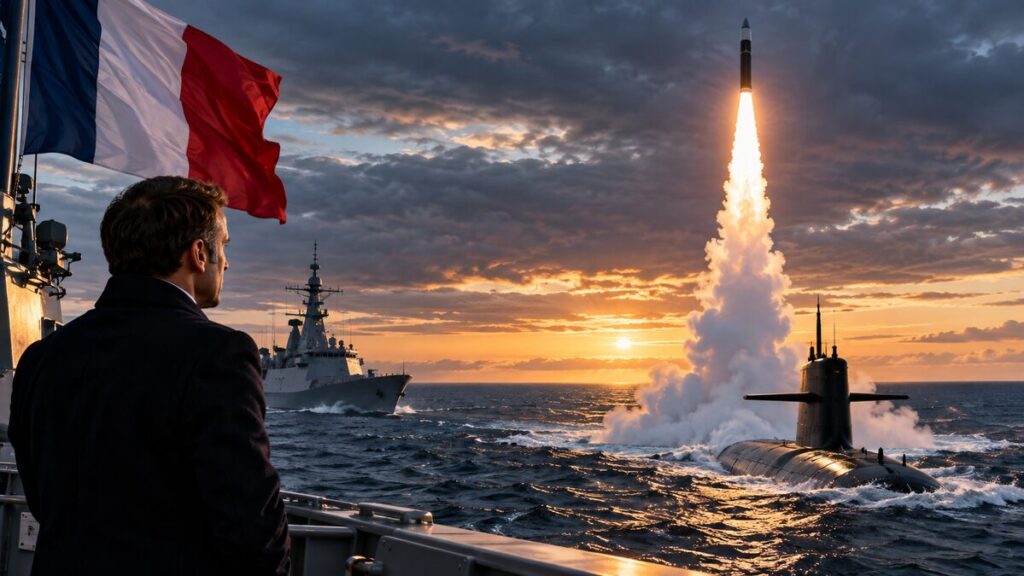
France fired its newest nuclear-capable missile into the North Atlantic on 6 October 2026. The timing matters more than the hardware.
The ballistic missile submarine Le Vigilant launched an M51.3 off Finistère in western France. The missile carried no warhead. It splashed down hundreds of kilometres from any coastline. President Emmanuel Macron watched from the frigate Auvergne. He posted the footage on X. “To be feared, one must be powerful,” he wrote.
What France Actually Tested
This was an acceptance firing rather than a development launch. Le Vigilant had just finished a major overhaul. France certifies every ballistic missile submarine this way afterwards. The M51.3 entered service in October 2025. Paris classifies its exact range. Public estimates for the M51 family start near 9,000 kilometres. French officials say the new version flies further.
France holds roughly 290 weapons, the world’s fourth-largest arsenal. Four submarines carry the sea-based leg. Rafale jets carry the airborne ASMPA-R. France is also building new submarines and a hypersonic nuclear cruise missile.
Why Paris is Signalling Now
Vladimir Putin spoke at Moscow’s Valdai Forum five days earlier. He ruled out any ceasefire on long-range strikes. Putin then warned that Russia would deploy every available weapon if anyone attacked Kaliningrad. He named France and Britain as nuclear powers directly. Moscow had already handed NATO a diplomatic note about the exclave. The Kremlin fears a Baltic blockade.
Macron rewrote French doctrine in March. At Île Longue he ordered an increase in warheads. France had not expanded its arsenal since at least 1992. He also stopped disclosing the numbers. He branded the new approach “advanced deterrence”. Macron offered European partners temporary basing for French nuclear aircraft. Berlin and Paris then created a joint nuclear steering group. France devotes roughly 13 per cent of its defence budget to deterrence.
Europe Buries its Pacifism
The continent has spent eighty years outsourcing hard power to Washington. That era is closing. The European Commission’s ReArm Europe plan aims to mobilise €800 billion. It includes a €150 billion loan instrument called SAFE. The money is moving. EU states spent €418 billion on defence in 2025, a 20 per cent jump. Spending should reach €454 billion in 2026, near 2.4 per cent of EU GDP.
Germany has gone furthest. Parliament approved a new military service law that reinstates mandatory medical checks for young men. Berlin wants 460,000 soldiers and reservists. Students protested in several cities. Conscientious objection applications also spiked sharply.
Does Europe Face War Within Three Years?
Senior officers now name a date. Lieutenant General Christian Freuding said that all 32 allies share one assessment. Russia could invade a NATO member by 2029. Defence Minister Boris Pistorius says war could begin in 2029. Some analysts tell him 2028. General Alexander Sollfrank warns Russia could strike NATO territory at any time.
Washington has shifted too. US intelligence now expects a possible hybrid attack or limited incursion between this autumn and 2029. Analysts rank the Baltic states and Poland as likeliest targets.
The grey-zone war has already started. Russian drones entered Polish airspace in September 2025. Donald Tusk called it Poland’s closest brush with armed conflict since 1945. German police later found explosive-laden drones at Leipzig airport. Romania and Moldova reported fresh drone crashes this month.
The Case Against
Three arguments cut the other way. Russia remains pinned down in Ukraine. Putin insists he has no plans to attack any European country. He also concedes NATO outweighs Russia roughly two to one. Europe’s rearmament lags its rhetoric. The European Defence Agency says current plans will not close gaps in air defence, ammunition and drones by 2030. Money strains the weakest budgets. Analysts note France carries 119 per cent debt and a 5.4 per cent deficit. Paris must cut €54 billion elsewhere.
The Bottom Line
Few planners expect Russian tanks crossing into Poland by 2029. Most expect probing below the Article 5 threshold. Drones, sabotage, cable cuts and deniable incidents fit that pattern. France aimed Tuesday’s launch squarely at that grey zone. A warhead-free missile over the Atlantic costs nothing diplomatically. It still tells Moscow that Europe’s only EU nuclear power works, and will keep working.