
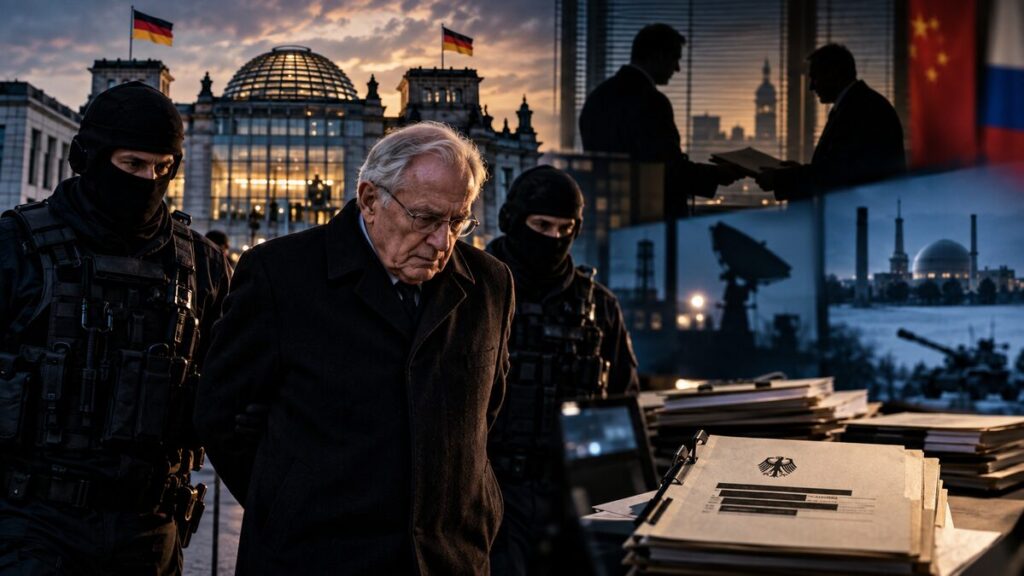
German federal prosecutors arrested August Hanning on Tuesday, 6 October 2026. The 80-year-old led the Federal Intelligence Service, or BND, from December 1998 to November 2005. Prosecutors say he is “strongly suspected of treasonous espionage, spying out state secrets, attempted treason, and espionage”. Officers detained a second man the same day. German privacy rules identify him only as Manfred D., a former aide who faces charges of aiding and abetting attempted treason and treasonous espionage.
What Prosecutors Allege he did
The case describes a paid pipeline that ran for more than a decade. Investigators say the two men struck their deal in spring 2010, four years after Hanning left the agency. Manfred D. would hand over BND intelligence. Hanning would pay him for it.
Prosecutors state that Manfred D. supplied roughly 2,000 documents over the years. Many carried classified markings and existed solely for internal BND use, particularly executive intelligence briefings. The alleged buyer’s position made this devastating. Manfred D. worked as Hanning’s chief of staff, then served several subsequent BND presidents in the same role from March 2012 until March 2026. He sat at the exact point where the agency’s best material reached its leadership.
The leaked files covered Iran’s nuclear programme and the Russian military, plus sensitive intelligence that allied services had classified.
Which country bought it?
Here the picture blurs. Prosecutors allege Hanning once used classified material “to draft an analysis” for an officer of a foreign intelligence service. They also say he maintained years of close contact with a representative of a second foreign service. Authorities have not disclosed which countries were involved.
Reporters have filled some gaps. German media say the service was not Russian. Bild separately reported that investigators are examining whether Hanning passed intelligence to China or Russia, where he held direct contacts. Money appears central. Prosecutors believe Hanning sold the files through his private consulting business. Bild also reported that he faced considerable financial difficulties after problems at a Baltic bank where he sat on the board.
A Kidnapping Exposed the Leak
Investigators stumbled on the files by accident. Hamburg prosecutors searched Hanning’s premises in September 2025 as part of the Christina Block case. Block, a steakhouse heiress, stands trial over the abduction of her children from Denmark. Officers found the BND material during that search. Prosecutors allege Hanning contacted Yaakov Peri, a former Shin Bet director who now heads Israel’s CGI Group, to assemble a team for the operation. The Hamburg court later closed the hearings. Hanning has denied involvement in the abduction.
Berlin Reacts
BND president Martin Jäger said his agency “quickly carried out extensive internal investigations” before prosecutors took over. Marc Henrichmann, who chairs parliament’s intelligence oversight committee, said Germany would “not tolerate the betrayal of secrets”. Greens MP Konstantin von Notz called the allegations “grave and deeply disturbing” and criticised the lobbying activities of retired senior officials, AFP reported. Welt reports that British and American services are now checking whether the leak compromised shared assets.
Germany’s Long History of Leaks
German intelligence has bled secrets since its founding.
East Berlin scored the most famous hit. Markus Wolf’s service planted Günter Guillaume among Chancellor Willy Brandt’s closest aides. Brandt resigned when the scandal broke in 1974.
Counter-intelligence itself proved vulnerable. In August 1985, West Germany’s counter-intelligence chief Hans-Joachim Tiedge defected to East Germany. His tips had already helped the East arrest nearly 170 Western agents. Chancellor Helmut Kohl called the defection “catastrophic”. The BND repeated the pattern after reunification. A Munich court jailed BND employee Markus R. for eight years in 2016. He had passed more than 200 documents to the CIA between 2008 and 2014 for at least €80,000.
Moscow returned in 2022. Prosecutors arrested BND officer Carsten L. in Berlin over state secrets he allegedly shared with Russian intelligence. They told the Berlin court he received €450,000 from the FSB; his lawyer denied the charges. One German intelligence expert told the Telegraph that internal security has always been the BND’s central weakness.
What Happens Next
Judges at the Federal Court of Justice in Karlsruhe have ordered both men held. Treason in a particularly serious case carries a possible life sentence in Germany. Hanning’s lawyers have not yet commented.
The damage assessment will take far longer than the trial.