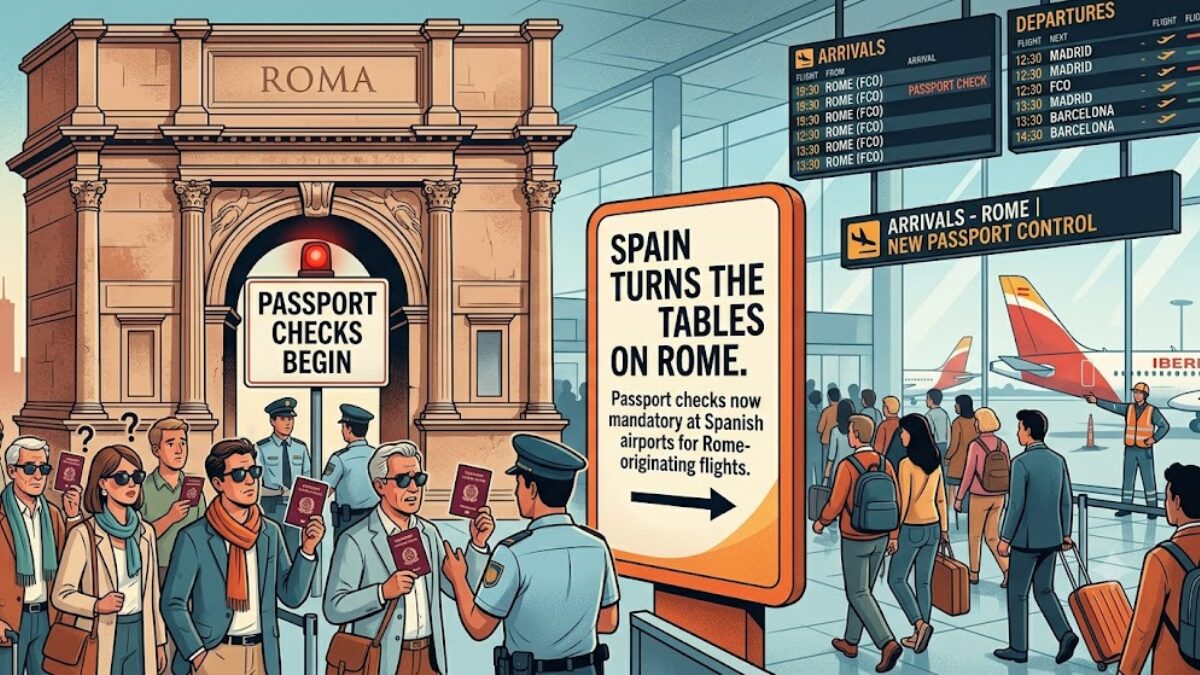
New Delhi: Spanish police began checking passports on flights and ferries arriving from Italy at midnight on Saturday, opening a new front in a row between two EU governments over who is to blame for last month’s migration surge at Ceuta.
The controls were ordered by the Spanish prime minister, Pedro Sánchez’s, government on Friday and will run until September 7. Spain’s interior ministry said officers would carry out passport, nationality and visa checks on Italian passengers and on travellers from other countries arriving from Italy, citing the “persistent irregular migration pressure” facing Italy — almost word for word the justification Rome used against Madrid a week earlier.
That is the point. Madrid is not pretending this is anything other than retaliation.
How it escalated
Italy suspended Schengen free movement for arrivals from Spain on August 1, after tens of thousands of people crossed from Morocco into Ceuta, Spain’s enclave on the North African coast, on July 30 and 31. The Italian prime minister, Giorgia Meloni, called it an “extraordinary measure” to safeguard national security, Euronews reported.
On Friday, Madrid gave Rome until Sunday to drop the checks, calling them “unjust, contrary to the interests of the European Union and discriminatory towards the Spanish population”. Rome replied within hours that Italy “does not accept ultimatums or impositions from abroad regarding national security and border control”, and said its own controls would stay until at least August 15, the date on which, it claims, Spain is expecting another mass crossing at Ceuta.
Spain went ahead anyway.
What travellers actually face
The checks are random rather than universal. El País reported that about 100 National Police officers had been deployed across ports and airports, with two to four officers per flight screening 5-10 per cent of passengers — roughly 15 people on a medium-sized aircraft and about 25 on a larger one.
Operations started at Madrid-Barajas and Barcelona-El Prat before extending to Seville, Malaga, Bilbao, Alicante and Valencia, and then to the Balearic and Canary Islands. Routes from Fiumicino, Ciampino, Malpensa, Naples, Venice and Florence are the most affected. Spain’s state news agency EFE said Italians landing in Barcelona were stopped for spot checks overnight.
No flights or sailings have been cancelled. But it is August, and both governments know exactly whose holidays are being inconvenienced.
Ceuta, and the numbers nobody agrees on
Estimates of the crossing vary sharply by source. Reuters put it at about 72,000, the BBC at roughly 78,000 and Al Jazeera at more than 60,000. Almost all returned to Morocco within 48 hours. Al Jazeera reported at least 72 deaths, and Ceuta’s president, Juan Jesús Vivas, told the broadcaster Telecinco that between 3,000 and 5,000 people remained in the enclave.
The trigger was a Spanish supreme court ruling that people intercepted at sea while trying to reach Ceuta or Melilla cannot be returned to Morocco. Under Ceuta’s special status, nobody there can travel on to mainland Europe without passing a further layer of checks.
Brussels watches, and does little
Magnus Brunner, the European commissioner for home affairs, has said there have been no movements towards mainland Europe. The Commission rejected calls, led by Italy, to suspend Spain from Schengen — a step it has no power to take — and has insisted internal checks must be a last resort, proportionate and time-limited. It also said Rome had not formally notified it of the suspension.
Spain’s foreign minister, José Manuel Albares, called Italy’s move “a torpedo fired at the hull of European unity”. Meloni has backing from Denmark and Finland, and 22 member states signed a joint letter aligning with her position. Eight countries already run internal border controls of their own.