The Gen Z protests in Germany filled the streets of more than 30 cities on 31 October. By nightfall, rioters were smashing windows and looting shops in central Frankfurt. The young marchers wanted better schools, cheaper living and no return of conscription. Their grievances deserve a hearing. Their proposed remedies deserve much harder scrutiny.
What happened on Halloween
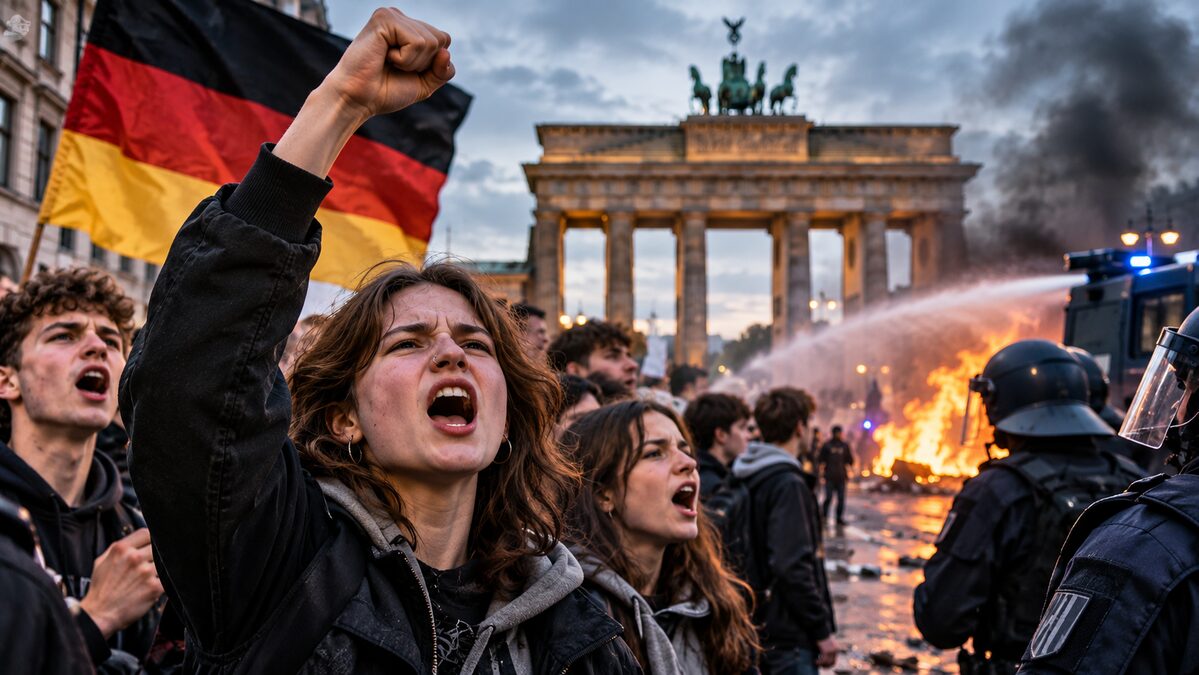
The campaign calls itself Gen Z regelt, roughly ‘Gen Z takes charge’. Organisers claimed about 120,000 participants nationwide. Berlin police counted around 5,000 people at the Brandenburg Gate, while organisers claimed 11,000. The platform demands more money for schools, mental-health care and climate protection. It also opposes compulsory military service and wider state surveillance.
Daytime rallies stayed largely peaceful. The evenings told a different story. In Frankfurt, attackers pelted police with stones and injured several officers, one severely. Police also reported Molotov cocktail attacks and an assault on a gun shop. Officers in Cologne and Hamburg turned water cannon on crowds hurling stones and fireworks.
Who speaks for the movement?
Hesse’s interior minister, Roman Poseck, blamed around 100 left-wing extremists for infiltrating the Frankfurt march. Berlin’s interior department had warned beforehand that left-wing and foreign-linked extremists probably aimed to radicalise the rallies.
The movement’s own house looks shaky. Its former spokesperson, Gianni Matheja, quit over doubts that the protests would stay peaceful. Other defectors criticised unclear responsibilities and opaque funding. Germany’s national school-student body, the BSK, has distanced itself and plans its own protest day.
None of this discredits the teenagers with genuine complaints. One Berlin pupil told reporters her school ceiling ‘is collapsing because of water damage’. That is a disgrace in Europe’s largest economy.
A continental wave
Germany is simply the latest stop on a continental circuit. French high-school pupils started their revolt in September, angry about neglected buildings and teacher shortages. Trade unions and the yellow vests then joined in. The 17 October marches drew 550,000 people and spiralled into some of France’s worst rioting in years. Flames nearly destroyed the 19th-century town hall in Limoges, and police made 2,400 arrests that weekend. President Emmanuel Macron blamed far-left agitators and vowed that looters would pay.
Other capitals face their own versions. In Milan, police arrested 271 people, mostly minors, after masked rioters looted stores. In Madrid, protesters have camped in the Puerta del Sol for weeks over housing costs. Spain’s minimum wage stands at €1,221, against an average monthly rent of €1,130 for an 80-square-metre flat. Housing marches have also reached Lisbon, while Albanian students have joined anti-corruption protests.
Grievances differ from country to country. Debt unites them. The EU countries with the most unrest, from Greece to Portugal, all carry heavy national debt. That debt leaves governments little room to spend. In late October, French bond yields touched their highest level since 2002.
The bill behind the anger
Germany faces its own reckoning. The country struggles to revive growth as baby boomers retire and the workforce shrinks. Pensions and public services feel the squeeze. Consumer prices still rose 2.8% year on year in October, with energy up 12.2%.
Here the protesters have half a point. Europe’s welfare states have long promised more than their shrinking workforces can fund. Today’s teenagers inherit that bill, along with crumbling classrooms. That is a genuine generational injustice.
But the marchers aim at the wrong target. Tanks did not rot Berlin’s school ceilings. The likelier culprit is decades of budgets that favoured current consumption over upkeep and investment.
The conscription panic also outruns the facts. Since January, 18-year-olds receive a questionnaire, and eligible men face a medical check. Service itself remains voluntary. Any compulsory call-up would require a separate vote in parliament. With the war in Ukraine, a fitness survey hardly amounts to militarism. A Germany that cannot ask its 18-year-olds a few questions will keep leaning on American taxpayers.
Then there is the violence. Organisers say they cannot control events once their rallies end. That admission should worry them more than anyone. A loosely run movement with opaque funding leaves the door open to extremists. German police must treat looting as crime, not as political speech.
What would actually help
Chancellor Friedrich Merz should resist buying calm with borrowed money. A better plan has five parts. First, fix the schools, and put maintenance ahead of new subsidy schemes. Second, reform pensions before today’s pupils fund promises the system cannot keep for them. Third, build homes, because rent caps cannot conjure flats that nobody has built. Fourth, keep the Bundeswehr reforms, because security underpins every other promise. Finally, enforce the law without apology.
Europe’s young people have noticed that the post-war bargain no longer adds up. They are right about the arithmetic. They are wrong about the answer. More debt and less defence would only deepen the hole they inherited. Their leaders should respond with growth, reform and order before the next protest day on 20 November.