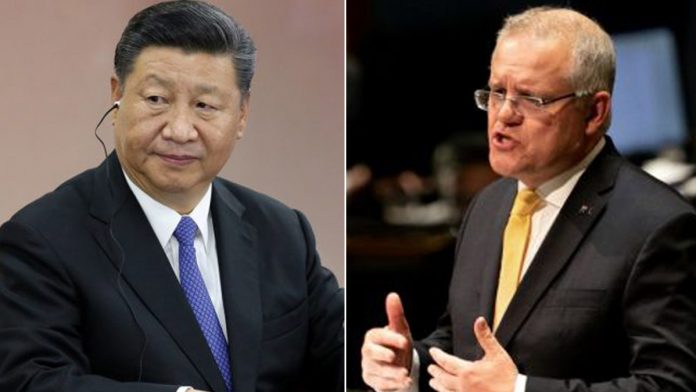
China has launched a massive, unprecedented trade war against Australia. Since April last year, China has imposed tariffs and other trade barriers or even unofficial restrictions on a range of Australian goods like coal, barley, wine and wheat. But what China has achieved is rather minuscule. There was only a $6 billion drop in Australian exports to China, that is, a mere 4 per cent fall as against the 2019 numbers.
In fact, 2020 was a good year for Australian exporters. Canberra recorded the second-highest ever level of Australia exports to China. At the same time, the Australian government has managed to find some new, lucrative markets.
As per the data released by Beijing’s customs agency, Australia exported goods worth $148 billion ($US114.8 billion) to China last year. This is a small decline against the record level of exports worth $154 billion ($US119.6 billion) set in 2019. And even the small decline can be explained by the drastic decline in Chinese consumption following the Wuhan virus outbreak and the general economic slowdown triggered by a global backlash against Beijing.
Yet, Australian exports to China are almost ten per cent higher than the 2018 levels. China’s trade tariffs campaign against Canberra has been undermined by the high iron ore prices. Iron ore, the basic raw material in steel manufacturing, is in high demand across China. Steel demand is going up in the Communist nation because of Xi Jinping administration’s ambition to revive the Chinese economy by pumping billions of dollars into construction activity.
So, here is the real deal- Xi’s infrastructure development blitz needs lots of steel, and steel manufacturing itself needs more and more iron ore. And it so happens that Australia accounts for 60 per cent of iron ore supplies to the Chinese steel mills. Australian miners like BHP, Rio Tinto and Fortescue are some of the biggest suppliers of iron ore to China. Elevated iron ore prices are thus poking holes in Xi’s trade wars against Canberra.
Also, sales of Australia’s liquified natural gas to China have remained immune from trade wars. Presently, China, Japan and South Korea are experiencing extraordinarily cold winters, which have further pushed prices of the gas. Australian supplies meet 40 per cent of the Chinese needs when it comes to liquified natural gas. Higher prices of such strategic goods are making up for the losses that Australia could be suffering in other sectors like farm products.
The Sino-Australian trade war has proved that China cannot harm Australia as easily as it would want to. There are certain sectors like iron ore supplies in which China simply cannot find a substitute for replacing Australia.
In the coal sector too, China did impose an unofficial ban on Australian coal but that has led to shortages of the crucial good within the Communist nation. Power outages have become common in China, as the power sector struggles under a serious lack of Australian coal. Chinese coal users are paying almost 40 per cent extra costs for Xi’s trade wars against Canberra, as Beijing continues to reject pleas for importing cheaper and higher-quality Australian coal.
Nevertheless, Sino-Australian trade could still dip in 2021 more remarkably, especially if iron prices stabilise. China is anyway showing the intent to hurt Australia wherever it can. Some examples being the wine export industry or Australian wine as well as the lobster trade.
Anyhow, Australia is gearing up for such challenges and finding alternates. As China started buying Indonesian coal after blocking Australian coal supplies, Australia itself replaced Indonesia as India’s biggest source of coal supplies in December last year.
Throughout 2020, China failed to put Australian export industry at a disadvantage. Now, Australia has found ways to immunise itself from Chinese trade wars. In hindsight, the Australian economy remains unscathed despite Xi Jinping’s tariffs and the Chinese people paid for his actions.