TFIGlobal
TFIGlobal
TFIPOST English
TFIPOST हिन्दी
No Result
View All Result
  • Indo-Pacific
  • Americas
  • Canada
  • Indian Subcontinent
  • West Asia
  • Europe
  • Africa
  • The Caribbean
TFIGlobal
  • Indo-Pacific
  • Americas
  • Canada
  • Indian Subcontinent
  • West Asia
  • Europe
  • Africa
  • The Caribbean
No Result
View All Result
TFIGlobal
TFIGlobal
No Result
View All Result
  • Indo-Pacific
  • Americas
  • Canada
  • Indian Subcontinent
  • West Asia
  • Europe
  • Africa
  • The Caribbean

Australia-ASEAN Urges Restraint in South China Sea

Tripti Garg by Tripti Garg
March 7, 2024
in Geopolitics
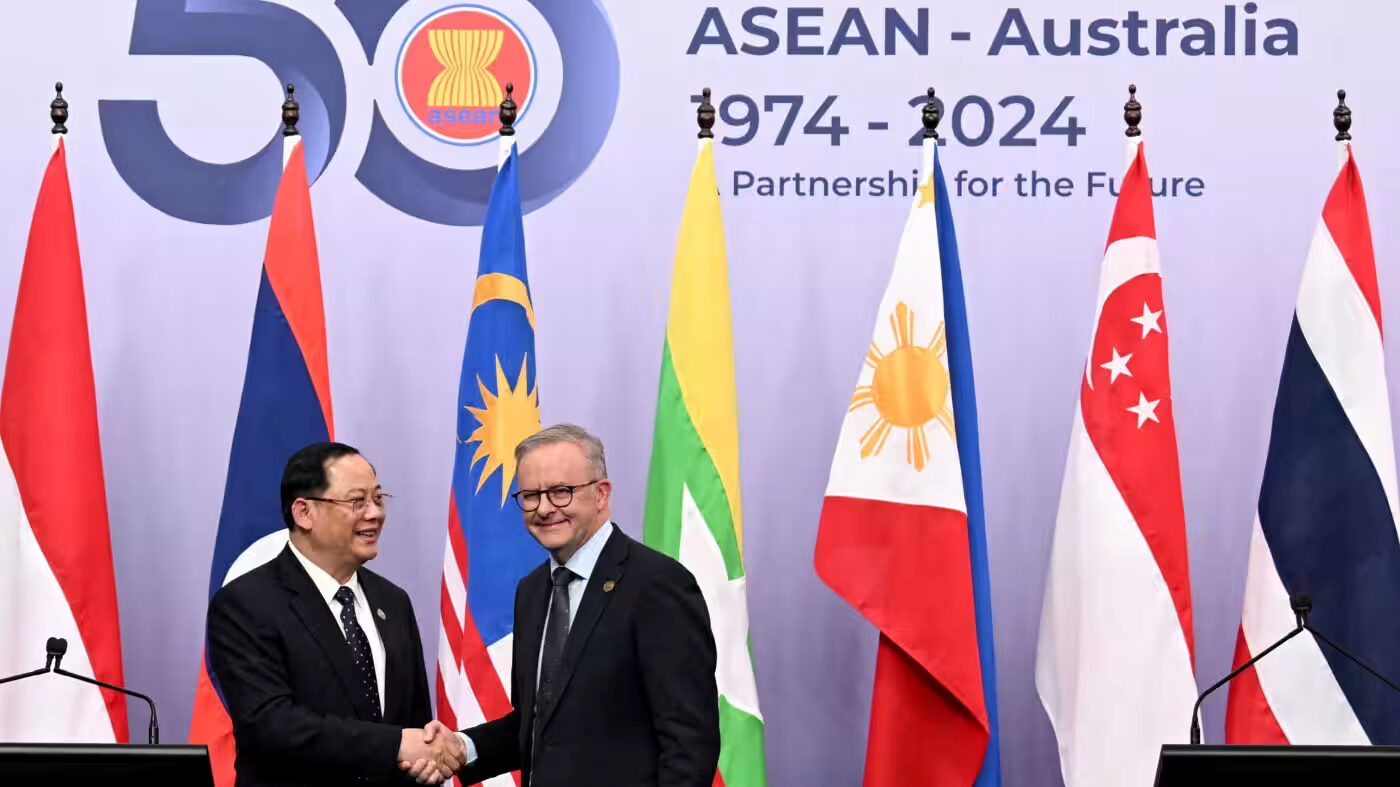
Australian Prime Minister Anthony Albanese shakes hands with Laotian Prime Minister Sonexay Siphandone during a joint media statement at the ASEAN-Australia Special Summit in Melbourne on March 6. © Reuters

Australian Prime Minister Anthony Albanese shakes hands with Laotian Prime Minister Sonexay Siphandone during a joint media statement at the ASEAN-Australia Special Summit in Melbourne on March 6. © Reuters

Share on FacebookShare on X

Australia recently concluded a three-day summit with the Association of Southeast Asian Nations (ASEAN) in Melbourne, commemorating the 50th anniversary of their alliance. Despite shared objectives, varying opinions emerged regarding China’s intentions to expand its diplomatic and military influence in the region.

The summit concluded with a joint statement from Australia and ASEAN, emphasizing the importance of a “rules-based” order in the Indo-Pacific region. Notably, the statement urged restraint in the contested South China Sea and advocated for a lasting ceasefire in the Gaza Strip.

Also Read

One Man, 14 Break-Ins: Anthropic’s Report on How AI Became a Weapon for Hire

The 1,000-Mile Kill Shot: America’s New Missile Plan Puts China in Its Sights

Orca XLUUV Completes 1,852km Uncrewed Patrol Across the Pacific

Join us on Telegram: https://t.me/tfiglobal

The gathering highlighted the ongoing complexities in the region, particularly concerning China’s expanding presence. The call for a rules-based order reflects a shared commitment to stability and cooperation.

“We recognise the benefits of having the South China Sea as a sea of peace, stability, and prosperity,” the statement said.

“We encourage all countries to avoid any unilateral actions that endanger peace, security and stability in the region.”

According to a spokesperson from the Chinese foreign ministry, the current situation in the South China Sea is deemed stable.

Read More: Australia Launches $1.3 Billion Investment Fund with ASEAN Allies

“We will properly manage differences with the countries concerned and fully and effectively implement them with ASEAN countries,” they said in response to questions about the ASEAN statement during a regular press briefing on Wednesday.

China responded to the Philippines’ summons of Beijing’s deputy chief of mission in Manila, expressing concern over what it deemed “aggressive actions” by Chinese naval forces during a resupply mission for Filipino troops in the South China Sea. Beijing asserts near-complete sovereignty over the South China Sea, a critical maritime route for over $3 trillion in annual ship-borne commerce, causing tensions, particularly with the Philippines. Despite the 2016 ruling by the Permanent Court of Arbitration rejecting China’s legal basis for claims in the area, Beijing continues to reject this decision.

Malaysian Prime Minister Anwar Ibrahim, in a press conference with Albanese, noted a perceived “China-phobia” in the West and downplayed the risk of conflict in the South China Sea. The joint statement from the summit also expressed concern about the “dire” humanitarian situation in Gaza and called for the release of hostages amid the Israel-Hamas conflict. 

“We condemn attacks against all civilians and civilian infrastructure, leading to further deterioration of the humanitarian crisis in Gaza including restricted access to food, water, and other basic needs,” the statement said.

Read More: Australia’s FM Wong: No Country Should Rule Our Neighborhood

“We urge for an immediate and durable humanitarian ceasefire.”

ASEAN comprises Muslim-majority nations such as Malaysia, Indonesia, and Brunei. In contrast, Australia has historically been a staunch supporter of Israel. However, it is noteworthy that Australia, despite its pro-Israel stance, has advocated for a ceasefire and voiced criticism regarding the extent of casualties in the ongoing conflict.

Tags: ASEANAustraliaAustralia-ASEANChinaGazaSouthChinaSea
ShareTweetSend
Tripti Garg

Tripti Garg

Orator. Writer. Determined.Life-long Learner.

Also Read

A US dollar bill breaking apart beside BRICS flags, a glowing globe, cargo ship and stacks of currencies, symbolising de-dollarisation and the shift toward a multipolar financial system.

BRICS De-Dollarisation: Is the World Leaving the Dollar?

September 13, 2026
BRICS emblem above an empty international summit table, with a global trade port, UN-style building, currency, justice scales and critical minerals symbolising geopolitics and multilateral cooperation

BRICS Declaration Backs South Africa’s G20 Seat and Criticises Tariffs, Without Naming any Country

September 13, 2026
“Cinematic depiction of China–Iran–US tensions, showing Xi Jinping and Donald Trump flanking a reconnaissance satellite surveying a military air base, with Iranian ballistic missiles launching in the background.”

Chinese Eyes, Iranian Missiles: Us Traces A Satellite Trail To The Attack iJordan

September 13, 2026
Indian Prime Minister Narendra Modi and Chinese President Xi Jinping shake hands during a formal diplomatic meeting, with the Indian and Chinese flags displayed behind them.

Modi and Xi Met for Under an Hour. Their Governments Told Two Different Stories

September 13, 2026
Kim Jong Un watches missiles launches as U.S., Japanese and South Korean warships patrol the sea, with Trump and Iran's leadership depicted amid a backdrop of military escalation and conflict.

North Korea Fires Missiles Into the Sea as Washington’s War on Iran Grinds On

September 13, 2026
Narendra Modi sits between Vladimir Putin and Xi Jinping at a BRICS summit table, with Iranian President Masoud Pezeshkian beside them and national flags in the background.

One Table, Two Wars: Modi Seats Putin and Xi as Delhi Opens BRICS

September 11, 2026
Youtube Twitter Facebook
TFIGlobalTFIGlobal
Right Arm. Round the World. FAST.
  • About Us
  • Contact Us
  • TFIPOST – English
  • TFIPOST हिन्दी
  • Careers
  • Brand Partnerships
  • Terms of use
  • Privacy Policy

©2026 - TFI MEDIA PRIVATE LIMITED

Welcome Back!

Login to your account below

Forgotten Password?

Retrieve your password

Please enter your username or email address to reset your password.

Log In

Add New Playlist

No Result
View All Result
  • Indo-Pacific
  • Americas
  • Canada
  • Indian Subcontinent
  • West Asia
  • Europe
  • Africa
  • The Caribbean
TFIPOST English
TFIPOST हिन्दी

©2026 - TFI MEDIA PRIVATE LIMITED

This website uses cookies. By continuing to use this website you are giving consent to cookies being used. View our Privacy and Cookie Policy.