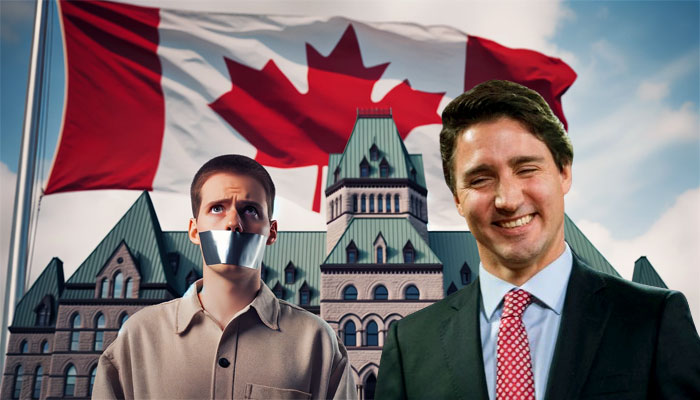
Punishments are severe and wide-ranging. Citizens can face fines up to $50,000 for reported hateful behavior, and life imprisonment for hate-motivated offenses, including non-criminal acts like littering with hateful intent. The bill also allows for preemptive penalties based on potential future crimes, leading to imprisonment or house arrest without actual offenses. Past statements can be penalized retroactively, and internet platforms must remove harmful content swiftly or face significant fines.
Statutory Warning for Canadians: Wish to live, prepare to surrender your rights.
On February 21st, Canadian Prime Minister Justin Trudeau held a press conference in Edmonton to unveil the Online Harms Act, or Bill C-63. Canadian media portrayed this legislation as a measure to protect children from exploitation. Trudeau’s speech was notably focused on minors, and he vehemently dismissed concerns that the bill had broader implications.
“I look forward to introducing the Online Harms bill, which people will see is very specifically focused on protecting kids, not on censoring the Internet,” he stated firmly. “I believe everyone, regardless of their political stance, can agree that protecting children is a governmental priority.”
Shortly after, on February 26th, the government introduced the bill. Canadian media, including CTV’s Omar Sachedina, enthusiastically reported on its introduction, highlighting its aim to tackle online dangers and safeguard children. Initial reactions were largely supportive, as the bill appeared to be a straightforward effort to enhance child safety and protect the vulnerable.
However, scrutiny increased once the public began to examine the bill’s details. Canadian attorney Dan Freiheit noted, “If you look at the purpose of this law, it’s actually quite noble and most lawyers would agree with it—online safety and protecting children’s physical and mental health.” Yet, the bill’s text raised significant concerns. “It’s wild,” Freiheit remarked, suggesting that the legislation’s content was more controversial than its stated intentions.
Trudeau’s claim that C-63 was “very specifically focused on protecting kids” was misleading. The Online Harms Act extends well beyond child protection, transforming society with new procedures that include:
– Enlisting citizens in a social monitoring system, rewarding informants up to $20,000 for reporting hateful behavior, with offenders facing fines up to $50,000.
– Introducing severe criminal penalties, including life imprisonment for crimes like “advocating genocide” and any offense motivated by hatred.
– Punishing potential future crimes based on informant reports, allowing for imprisonment, house arrest, firearm seizures, and mandatory testing.
– Penalizing past statements by labeling them as “continuous communication” of hate.
– Forcing internet platforms to remove harmful content within 24 hours, with fines up to 6% of global revenue for non-compliance.
Under Trudeau’s new Bill C-63, statements you make, have made, or might make in the future could be restricted, with neighbors empowered as enforcers. This legislation represents a significant step back for individual rights. Trudeau’s Online Harms Act, also known as C-63, merges the harshest elements of censorship laws from Europe’s Digital Services Act, Australia’s ACMA, and Scotland’s Hate Crime and Public Order Act.
This bill intensifies social surveillance by compelling major platforms like Facebook and Twitter to “self-police” and imposing civil and criminal penalties for speech on an unprecedented scale. The definition of hate speech in the bill is broad, described as anything likely to “foment detestation or vilification” of protected groups, but its practical application remains unclear. Bruce Pardy, Executive Director of Rights Probe, noted the ambiguity, stating, “It’s impossible to know what exactly it’s going to mean.”
Most lawyers agree that if passed, C-63 will drastically alter the landscape of individual rights. It targets more than just speech, undermining fundamental concepts like the presumption of innocence and the right to confront one’s accuser, using questionable methods such as retroactive laws. Although Canada has historically been lenient on rights issues, Trudeau’s approach threatens to replace its reputation for kindness with one of rigidity and paranoia.