In a subtle yet significant diplomatic shift, India has appointed an ambassador to North Korea after reopening its Embassy in 2024. Aliawati Longkumer will take up the post, reflecting New Delhi’s intent to re-establish formal ties with Pyongyang amid a broader realignment of global alliances.
While China and Russia already enjoy deep and sustained strategic relations with North Korea, this move by India adds a new dimension to BRICS solidarity. Meanwhile, on the opposite front, the White House has expressed willingness to resume dialogue with Kim Jong Un, even attempting to send a personal letter via former President Donald Trump. However, as reports indicate, Kim Jong Un has rejected this outreach, reinforcing North Korea’s pivot away from the West and toward its Eastern allies.
North Korea: From Outcast to Asset in a New Geopolitical Game
For decades, North Korea was treated by NATO-aligned states as a pariah—its nuclear ambitions checked with sanctions and isolation. But that approach has not only failed to contain Pyongyang, but it has also pushed the regime further into the orbit of BRICS heavyweights—especially China and Russia.
The result? North Korea is now less an isolated nuclear state and more a strategic wedge, leveraged by Beijing and Moscow as a tool to challenge NATO’s influence in East Asia.
Russia’s Embrace: From Symbolic Support to Military Integration
With the war in Ukraine grinding into its third year, Russia is drawing support from every corner of its geopolitical network. Pyongyang has emerged as one of its boldest backers, reportedly sending arms and even troops to assist Moscow in its counteroffensive efforts, particularly in the Kursk region.
In return, Russia provides North Korea with energy, technical support, and most critically, diplomatic shielding at the UN Security Council. This reenergized Moscow-Pyongyang axis is not just about bilateral gain—it signals Russia’s use of non-Western alliances as a bulwark against NATO containment.
Russia is also asserting its role within BRICS as a geopolitical disruptor, using North Korea to test the limits of NATO’s red lines in Asia, much like it has in Ukraine and Syria.
China’s Tightrope Walk: Patron, Buffer, and Regional Architect
Beijing plays a more layered game. China remains North Korea’s largest economic partner and political guarantor, providing essential food, fuel, and trade access, though much of this flows through unofficial or deniable channels. But China’s calculus is not based on affection; it is rooted in control and strategic geography.
North Korea serves China in three essential ways:
Strategic Buffer: It insulates China’s border from U.S. troops in South Korea.
Diplomatic Bargaining Chip: Beijing can escalate or de-escalate tensions on the Korean Peninsula to gain leverage in unrelated negotiations, such as trade or Taiwan.
Demonstration of Multipolar Loyalty: Supporting Pyongyang without fully endorsing its nuclear program allows China to showcase BRICS cohesion while maintaining plausible deniability.
While Beijing publicly supports denuclearization, it also ensures that sanctions enforcement remains selective, weakening the efficacy of NATO-aligned pressure.
India’s Quiet Return: Re-engagement, Not Re-alignment
India’s appointment of an ambassador to North Korea is more than a ceremonial gesture. It reflects a strategic recalibration—a recognition that in the emerging BRICS vs. NATO world, maintaining diplomatic flexibility is crucial. Despite drastically cutting ties with North Korea in 2017 to comply with UN sanctions, India is re-entering the game, likely to avoid leaving the Korean Peninsula entirely in China and Russia’s domain.
This move reinforces India’s independent foreign policy posture: align with the West tactically, but never ideologically. By nurturing low-key engagement with North Korea, New Delhi maintains influence in a region where BRICS and NATO interests are colliding.
NATO’s Position: Stuck in Static Containment
In contrast, NATO remains anchored in a containment strategy forged during the Cold War. Despite Trump’s diplomacy with Kim Jong Un—described by him as a “love affair”—there has been no real policy innovation. His recent, rebuffed attempt to deliver a letter to Kim reflects Washington’s confusion: stuck between coercion and charm, with little strategic clarity.
South Korea’s new president, Lee Jae-myung, is making modest attempts at reconciliation, like silencing anti-North propaganda broadcasts. Yet without broader NATO flexibility, Seoul’s efforts may stall, particularly if the U.S. and its allies cannot offer North Korea something beyond isolation or regime change.
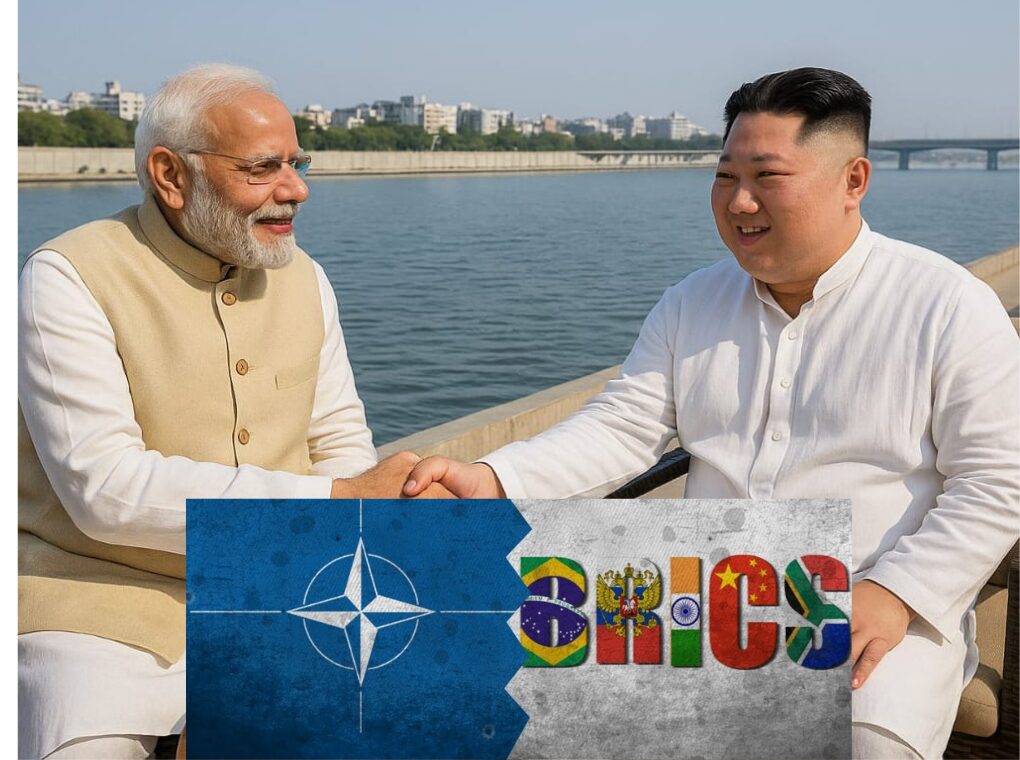
BRICS vs NATO: A New Order Emerges
NATO presents itself as a champion of a rules-based international order, non-proliferation, and liberal democracy. However, it often faces criticism for unilateral actions, hegemonic tendencies, and contributing to instability, particularly in West Asia. Many also view NATO as a central player in escalating the Russia-Ukraine conflict. Moreover, it continues to struggle with addressing asymmetric threats like North Korea effectively.
BRICS, led by the strategic assertiveness of China and Russia, prioritizes sovereignty, multipolarity, and transactional diplomacy—using states like North Korea as part of a broader toolkit to challenge Western dominance
In the ongoing Iran versus Israel escalation of conflict, the U.S.-led NATO bloc has backed Israel’s right to defend itself, reinforcing its traditional alliance. In contrast, both Russia and China have openly criticized Israel’s military actions against Iran, reflecting their broader opposition to Western unilateralism in the region. India, maintaining strong diplomatic and economic ties with both Iran and Israel, has adopted a neutral stance, urging restraint and emphasizing the need for dialogue, debate, and a peaceful resolution to the crisis.
What’s unfolding is not a new Cold War, but something more complex: a fluid global competition where regional players like North Korea, while minor in GDP or global appeal, play outsized roles in shaping alliances.
Competing Visions for Global Order
As BRICS expands its influence and institutions, NATO is challenged to rethink its traditional strategies. The North Korea issue highlights deeper divisions in how global powers define legitimacy and international norms. China and Russia are not just reacting to the West—they’re shaping an alternative vision. In this context, North Korea is emerging as a strategic player in the broader contest over the future of global governance.