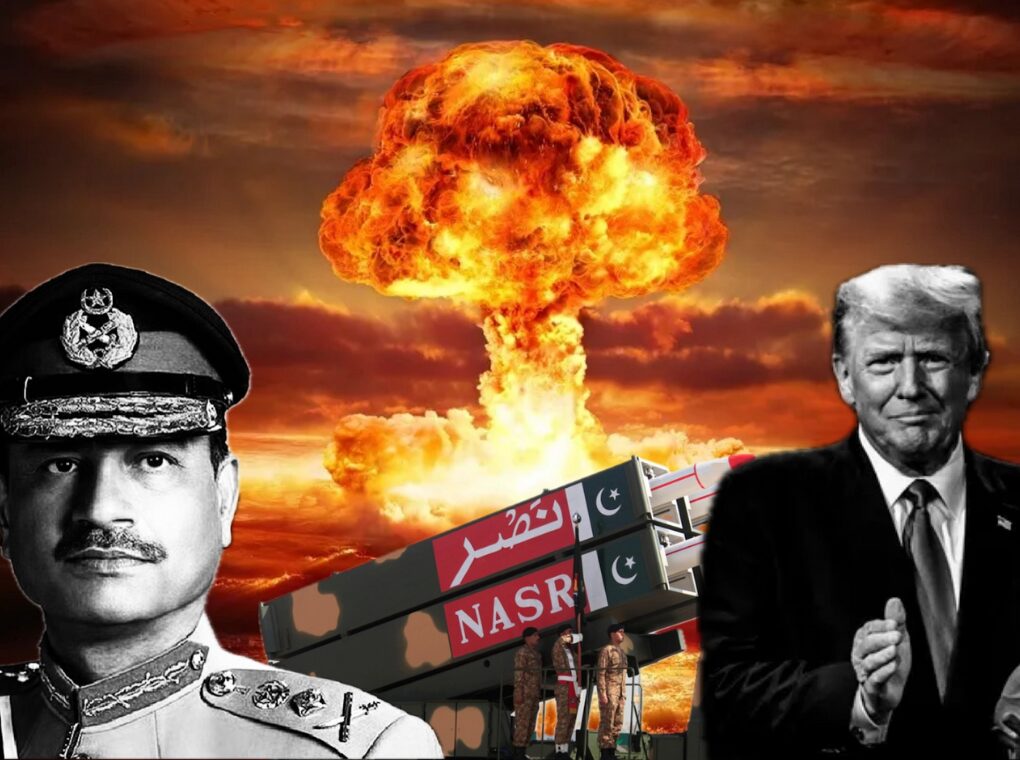
When Pakistan’s Army Chief, General Asim Munir, stood before an audience at a private dinner in Florida this August and declared that Pakistan would “take half the world down” if pushed to the brink, it wasn’t just another flare-up in South Asia’s turbulent politics. The remark, carrying clear nuclear overtones, reverberated far beyond Islamabad and New Delhi. It was an unusual and deliberately conspicuous message delivered in the heart of the United States.
Why it Matters?
The India–Pakistan rivalry has generated fiery rhetoric for decades, but Munir’s choice of venue instantly changed the equation. Speaking on American soil lent the words both symbolic weight and diplomatic complexity. It wasn’t simply a threat to India; it was a public signal to Washington and the wider world that Pakistan still sees nuclear deterrence as the ultimate insurance policy—one it’s willing to brandish in an open forum.
Domestically, the statement serves a different purpose. Back home, Pakistan is wrestling with political fragmentation and an economic crisis. By taking a hard nuclear line, Munir reinforces the military’s status as the ultimate guardian of the national interest, reassuring hawkish factions at a time when public confidence in civilian leadership is shaky.
Why the United States Allowed the Platform
The natural question is: how was Pakistan’s top general able to make such a declaration on US territory without triggering a public reprimand from Washington?
The answer lies in the intricate balance of US regional policy. For the United States, Pakistan remains a double-edged partner—problematic on some fronts but still valuable on others. Counterterrorism collaboration, influence over Afghanistan, and potential economic cooperation in resource development keep Pakistan on Washington’s radar. In recent months, American officials have been cautiously re-engaging with Islamabad, partly because of souring trade tensions with India and partly to counterbalance China’s footprint in the region.
In diplomatic practice, that often means tolerating uncomfortable moments to preserve working relationships. Openly berating Munir might have damaged the revived channels of cooperation. Instead, the absence of a strong rebuke suggests a deliberate effort to avoid hardening Pakistani positions further.
This episode offers a telling illustration of how the Pakistan–US relationship operates in practice. Just weeks after a rare warm reception at the White House, Pakistan’s Army Chief Asim Munir stood in a Florida hall and threatened India with nuclear strikes. The blunt warning, timed amid renewed US–Pakistan engagement, raises a stark question — is Washington naive, or is Islamabad simply outplaying it?
How Pakistan Can Speak This Boldly?
Pakistan’s confidence in making such statements, especially abroad, rests on a few pillars.
First, the country’s nuclear arsenal—though smaller than some—remains a credible deterrent in South Asia. Second, Islamabad has historically leveraged its strategic geography and relationships with major powers to shield itself from the full force of international backlash. Finally, there’s precedent: Pakistan’s military has never shied away from sharp rhetoric when tensions with India flare, knowing it plays well to certain domestic audiences and reinforces the perception of strength.
The Trump administration’s silence has fuelled speculation that Washington may be recalibrating its South Asia tilt towards Pakistan, driven by shifting geopolitical priorities and the strategic demands of its stand-off with Iran.
It is notable that Pakistan is increasing its nuclear arsenal, believed to be with China’s assistance. According to the Stockholm International Peace Research Institute (SIPRI), a leading defence and armaments think-tank, Pakistan is a strong nuclear power, having an estimated 170 warheads, as per its latest assessment. In comparison, India has 180 nuclear stored warheads as of January 2025.
Global Ramifications
For India, Munir’s remarks are more than just diplomatic theater. With tensions already heightened over military operations in Kashmir, hearing such a blunt nuclear warning—issued in a friendly third country—adds a new layer of mistrust. New Delhi quickly condemned the comments as “reckless nuclear blackmail.”
For a nation that Donald Trump, only seven years ago, accused of offering the US “nothing but lies and deceit” and sheltering terrorists — and that Joe Biden later branded “one of the most dangerous countries” — the change in tone and stance is nothing short of dramatic.
From a broader perspective, this episode underscores how fragile nuclear stability in South Asia remains. Unlike Cold War deterrence, where lines of communication were rigid yet constant, India and Pakistan’s exchanges are often fraught, sporadic, and colored by domestic politics. In such an environment, verbal brinkmanship can escalate dangerously fast.
For global powers, the takeaway is sobering: even in an era dominated by conflicts elsewhere, South Asia’s nuclear fault lines are alive and volatile. The fact that such threats can be made—unchecked—on the territory of the world’s most powerful nation should be a wake-up call for anyone invested in regional stability.