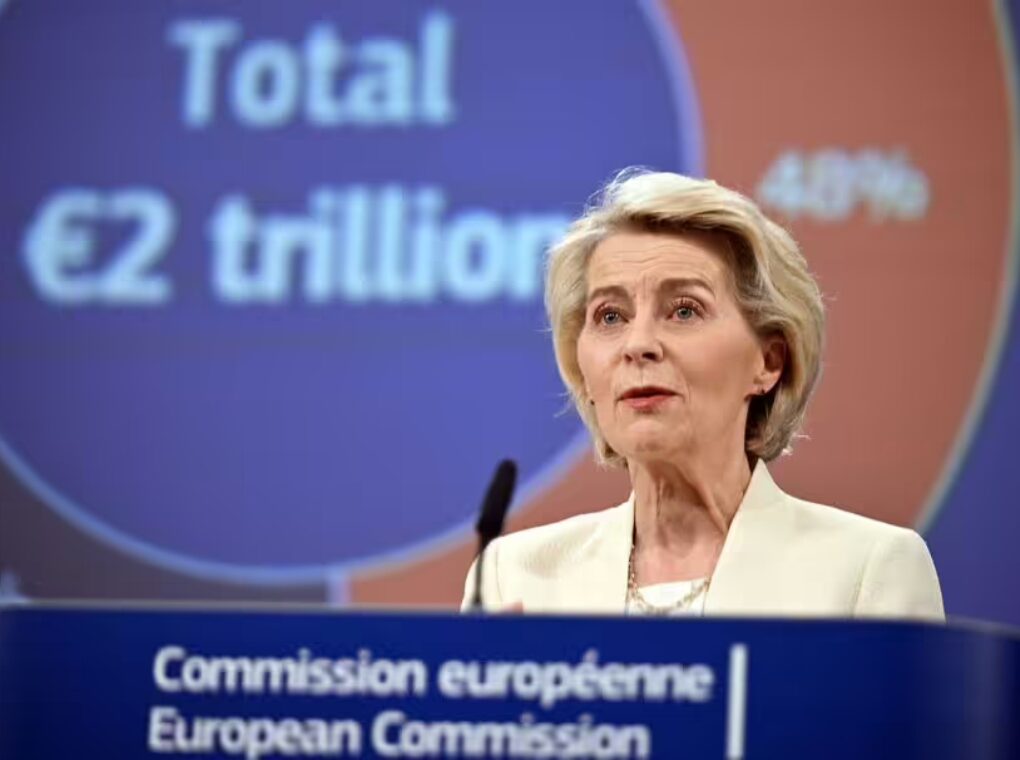
European Commission President Ursula von der Leyen issued a sharp warning against Russian President Vladimir Putin during her visit to the Polish Belarusian border on Sunday, describing him as a “predator” who can only be restrained through firm deterrence. Her remarks came amid growing tensions on Europe’s eastern frontier and renewed debates on how the EU should strengthen its collective defence posture.
“Putin Has Not Changed”
Speaking alongside Polish Prime Minister Donald Tusk, von der Leyen said the EU must not underestimate Moscow’s intentions. “Putin has not changed and will not change. He is a predator,” she declared. “He can only be kept in check through strong deterrence.”
The European Commission president also assured Warsaw that the EU stands united with Poland, describing the country as a frontline state in Europe’s confrontation with Russia and its allies. Her comments reflect mounting concerns within Brussels about the long-term challenge posed by Moscow and its willingness to exploit instability in neighboring regions.
The trip was the first stop in von der Leyen’s four-day tour of European countries that share borders with Russia or Belarus. She will also visit Estonia, Lithuania, Latvia, Finland, Bulgaria, and Romania, signaling that eastern security is at the top of the EU’s strategic agenda.
Poland’s Expanding Military Role
Poland has emerged as one of Europe’s most vocal advocates of a tougher stance against Moscow. Already the EU’s biggest spender on defence relative to GDP, Warsaw is set to expand its military budget further. Prime Minister Tusk announced that the government would allocate PLN 200 billion (€47 billion) next year to strengthen the Polish army and invest in the domestic defence industry.
“Poland takes its responsibilities seriously,” Tusk said. “We expect all institutions and countries in Europe to take the security of the eastern border equally seriously and to adopt a firm stance against the aggressor, against Russia.”
Von der Leyen praised Poland’s efforts and confirmed that Brussels is proposing a substantial boost in European defence spending. According to her, the EU plans to increase defence investment fivefold and raise funding for military mobility tenfold, ensuring troops and equipment can be moved swiftly across Europe in times of crisis.
Border Pressures and “Hybrid Warfare”
Poland’s frontline status has been further complicated by tensions with Belarus. Since 2021, Warsaw has accused Minsk of deliberately pushing thousands of migrants toward the border as part of what it describes as “hybrid warfare.” The Polish government maintains that this tactic is designed to destabilize both Poland and the wider EU by creating humanitarian and security pressures.
Von der Leyen’s visit to the border was therefore both symbolic and strategic, underlining the EU’s recognition of Poland’s pivotal role in safeguarding Europe from unconventional threats.
A Symbolic Anniversary
The meeting between von der Leyen and Tusk also coincided with the 45th anniversary of the August Agreements, the 1980 deal between striking workers and Poland’s communist authorities that paved the way for the Solidarity Trade Union. That union later played a crucial role in dismantling communism in Eastern Europe.
Tusk drew a parallel between the past struggle for independence and today’s fight to defend Europe’s eastern borders. “Solidarity was a great dream of independence,” he said. “It was a movement to unite Europe and separate it from the evil empire of the time. This border is as important today as our dream of liberation was then.”
Europe’s Next Moves
Von der Leyen’s eastern tour comes at a critical moment for EU security policy. Russia’s war in Ukraine continues to grind on, while Belarus remains firmly aligned with Moscow. The EU has pledged support for Kyiv but also recognizes that the conflict has reshaped Europe’s long-term defence needs.
By highlighting solidarity with Poland and promising more EU resources, von der Leyen sought to send a dual message — to reassure frontline states of Brussels’ commitment and to warn Moscow that Europe is prepared to match its rhetoric with action.
Her tour will continue in the coming days, with stops in the Baltic states and Eastern Europe aimed at strengthening unity against Russia. For Brussels, the challenge remains clear: keeping Putin “in check” through deterrence while ensuring that solidarity among member states translates into concrete, sustained defence capabilities.