
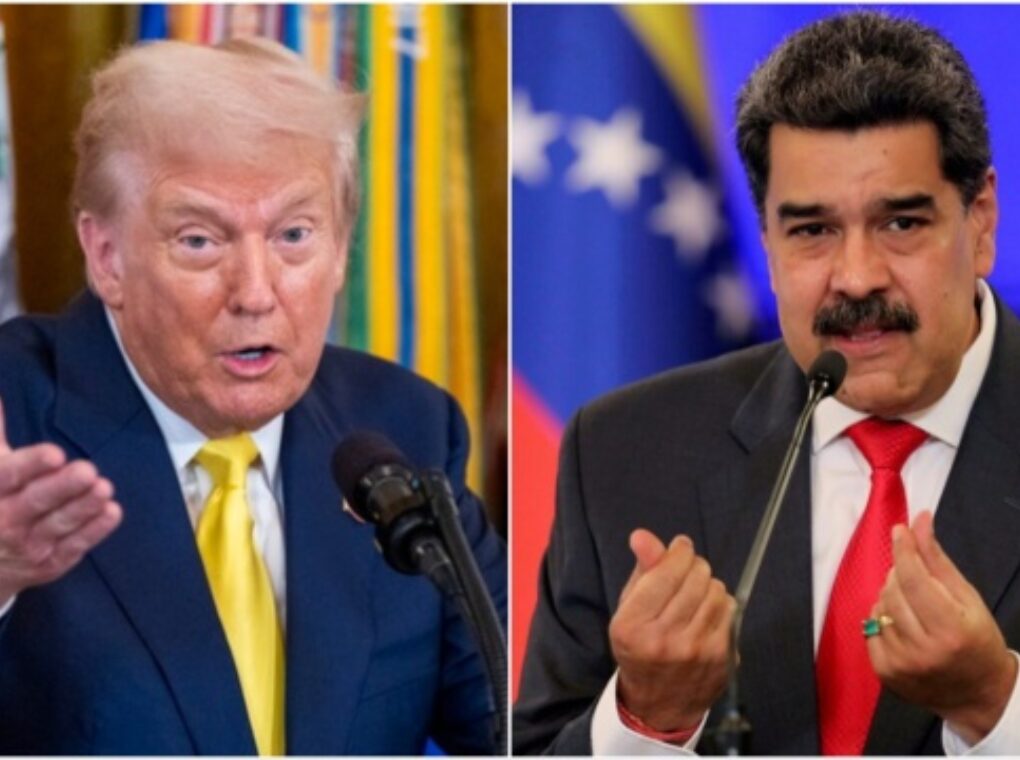
President Donald Trump is weighing a series of military options targeting drug cartels operating inside Venezuela, a move that could significantly escalate tensions with Nicolás Maduro’s government. Multiple sources familiar with internal deliberations told CNN that Tuesday’s strike on a Venezuelan drug boat marked only the beginning of what the administration views as a much larger campaign.
The Trump administration has tied Maduro directly to its counternarcotics strategy, branding him a “narco-terrorist” and doubling the reward for his capture to $50 million. Officials suggest that by hitting cartel networks, the U.S. could undermine the revenue streams sustaining Maduro’s grip on power.
Military Build-Up in the Caribbean
Over the past several weeks, the U.S. has deployed a substantial show of force in the Caribbean. Warships armed with Tomahawk missiles, an attack submarine, 4,000 sailors and Marines, and 10 F-35 fighter jets stationed in Puerto Rico are now within striking distance of Venezuelan targets. Officials describe the deployments as both deterrence and preparation for potential missions.
Secretary of State Marco Rubio, who has become the administration’s most vocal advocate for hardline action, made clear that strikes are not limited to maritime interdictions. “This is a counter-drug operation. We are going to take on drug cartels wherever they are,” Rubio said, adding that the destruction of a suspected smuggling vessel earlier this week “will happen again.”
Legal and Political Uncertainty
The strike has raised alarms in Washington. Lawmakers have questioned the administration’s legal authority and justification for military operations inside Venezuela. A scheduled congressional briefing on the strike was abruptly canceled on Friday, leaving staffers and members of Congress with few answers.
In a letter to congressional leaders, the White House insisted that Trump acted within his constitutional authority as commander in chief, but acknowledged the mission’s open-ended scope: “It is not possible at this time to know the full scope and duration of military operations that will be necessary.”
The ambiguity has fueled speculation that the administration is keeping its options deliberately vague — signaling to Maduro and his inner circle that further escalation is possible, even while avoiding a direct commitment to regime change.
Rubio Takes the Lead
Rubio, long one of Maduro’s harshest critics, has positioned himself as the public face of the administration’s anti-cartel drive. He has consistently argued that targeting Venezuela’s role in narcotics trafficking is essential to dismantling transnational organized crime.
“Maduro is an indicted drug trafficker in the United States, and he’s a fugitive of American justice,” Rubio said this week. He has also advocated for designating cartels as terrorist organizations, a move that expands the Pentagon’s role in counter-narcotics missions.
Contradictions in Policy
Yet even as Trump ramps up military pressure, his administration has quietly allowed limited cooperation with Caracas. The U.S. recently reissued a license for Chevron to resume oil operations in Venezuela and continues coordinating with Venezuelan officials on deportation flights.
Experts see mixed signals. “Are we going to invade Venezuela and depose the regime when it’s offering most of what the administration is asking?” asked Benjamin Gedan, former National Security Council director for Venezuela. “There have been a lot of hints that the U.S. was actually headed toward normalizing relations with this regime.”
Venezuela’s Role in the Drug Trade
Critics also challenge the premise of the mission. Venezuela is not a cocaine-producing country, and U.N. data suggests its role in trafficking is relatively minor compared to Colombia and other regional hubs. Instead, profits from illicit gold, smuggling networks, and military payoffs appear to play a greater role in sustaining Maduro’s government.
Still, U.S. officials, particularly Rubio, dismiss such assessments. “I don’t care what the UN says. The UN doesn’t know what they’re talking about,” Rubio retorted.
What Comes Next?
The Trump administration insists that “all options are on the table” — from additional strikes on drug cartels to broader action against Maduro himself. While officials publicly deny that regime change is the objective, insiders suggest that pressure on cartel-linked elites around Maduro may be designed to force him out.
“The preferred course of action is for Maduro to leave on his own,” said one source. “And then the message is, ‘Do you want it to be easy, or do you want it to be hard?’”
For now, Venezuela remains on edge, U.S. warships remain in position, and Washington waits to see if Trump’s new strategy against cartels doubles as a path toward finally dislodging Nicolás Maduro.