
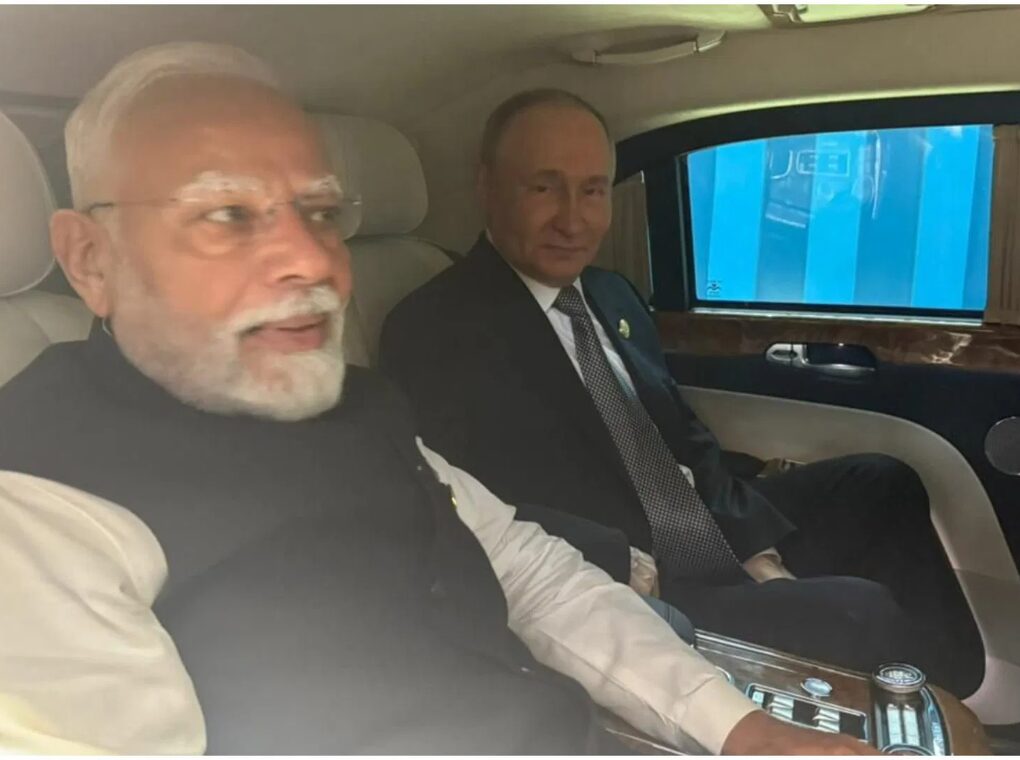
Russian President Vladimir Putin’s two-day visit to India — his first since 2021 — comes amid intense geopolitical flux. With the Ukraine war deadlocked, US-Russia relations strained, and global energy politics undergoing seismic shifts, Washington is following every detail of Putin’s trip with acute interest.
His meetings with Prime Minister Narendra Modi, President Droupadi Murmu, and senior Indian officials are not just ceremonial; they carry deep strategic implications for global power alignments, trade dynamics, and the future of the Russia-India partnership.
A Trip Under the Shadow of Ukraine
The Ukraine conflict continues to cast a long shadow over global diplomacy, and Putin’s arrival in New Delhi follows a failed round of US–Russia talks aimed at forging a peace roadmap. Despite US President Donald Trump’s high-profile 28-point peace proposal — rejected by Ukraine and European allies — negotiations remain stalled. Trump’s envoys, Steve Witkoff and Jared Kushner, met Putin in Moscow just a day earlier, but the talks produced no breakthrough.
Russian foreign policy adviser Yuri Ushakov described the discussions as substantive but inconclusive, noting that several American proposals were unacceptable. This diplomatic impasse makes India’s role as a potential mediator even more significant. Since 2022, New Delhi has consistently maintained that dialogue and diplomacy are the only paths to resolving the conflict, abstaining from UN resolutions targeting Russia while keeping channels open with both Moscow and the West.
Putin’s presence in India, therefore, takes on added relevance as Washington tries to gauge whether New Delhi will leverage its longstanding friendship with Moscow to influence the trajectory of the conflict — or at least keep communication lines open amid hardened global divisions.
The Battle Over Russian Oil
One of Washington’s biggest concerns revolves around India’s massive purchases of discounted Russian crude. Before 2022, Russian oil accounted for less than 1% of India’s energy imports. Today, it makes up nearly 40%. Moscow’s deep discounts helped India save billions on its import bill, offering a cushion against global price volatility.
However, the return of Trump to the White House has changed the tone dramatically. His administration has accused India of indirectly funding Russia’s war effort and has imposed a combined 50% tariff on Indian goods — 25% general tariffs and an additional 25% penalty for continued Russian oil purchases.
This pressure campaign signals that Washington wants New Delhi to scale down both volumes and visibility of its Russian energy ties. With energy security a non-negotiable priority and India importing 85% of its crude needs, Modi’s government is walking a tightrope: balancing economic imperatives with geopolitical sensitivities.
US–India Trade Tensions Add Another Layer
Even as Washington criticizes India’s oil policy, both countries are negotiating a major bilateral trade agreement projected to expand trade to $500 billion by 2030. But talks have been rocky. Trump has repeatedly attacked India’s trade practices, and tensions over agriculture and dairy remain unresolved as India maintains strict protections for farmers.
White House adviser Kevin Hassett recently claimed the deal is close to completion, but Trump’s erratic rhetoric — including labeling India and Russia “dead economies” — has raised doubts in Delhi about Washington’s reliability.
Putin’s visit, coming in the middle of these trade tensions, offers New Delhi a chance to reaffirm its diplomatic autonomy and signal that its partnerships cannot be dictated by external pressure.
Why This Visit Matters to Washington?
Strategic experts agree that the US is closely assessing how India balances its relationship with Russia at a time when Washington’s ties with both Moscow and Beijing are under strain.
Analysts note:
The US under Trump is more transactional, forcing India to hedge and deepen ties with middle powers.
Russia remains India’s largest defence supplier despite a decline from 70% to 36% of total imports in the past decade.
Deals under discussion — including Su-57 fighter jets, labour mobility agreements, and civilian nuclear cooperation — hint at a revitalized partnership.
For Washington, the optics are as important as the outcomes. A visibly strong Russia–India relationship could complicate America’s Indo-Pacific strategy, undermine efforts to isolate Moscow, and strengthen India’s bargaining position in US trade negotiations.
A Diplomacy Balancing Act
New Delhi continues to insist on strategic autonomy — maintaining robust ties with both Moscow and Washington while avoiding entanglement in great-power rivalries. Yet as the Ukraine war drags on, US–Russia hostility intensifies, and global supply chains remain fragile, India’s ability to balance will be tested.
Putin’s visit is more than a bilateral engagement; it is a geopolitical signal. India is demonstrating that it will engage all major powers on its own terms — and that its historical partnership with Russia remains an important pillar of its foreign policy.
For the United States, watching closely is not just prudent — it is necessary. The outcome of this visit may influence energy markets, defence cooperation, and even the diplomatic landscape surrounding the Ukraine conflict.