
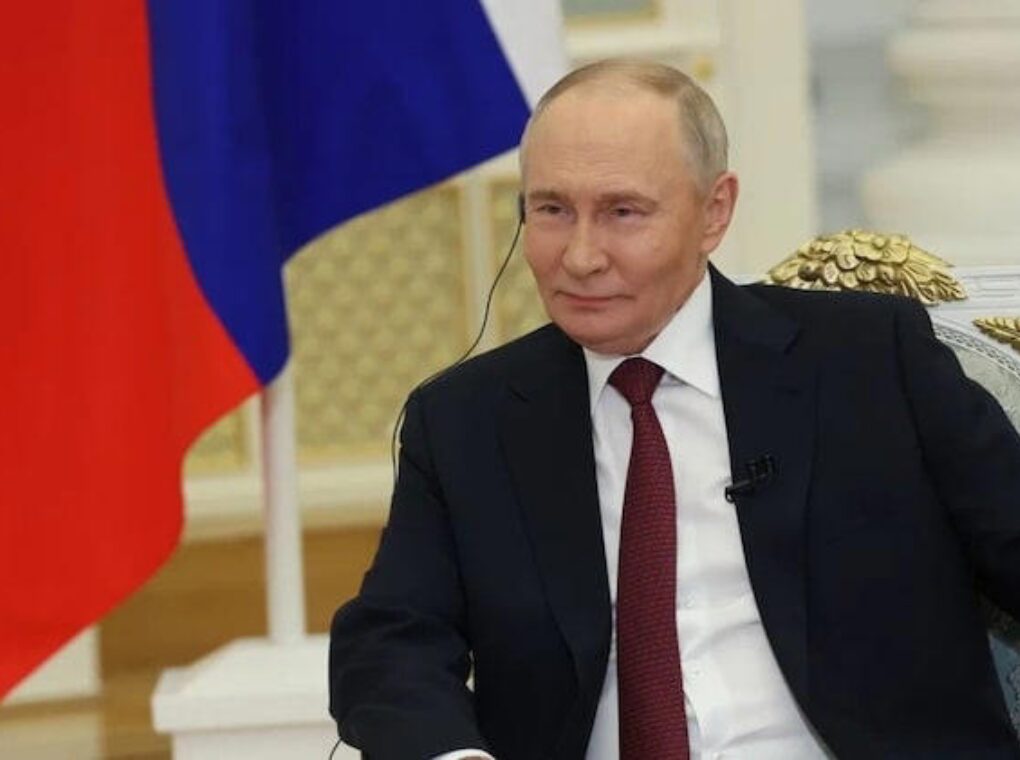
In a wide-ranging interview with India Today on December 4, Russian President Vladimir Putin delivered one of his most direct explanations yet of Moscow’s security doctrine, reiterating that Ukraine’s NATO ambitions represent a non-negotiable threat to Russia’s national interests. The remarks, made at the Kremlin, come amid renewed geopolitical friction and ongoing attempts to revive diplomatic channels surrounding the war.
Putin argued that while every sovereign nation—including Ukraine—has the right to determine its security strategies, these decisions cannot come at the cost of another country’s safety. “Each country, including Ukraine, has the right to choose its own means of defence and ensure its own safety. Do we deny Ukraine this? No. But it is not acceptable if done at Russia’s expense,” he said.
Criticism of Zelenskyy and Ukraine’s Political Direction
The Russian president did not hold back in criticising Ukrainian President Volodymyr Zelenskyy, accusing him of abandoning earlier promises of pursuing peace. Putin claimed that Zelenskyy has instead aligned himself with what he described as “radical nationalist” factions within Ukraine.
“When this gentleman came to power, he declared he would pursue peace at all costs. But now we see something very different. He follows the same pattern as his predecessors, putting the interests of a narrow nationalist group, particularly radical nationalists, ahead of those of the people,” Putin stated.
The president went further, suggesting that Ukraine’s political stance increasingly mirrors neo-Nazi ideology—an allegation Kyiv and its Western partners have repeatedly rejected. “Extreme nationalism and neo-Nazism are almost indistinguishable concepts,” he said, adding that Russia attempted negotiations in 2022 but saw no willingness for compromise.
NATO Expansion: Russia’s Core Objection
Putin repeatedly framed NATO’s eastward expansion as the central point of contention. He argued that Western leaders in the 1990s had pledged not to move the alliance closer to Russia’s borders—commitments he claims were ignored as NATO grew to include 14 former Warsaw Pact nations.
“We are not asking for anything unusual. These guarantees were pledged to Russia back in the ‘90s: no expansion eastward. Since then, several waves of expansion took place, culminating with Ukraine being drawn into NATO. This displeases us and poses a serious threat,” he said.
The Russian leader called for NATO to return to its pre-1997 posture, stopping deployment of weapons systems near Russian territory. For Moscow, Ukraine’s membership remains unacceptable because it would place NATO infrastructure directly along Russia’s borders.
Ukraine’s Neutrality and Historical Context
Putin also invoked Ukraine’s Declaration of State Sovereignty—the foundational document of its independence—arguing that Ukraine originally recognised itself as a neutral state. “Few people recall this, but the first document ratifying Ukraine’s independence clearly states that Ukraine is a neutral state,” he said.
Russia has long accused Kyiv of abandoning this neutrality by pursuing integration with NATO and the European Union, particularly after the 2014 Maidan protests.
Ukraine’s interest in NATO membership intensified after Russia annexed Crimea in 2014 and supported separatist forces in Donetsk and Luhansk. With a much smaller defence budget and weaker military compared to Russia, Kyiv argues that NATO membership offers the most credible security guarantee.
Putin on Trump and Efforts Toward Peace
During the interview, Putin also shared insights from his recent meeting with U.S. President Donald Trump in Alaska, describing Trump as sincere in his desire for peace.
“I have absolutely no doubt that President Trump had genuine intentions. He constantly speaks about minimising losses, and I am confident his sincerity is real,” Putin said.
While acknowledging the complexity of U.S.–Russia relations, he suggested there are strong political and economic incentives on both sides to end the conflict. “There are numerous areas where restoring economic relations between Russia and the United States would benefit both sides,” he noted.
Kyiv’s Peace Proposals and Russia’s Response
Putin dismissed Ukraine’s updated 28-point peace proposal as merely a repackaging of the previous framework. “They simply broke down those 28 points into four packages. But essentially, it is still just the same old 27 points,” he said.
For Russia, any long-term settlement must include security guarantees that NATO will not expand further eastward and that Ukraine will remain outside the alliance.
A Firm Message: Russia’s Security is Non-Negotiable
Putin’s remarks reaffirm Russia’s uncompromising view that NATO expansion is the defining security issue of the conflict—separate from cultural, linguistic, or territorial disputes. “NATO is a completely different matter. The Russian language, culture, religion, and territorial issues are all important topics, but NATO is something else entirely,” he emphasised.
The Russian president made it clear that while Moscow remains open to dialogue, it will not accept any framework that places NATO troops or missile systems on its borders. As the diplomatic standoff continues, Putin’s interview serves as a stark reminder that the core geopolitical divide between Russia and the West remains unresolved—and deeply entrenched