
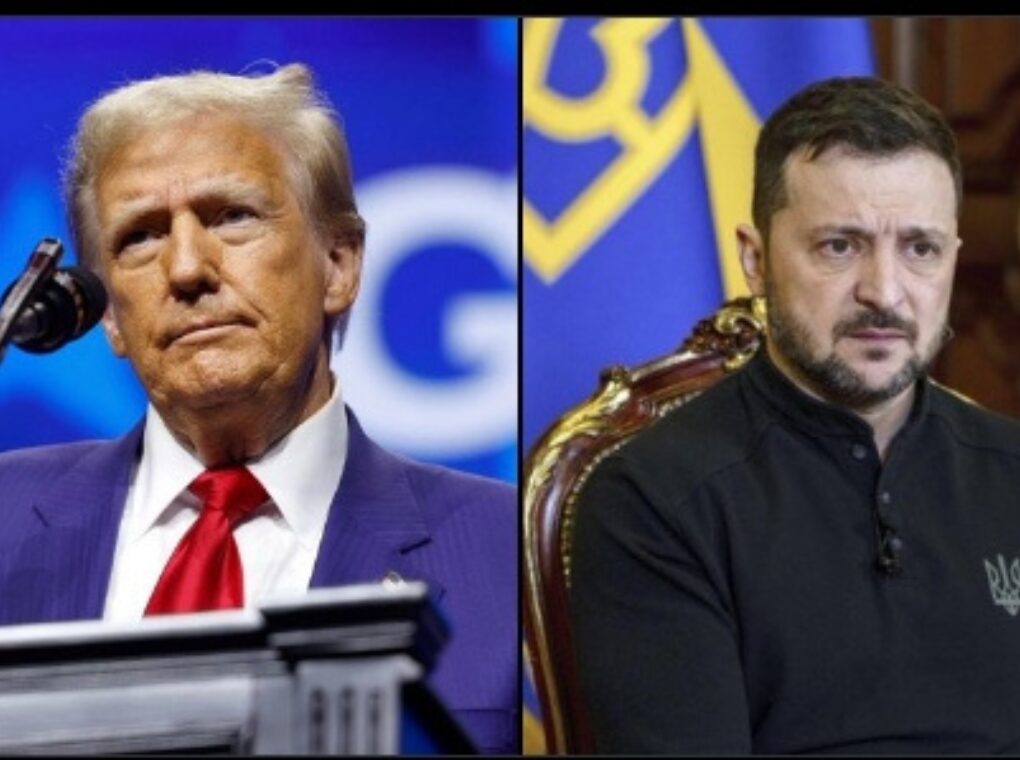
US President Donald Trump has reignited a politically sensitive debate in Ukraine by urging President Vladimir Zelensky to hold national elections—something the Ukrainian leader has declined to do since the escalation of the conflict with Russia in 2022. In an interview with Politico published Tuesday, Trump suggested that Kyiv’s refusal to conduct elections undermines its claims of defending democratic values.
The remarks come at a crucial moment for Ukraine. More than three years into full-scale war, the country faces territorial battles, internal political strains, and increasing demands from Western leaders for transparency, accountability, and visible democratic legitimacy. Zelensky’s presidential term officially expired in May 2024, but martial law—declared after Russia’s invasion—has suspended elections indefinitely.
Trump’s comments pose new questions not only for the Ukrainian leadership but also for its Western allies, who continue to provide military and financial support on the premise of defending democracy.
Zelensky’s Term Expired, But No Elections Under Martial Law
Ukraine’s constitution allows elections to be postponed while martial law is in effect. Since the escalation of conflict in February 2022, the Ukrainian parliament has repeatedly extended emergency powers, arguing that campaigning, voting, and political gatherings are unsafe and logistically impossible in a war-torn country.
In December 2023, Zelensky made it clear that neither presidential nor parliamentary elections would take place while the war continues. His position has been backed by several top Ukrainian officials who insist that national security and frontline operations must take precedence over political campaigns.
Nevertheless, the delay has drawn criticism domestically and internationally. Opponents argue that prolonged governance without a fresh electoral mandate risks weakening democratic institutions and consolidating excessive power in the president’s office.
Trump’s Challenge: “It’s Not a Democracy Anymore”
Trump’s latest remarks intensify this debate. Speaking to Politico, he said:
“They haven’t had an election in a long time. They talk about democracy, but it gets to a point where it’s not a democracy anymore.”
He stressed that Ukraine should no longer use the war as an excuse to avoid elections, calling this moment “an important time to hold an election” and asserting that Ukrainians “should have that choice.”
The comments echo his earlier criticism just days prior, when he said he was “disappointed” that Zelensky had not even reviewed the US-authored peace proposal. The criticism fits a broader pattern of Trump challenging Kyiv’s internal political decisions, military strategy, and reliance on Western support.
Political Implications for Kyiv
For Zelensky, Trump’s words carry significant weight. He must balance the urgent realities of wartime governance with the expectations of Western partners—particularly the US, Ukraine’s largest military aid provider.
Holding an election during war raises numerous practical and ethical questions:
Can millions of displaced citizens vote safely?
With millions living abroad or in frontline zones, free and fair elections would be extremely difficult to organize.
Would active soldiers be able to vote?
Ukraine’s armed forces are deployed across multiple regions, complicating voter participation.
Could elections be manipulated or disrupted by Russia?
Cyberattacks, missile strikes, and disinformation campaigns would be almost guaranteed.
Some Ukrainian officials argue that elections under wartime conditions could weaken—not strengthen—national unity and resilience.
Pressure from the US and Europe Is Growing
While the Biden administration largely avoided public criticism of Zelensky’s election delays, some European leaders and rights groups have expressed concern. Trump’s remarks, however, signal a possible shift: stronger expectations from Washington for Ukraine to demonstrate democratic continuity, especially as war fatigue grows among Western populations.
If Trump continues to press Kyiv on this issue, it could force Ukraine’s leadership into choosing between security concerns and the political optics of democracy.
A New Front in an Already Complex War
The dispute over elections underscores the complexity of Ukraine’s wartime governance. Zelensky, still popular but increasingly scrutinized, must navigate the dual challenge of leading a defensive war while maintaining democratic legitimacy. Trump’s intervention—whether viewed as pressure, political strategy, or a call for democratic accountability—adds a new layer of tension to an already strained geopolitical landscape.
As Ukraine enters another year of conflict, the question remains:
Can a nation at war afford elections—and can it afford not to have them?