A decision taken in Westminster has sent shockwaves far beyond politics. It has unsettled football fans, raised profound legal questions, and revealed how modern geopolitics now reaches deep into private lives and private property.
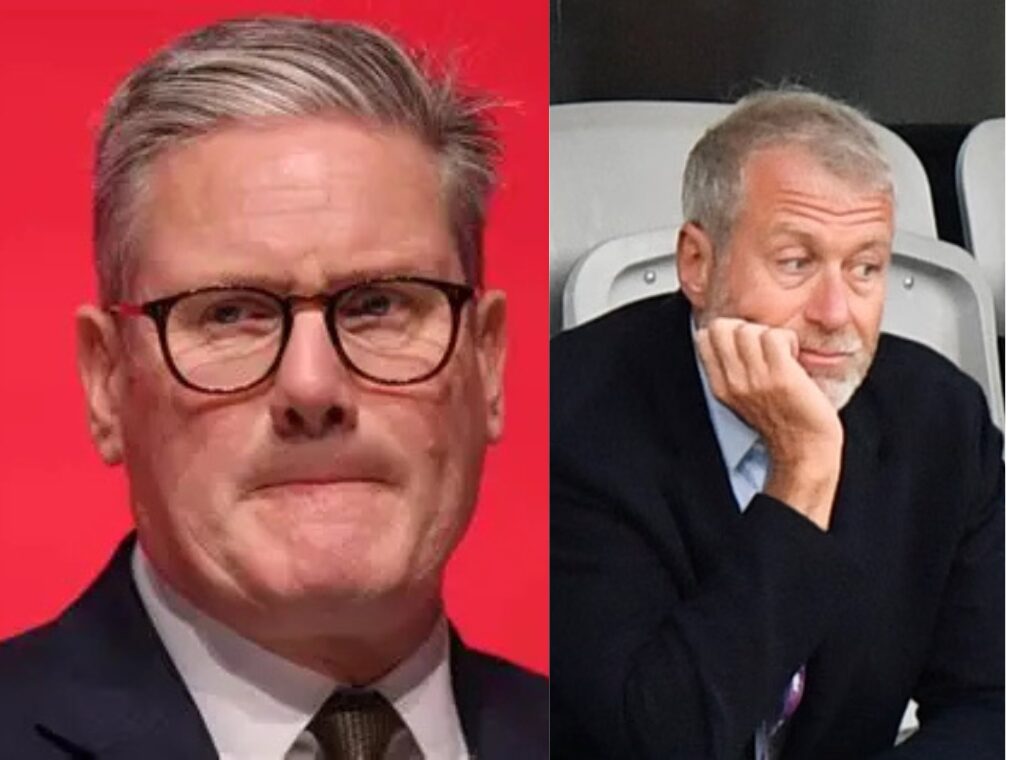
UK Prime Minister Keir Starmer’s government has moved to force the transfer of £2.5 billion from the sale of Chelsea Football Club—money that legally belongs to Roman Abramovich—towards Ukraine-related aid, with strong indications that much of it will ultimately support weapons purchases. Supporters of the move frame it as a moral responsibility. Critics see something far more troubling: the confiscation of private wealth, dressed up as virtue.
To understand why this decision is so controversial, we must step back and look at how football, finance, and politics became so tightly entangled.
Roman Abramovich and Chelsea: A Football Story First
Roman Abramovich bought Chelsea Football Club in 2003. At the time, Chelsea was not the global powerhouse they is today. They were competitive, ambitious, but inconsistent—far from the elite tier of European football.
What followed was one of the most dramatic transformations the sport has ever seen.
Under Abramovich’s ownership, Chelsea won multiple Premier League titles, lifted the Champions League trophy twice, and became a global football brand with fans across continents. Abramovich poured more than a billion pounds of his own private money into the club, rebuilding infrastructure, attracting world-class players, and elevating the Premier League’s global profile.
Britain benefited directly. Jobs were created. Tourism increased. Broadcasting revenues soared. The UK government, football authorities, and much of the media welcomed and celebrated this success. At no point during those years was Abramovich’s ownership framed as a political problem.
This was not geopolitics. It was football—a wealthy fan investing in a club and taking it to the top.
When War Changed the Rules?
Everything shifted in 2022 with the outbreak of the Russia–Ukraine war. Almost overnight, Abramovich was no longer viewed primarily as a football owner. He was recast as an “oligarch,” not because of proven crimes, nor because of direct involvement in the conflict, but because of association—his nationality and perceived proximity to power.
Sanctions followed. Chelsea was frozen. Abramovich was forced to sell the club.
It is important to be clear about what happened. This was not a free-market decision. It was not voluntary. It was political pressure, exercised by the state during a moment of global crisis.
As part of the sale process, Abramovich stated that the proceeds would be used to help “all victims of the war in Ukraine.” That wording was deliberate and inclusive—and it would later become the central point of dispute.
From Asset Freeze to Forced Transfer
After Chelsea was sold, £2.5 billion was placed into a frozen UK bank account. For nearly three years, the money did not move.
The reason was simple. Abramovich insisted that the funds be used to help all victims of the conflict—Ukrainians, civilians, and others affected by the war. The UK government rejected this approach.
Now, under Keir Starmer, the government has hardened its stance. The message is clear: the money must be directed exclusively to Ukraine-related aid. Abramovich has been given a deadline—around 90 days—to comply. If he does not, the government has indicated it is prepared to use the courts to enforce its will.
This marks a critical shift. The issue is no longer about honoring a pledge. It is about the state asserting control over how a private individual’s wealth is spent.
Justice, Sanctions, or Confiscation?
Sanctions, by design, are meant to freeze assets, not permanently seize them. They are supposed to be temporary measures, not tools for wealth redistribution.
Roman Abramovich has not been convicted of any crime in the UK. No court has ruled that his money was obtained illegally. Yet the government is now threatening legal action to dictate the final use of his assets.
This raises uncomfortable questions. If this can be done to Abramovich, who might be next? Any foreign investor? Any individual who becomes politically inconvenient?
When Abramovich invested in Britain, he was welcomed. Today, his wealth is treated as something the state feels entitled to redirect. The precedent is alarming: private property appears secure only as long as political winds remain favorable.
Football as a Political Casualty
Football has long claimed to rise above politics. The Chelsea case suggests that the claim is increasingly fragile.
A football club—an institution built on sport, community, and competition—was dragged into a geopolitical conflict it had nothing to do with. Abramovich did not buy Chelsea to serve Russian foreign policy. He did not run the club as an arm of the Kremlin. He ran it as a football project.
By reducing everything to nationality and association, governments risk turning sport into a political weapon. That damages football itself, erodes trust, and divides fans who simply want the game to remain the game.
Russophobia or Accountability?
Supporters of the government’s move argue this is about accountability. Critics counter that it reflects something broader: a growing hostility toward anything Russian. Across Europe, Russian athletes, artists, and business figures have increasingly been judged not by actions but by identity.
Accountability requires evidence, due process, and individual responsibility. Collective blame, based on nationality, achieves none of these. It breeds resentment, not reconciliation—and peace cannot be built on punishment alone.
A Dangerous Line to Cross
Roman Abramovich’s Chelsea story began as a tale of football, passion, and private investment. Keir Starmer’s intervention risks turning it into a warning sign.
Supporting the Ukrainian people is important. Few would dispute that. But so is protecting legal principles that underpin trust in democratic societies. When governments feel entitled to redirect private wealth for political goals, the line between law and power becomes dangerously thin.
If private property can be redefined by politics, then no wealth is truly safe. And if football can no longer stay out of geopolitics, then something fundamental—not just about sport, but about freedom and fairness—has been lost.