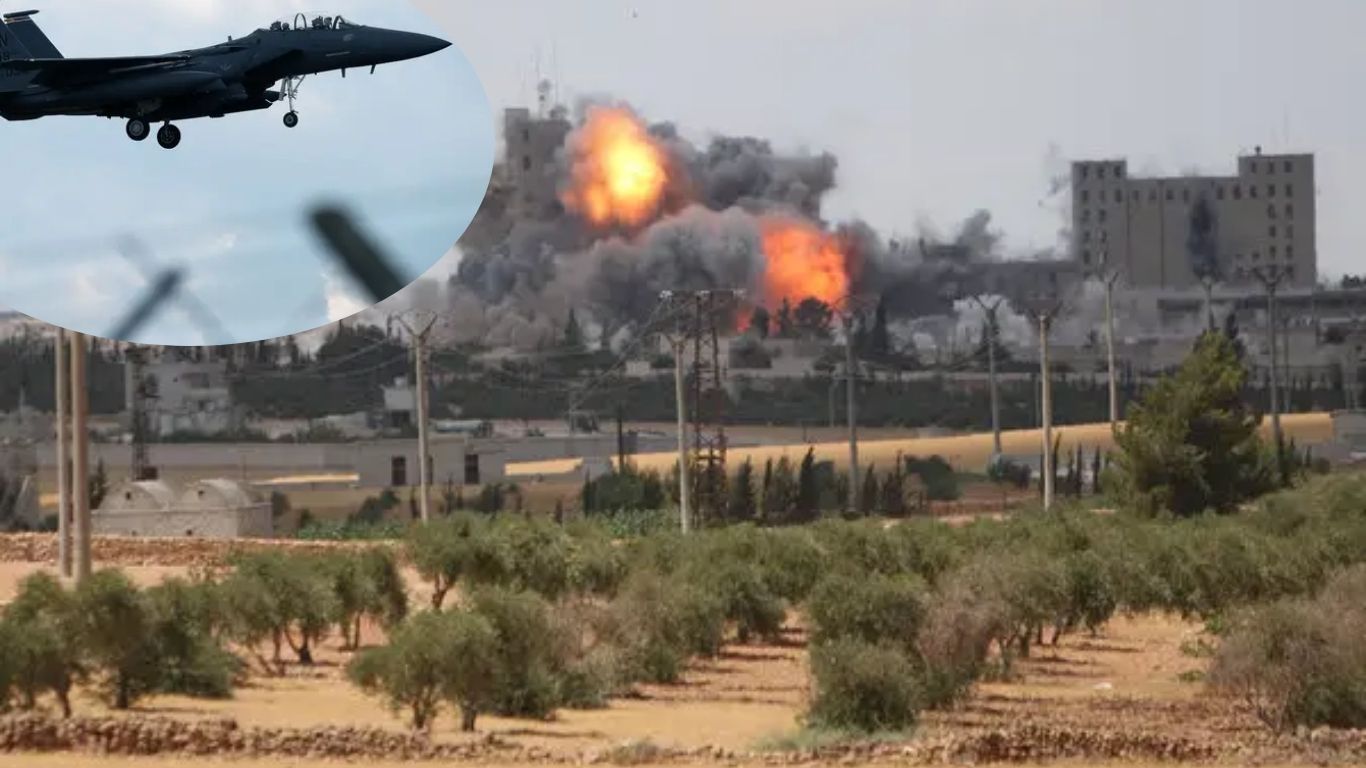
The US military carried out extensive retaliatory strikes against Islamic State targets in central Syria. During the aerial operation, it hit more than 70 terror-linked locations with precision-guided munitions under “Operation Hawkeye Strike.” The offensive followed an ISIS ambush that killed two American soldiers and a US civilian interpreter. Defence Secretary Pete Hegseth described the operation as a “declaration of vengeance,” while President Trump pledged unrelenting action against any group that threatens Americans. Pentagon officials said the objective was to degrade ISIS’s infrastructure and leadership network.
On Friday (December 19), the US launched major air and artillery strikes against the Islamic State in Syria to avenge the deaths of two US Army personnel and an American civilian killed in a terrorist attack in central Syria the previous weekend.
According to US Central Command, American fighter aircraft, attack helicopters, and artillery units fired over 100 munitions at more than 70 suspected ISIS targets across several locations in central Syria. These included weapons depots and operational support facilities. Jordanian air force jets also participated in the operation. US officials said the strikes were expected to continue for several hours into early Saturday, describing them as a “massive attack.”
“This is not the start of a war — it is a declaration of vengeance,” Mr Hegseth wrote on social media. “Under President Trump’s leadership, the United States will never hesitate or relent when it comes to protecting its people.”
On one hand, President Trump consistently presents himself as a global peacemaker, promoting peace deals and repeatedly projecting that image on international platforms. On the other, the US military continues to conduct strikes in foreign territories, including Syria and even Venezuelan waters. Trump appears to view peace as a transactional deal rather than a sustained political process, failing to grasp that peace cannot be treated like a business agreement. This approach is one of the reasons peace deals in West Asia and East Asia rarely last beyond a few months.
Trump’s rhetoric on Islamic terrorism is beautiful at the same time the actions reveal his hypocrisy when he dines with a Pakistani General, a nation which trains Jihadists and spreads radical ideas of Islam around the world.
Mr Hegseth further stated, “Today, we hunted, and we killed our enemies. Many of them. And we will continue.” He did not provide additional operational details.
Earlier today, U.S. forces commenced OPERATION HAWKEYE STRIKE in Syria to eliminate ISIS fighters, infrastructure, and weapons sites in direct response to the attack on U.S. forces that occurred on December 13th in Palmyra, Syria.
This is not the beginning of a war — it is a…
— Secretary of War Pete Hegseth (@SecWar) December 19, 2025
The soldiers killed last Saturday (December 20) were the first American fatalities in Syria since the collapse of Bashar al-Assad’s regime last year. They were supporting counterterrorism operations against ISIS near Palmyra when they came under fire from a lone attacker, according to US and Syrian officials.
However, the issue extends beyond counterterror strikes. It underscores the inconsistency in Trump’s narrative. He previously claimed that Syria under an ex-ISIS commander was more stable than under Assad. Current developments suggest otherwise. ISIS activity is resurging, and sectarian violence continues under the new Syrian leadership led by Ahmed al-Sharaa.
The US strikes, and the likelihood of further operations at a time when Washington has reduced its troop presence in Syria to around 1,000 personnel, roughly half of what it had earlier this year. The drawdown reflected assumptions that Syria’s security environment had improved following Assad’s fall. The recent attack, however, highlights persistent dangers and renews questions over whether US forces should remain deployed at all.
No group has formally claimed responsibility for the ambush, but initial assessments by US intelligence and the Pentagon point to the Islamic State. Earlier this year, senior intelligence officials warned Congress that ISIS would attempt to exploit the post-Assad vacuum by freeing between 9,000 and 10,000 detained fighters and around 26,000 family members held in northeastern Syria, enabling the group to rebuild its operational capacity.
Although ISIS no longer controls significant territory, it continues to propagate its extremist ideology through covert cells, regional affiliates, and online platforms. The group was responsible for major attacks last year in Iran, Russia, and Pakistan.
The killing of American troops also shows the immense challenges facing Syria’s fragile new government. President Ahmed al-Sharaa is attempting to stabilize a deeply divided nation after nearly 14 years of civil war, while simultaneously confronting ISIS, rival armed factions, and the task of constructing a unified national military.