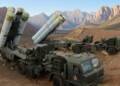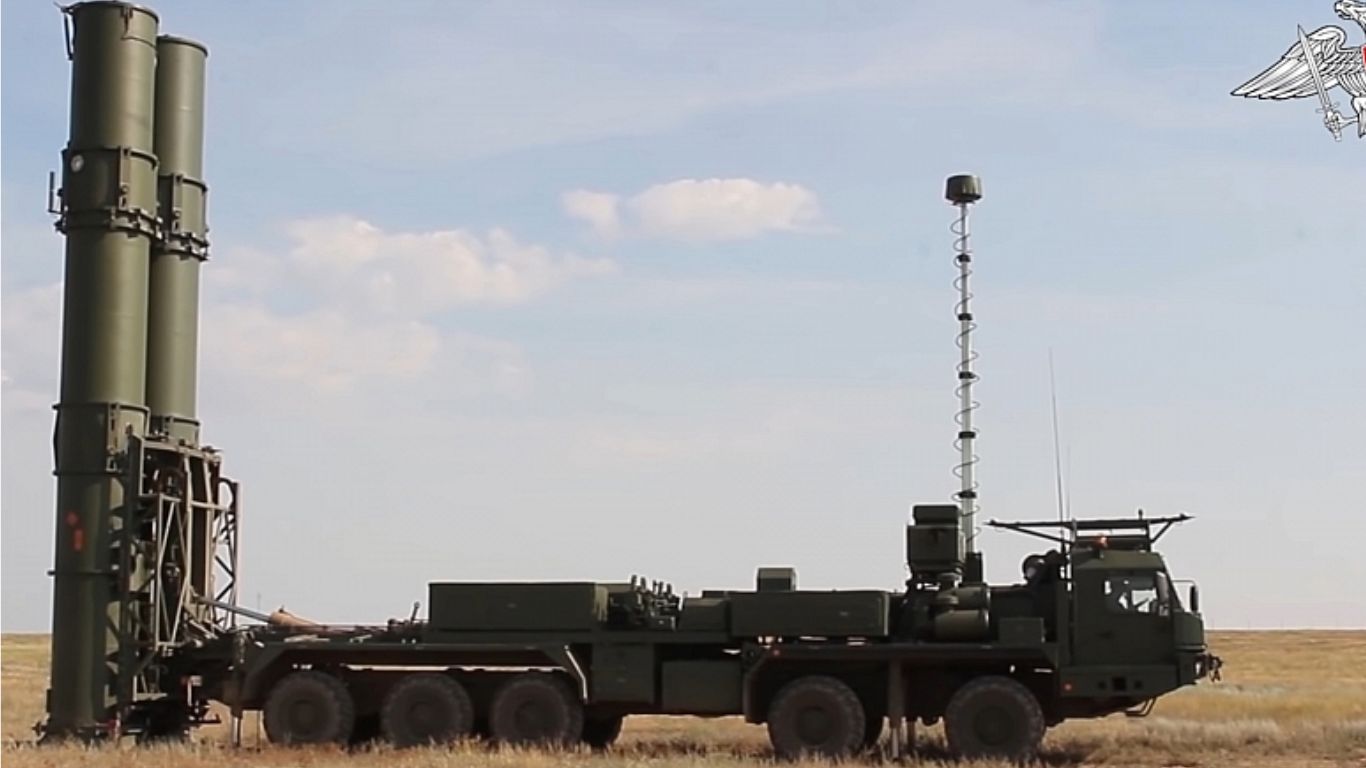
Russia has revealed that its first air and missile defence regiment, equipped with the S-500 “Prometheus” system, has entered combat duty. This is really huge for Russia and a nightmare for Ukraine, knowing the Russia-Ukraine war is in a decisive phase.
Russian Defence Minister Andrei Belousov confirmed the news. The move signals that the system has transitioned from prolonged testing and limited deployment to an operational role within the Russian Aerospace Forces. Although Moscow has not disclosed details about deployment locations or engagement rules, the induction itself carries strategic importance.
To understand the importance of the S-500, it is necessary to first look at the record of its predecessor, the S-400 Triumf. Introduced into service in 2007, the S-400 reshaped regional air defence balances wherever it was deployed. Designed to counter aircraft, cruise missiles, and ballistic missiles at varying ranges and altitudes, the system quickly gained a reputation for flexibility and layered defence. Its radar suite, combined with multiple interceptor options, allowed it to engage targets across different threat profiles within a single integrated network.
S-400 and India-Pak Conflict
The S-400’s operational relevance was demonstrated not only in Europe, where its deployment altered NATO air planning, but also in South Asia. During a brief but intense period of the India-Pakistan war, Indian S-400 batteries played a central role in neutralizing incoming aerial threats from Pakistan. Indian officials have indicated that the system successfully tracked and intercepted hostile assets, providing critical airspace denial. More notably, an airborne early warning and control (AWACS) platform was engaged at a distance approaching 300 kilometres inside Pakistani territory. This is a huge success story of S-400, which countries around the world witnessed. As the system proved the value of long-range air defence systems in modern conflict.
Against this background, the S-500 represents a clear step upward rather than a simple replacement. Development of the system began around 2010, with the aim of complementing, not supplanting, the S-400. According to the state-run TASS news agency, the S-500 is intended to address both tactical and strategic threats, particularly those emerging at higher altitudes and greater speeds. This includes targets in near space, such as low-orbit satellites, as well as advanced ballistic missile threats.
Capabilities of S-500
Technically, the S-500 introduces several enhancements. It can deploy long-range 40N6M surface-to-air missiles with reported ranges of up to 400 kilometres, while the dedicated 77N6 interceptors are designed to engage targets at distances of up to 600 kilometres. More importantly, the system’s radar architecture is structured to detect and track threats far beyond the envelope of previous systems. Independent assessments, including those by the Centre for Strategic and International Studies, suggest that its radar components can detect ballistic targets at ranges of up to 2,000 kilometres and airborne targets at around 800 kilometres. This provides early warning and engagement opportunities that extend well beyond national airspace.
As a result, the S-500 blurs the traditional distinction between air defence and missile defence. Whereas the S-400 focused primarily on aircraft and shorter-range ballistic threats, the S-500 is positioned as a system capable of countering hypersonic vehicles and space-based assets. This shift reflects broader changes in military doctrine, where space and near-space are increasingly viewed as contested domains.
The Geopolitical Angle
The geopolitical implications are equally important. Russia’s decision to supply the S-400 to India, while reportedly declining to provide the same system to China due to Indian security concerns, has already influenced regional power equations. India’s acquisition of the S-400 strengthened its air defence posture against both Pakistan and China, particularly along contested borders and critical infrastructure zones. The entry of the S-500 into service means there is a high possibility that It will be passed to Russia’s old and trusted allies India.
If India were to gain access to the S-500, the strategic picture across South and East Asia would change further. Extended-range coverage could theoretically provide overlapping air and missile defence zones across large parts of the region, complicating adversary planning and increasing the cost of escalation. At the same time, China’s own investments in advanced air defence and missile systems suggest that any such development would feed into an ongoing cycle of capability and counter-capability.
At last, the induction of the S-500 into combat duty is a huge success. It builds directly on the operational record of the S-400, which has already shown its impact in combat time, including in South Asia. As air defence systems move higher in altitude and farther in range, their role in shaping regional security environments will continue to grow. The S-500, by extending the reach of integrated air and missile defence into near space, marks the next phase in that progression.