Was it merely a tragic aviation accident—or did it occur at the most politically convenient moment possible?
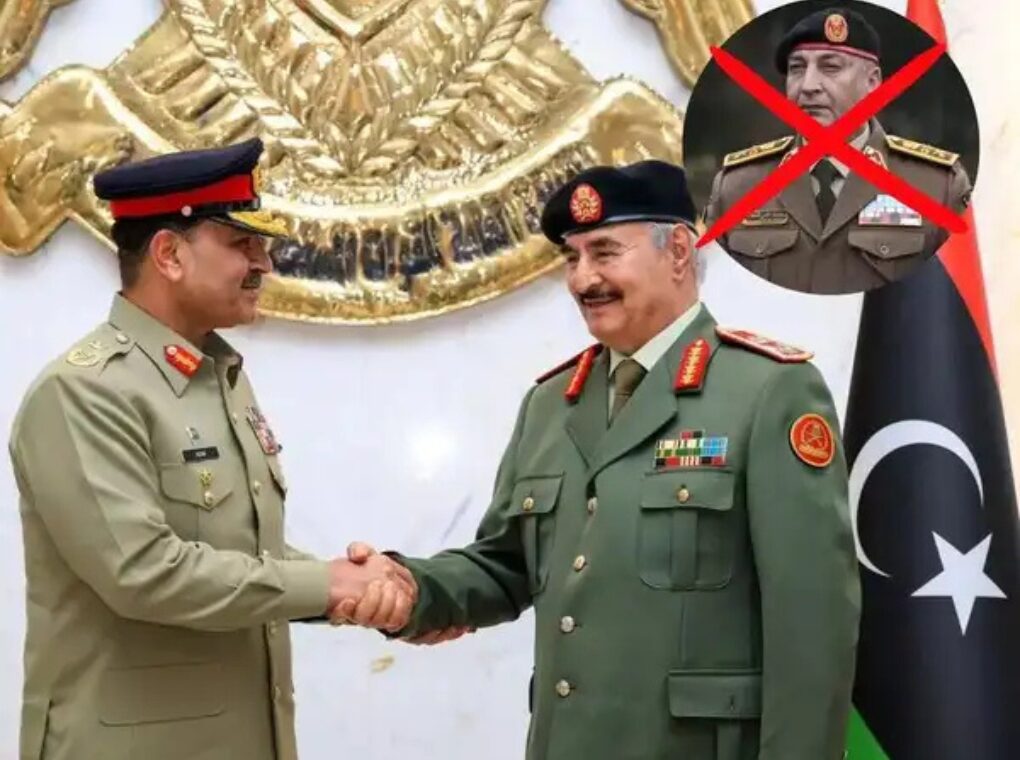
Libya’s Army Chief, Lieutenant General Mohamed Al-Haddad, has died in a plane crash shortly after departing Ankara, Turkey. The incident comes just days after Pakistan’s Army Chief, General Asim Munir, held high-level meetings with eastern Libyan commander Khalifa Haftar, and amid reports of a multi-billion-dollar defence deal allegedly signed in violation of a United Nations arms embargo.
The timing has raised eyebrows across diplomatic and strategic circles, as Turkey’s regional ambitions, Pakistan’s expanding military outreach, Israel’s warnings, Russia’s growing hostility, and India’s strategic recalibration appear to be converging at once. Coincidence—or part of a larger geopolitical realignment?
The Crash That Sparked Questions
On Tuesday night, a Falcon 50 business jet took off from Ankara’s Esenboğa Airport. Onboard were Libya’s Army Chief Mohamed Al-Haddad and four senior military officials.
Minutes after take-off, Turkish authorities lost contact with the aircraft. According to official statements, the jet declared an electrical emergency, requested permission to return to the airport, and then disappeared from radar near the Haymana district southwest of Ankara.
All five Libyan officials were killed in the crash. The aircraft’s three crew members—French nationals—also died. Turkish authorities have described the incident as a “tragic accident” and announced a full investigation.
Yet the identity of the passengers and the geopolitical context surrounding the flight have made the incident far more consequential than a routine aviation disaster.
Who Was Mohamed Al-Haddad?
Lt Gen Mohamed Al-Haddad was not just a senior military officer—he was the Army Chief of Libya’s UN-recognised Government of National Unity, based in Tripoli. He was also a direct political and military rival of Khalifa Haftar, the eastern Libyan strongman who commands the Libyan National Army (LNA).
Haftar’s forces previously launched a major offensive to seize Tripoli by force, an effort that was ultimately repelled by government troops under leaders such as Al-Haddad. In effect, Al-Haddad stood in the way of Haftar’s ambition to dominate Libya militarily.
Haftar, meanwhile, maintains links with several external powers, including Egypt, the UAE, Russia—and increasingly, Pakistan.
Pakistan, Libya, and the $4 Billion Question
Just days before the crash, Pakistan Army Chief General Asim Munir met senior Libyan military leadership aligned with Haftar in Benghazi. According to multiple Pakistani officials quoted by Reuters, the meeting resulted in the finalisation of a military equipment deal reportedly worth more than $4 billion.
The agreement is said to have been concluded despite an active UN arms embargo on Libya. The officials declined to be identified due to the sensitivity of the matter.
During his interactions, Munir reportedly told Libyan commanders that Pakistan would share “whatever technological equipment it possesses.” He also repeated controversial claims that Pakistan’s forces had destroyed Indian Rafale jets and an S-400 air defence system during recent tensions—claims that India has categorically denied.
The messaging was clear: Pakistan was positioning itself as a weapons supplier, strategic partner, and ideological ally. And Turkey was the diplomatic and logistical backdrop to this outreach.
Turkey’s Expanding Axis
Turkey today is no longer merely a NATO member following Western consensus. Under President Recep Tayyip Erdoğan, Ankara has increasingly acted as an independent power broker—selling drones, training foreign forces, and shaping conflicts from North Africa to the Black Sea.
Turkey backs factions in western Libya, openly supports Pakistan on diplomatic and defence issues, supplies military assistance to Ukraine, and controls key maritime access points in the Black Sea. Critics argue that Ankara is attempting to construct a parallel geopolitical axis—linking Pakistan, Libya-aligned factions, Bangladesh, and other states—through weapons sales, military cooperation, and ideological alignment.
Supporters describe this as strategic autonomy. Detractors call it Erdoğan’s neo-Ottoman ambition—an attempt to project influence far beyond Turkey’s borders under the banner of leadership in the Muslim world.
Israel, Greece, Cyprus—and a Clear Warning
Israel has taken careful note of Turkey’s expanding footprint. In response, it has quietly deepened military and strategic cooperation with Greece and Cyprus, focusing on energy corridors, naval coordination, and regional security.
Israeli Prime Minister Benjamin Netanyahu has issued explicit warnings to Ankara, signalling that Turkey’s regional push has defined limits. At the same time, Russia has grown increasingly hostile to Turkey’s role in facilitating Ukrainian operations targeting Russian “shadow fleet” assets in the Black and Mediterranean Seas.
For both Israel and Russia, Turkey is no longer a difficult partner—it is increasingly viewed as a strategic adversary.
India’s Strategic Recalibration
India, too, is adjusting. Turkey has consistently taken positions hostile to Indian interests—on Kashmir, defence exports to Pakistan, and international forums. In response, New Delhi has strengthened defence diplomacy, invested in AI-driven intelligence systems, and deepened ties with Greece, Israel, and France.
As global power blocs harden, neutrality becomes increasingly untenable. Alignment, not ambiguity, is becoming the dominant strategy.
Accident or Signal?
So was Mohamed Al-Haddad’s death simply a tragic aviation accident?
Or did it remove a key obstacle at a moment of sensitive military realignment?
There is no proof of foul play. No confirmed evidence of sabotage. But geopolitics rarely hinges on proof alone—it is shaped by timing, patterns, and outcomes.
One general is gone. Military alignments are shifting. Regional ambitions are colliding.
History will ultimately decide whether this was coincidence—or a warning signal in a rapidly hardening world order.