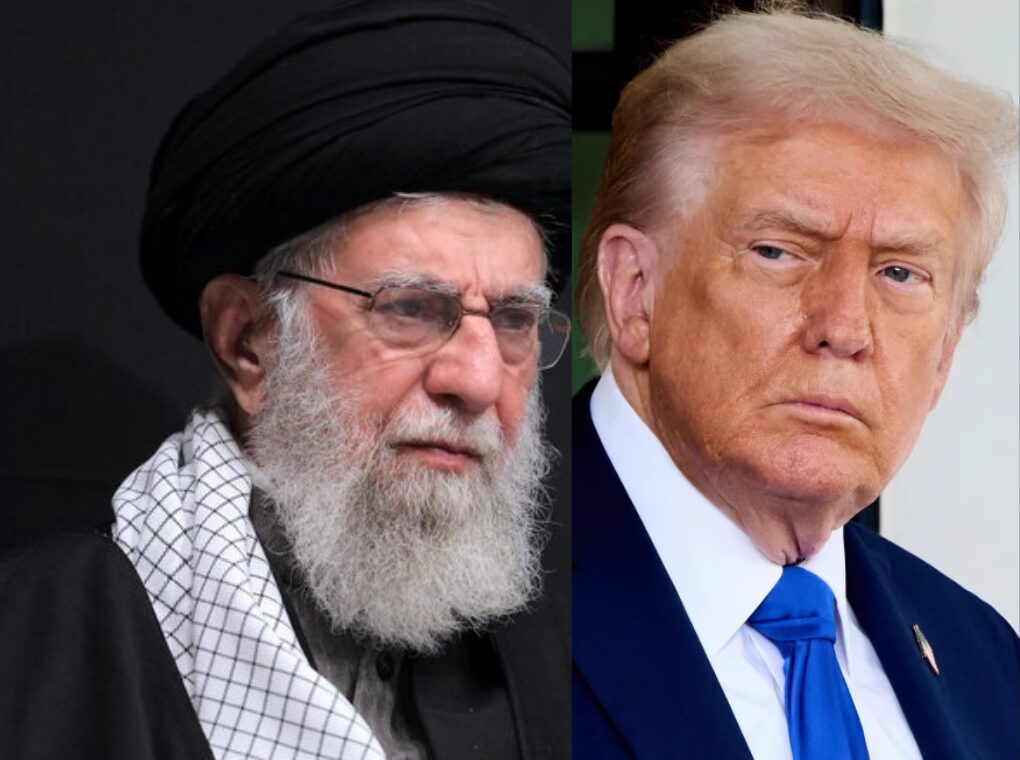
Iran’s Supreme Leader Ayatollah Ali Khamenei has issued a stark warning to the United States, threatening to sink American aircraft carriers deployed in the Middle East while firmly rejecting demands to limit Iran’s ballistic missile program.
In recent statements, Khamenei described U.S. interference in Iran’s affairs as a sign of the “decline of the corrupt, oppressive US empire,” highlighting what he called irrational behavior, such as dictating restrictions on Tehran’s missile range.
Khamenei’s remarks came amid heightened tensions in the region, as indirect nuclear talks between Iran and the United States resumed in Geneva in mid-February 2026. The negotiations, mediated through third parties and building on earlier rounds in Oman, aim to address Iran’s nuclear program but have been complicated by broader U.S. demands.
U.S. President Donald Trump has signaled a hardline stance, emphasizing that any meaningful deal must cover not only nuclear enrichment but also ballistic missiles, support for proxy groups, and human rights issues inside Iran. Trump has repeatedly warned of severe consequences—including military action—if talks fail, while deploying significant U.S. naval assets to the area to underscore Washington’s leverage.
In his pointed comments, Khamenei rejected these pressures outright. He stated that U.S. officials insist, “Limit your missiles to this range. What’s that to do with you?!” He argued that without deterrent weaponry, a country would be “crushed by the enemy,” framing Iran’s missile capabilities as essential for national defense and survival. This stance aligns with longstanding Iranian policy, where the ballistic missile arsenal—viewed by Tehran as a key asymmetric tool—is considered non-negotiable. Iran has previously imposed self-restrictions on missile ranges (around 2,000-2,200 km), but recent developments suggest a willingness to expand capabilities if pressured.
Khamenei’s most provocative rhetoric targeted U.S. naval power directly. He acknowledged the danger posed by American warships but countered: “Of course an aircraft carrier is a dangerous device, but more dangerous than the carrier is the weapon that can send it to the bottom of the sea.” In other statements, he taunted that even the “strongest army in the world” could be “slapped so hard” it “cannot get up,” implying Iran possesses the means—likely advanced anti-ship missiles, drones, or hypersonic weapons—to challenge U.S. dominance in the Gulf.
These threats coincided with Iranian military exercises, including live-fire missile drills in the Strait of Hormuz by the Islamic Revolutionary Guard Corps (IRGC) Navy. The IRGC has long boasted about its ability to close the strategic waterway, through which roughly 20% of global oil passes, and recent war games demonstrated strikes on mock naval targets.
The backdrop to these statements is a significant U.S. military buildup. Reports indicate at least one aircraft carrier, the USS Abraham Lincoln, positioned in the region, with a second on the way, alongside additional air defense systems and forces to counter potential Iranian missile or drone attacks. This escalation follows earlier U.S. actions, including responses to Iran’s nuclear advancements and regional proxy activities. Satellite imagery has shown U.S. carriers operating hundreds of kilometers from Iran’s coast, yet still within reach of Tehran’s growing arsenal of precision-guided munitions.
Iran’s position remains defiant. Foreign Minister Abbas Araghchi and other officials have emphasized that missiles are off-limits in negotiations, with Tehran insisting talks focus narrowly on nuclear issues. Khamenei reinforced this by portraying U.S. demands as interference in sovereign affairs, accusing Washington of irrationality amid its own perceived decline. He also referenced Trump’s past admissions that the U.S. has failed to eliminate the Islamic Republic over 47 years, declaring that America “will not succeed” in doing so now.
These exchanges highlight the fragile nature of the current diplomatic push. While some progress has been reported—such as understandings on guiding principles—the gap between the sides is wide. The U.S. seeks comprehensive curbs to prevent Iran from acquiring nuclear weapons and projecting power regionally, while Iran views concessions on missiles or proxies as existential threats. Trump’s administration has mixed diplomacy with threats, describing military options as a last resort but maintaining that “no nuclear capability” for Iran is non-negotiable.
The rhetoric from Khamenei serves multiple purposes: deterring potential U.S. or Israeli strikes, rallying domestic support amid internal challenges, and signaling resolve to regional allies. However, it risks further escalation in an already volatile Middle East, where proxy conflicts, oil routes, and nuclear ambitions intersect. As talks continue, the world watches whether diplomacy can prevail over the drumbeat of threats, or if miscalculation could lead to broader confrontation.