
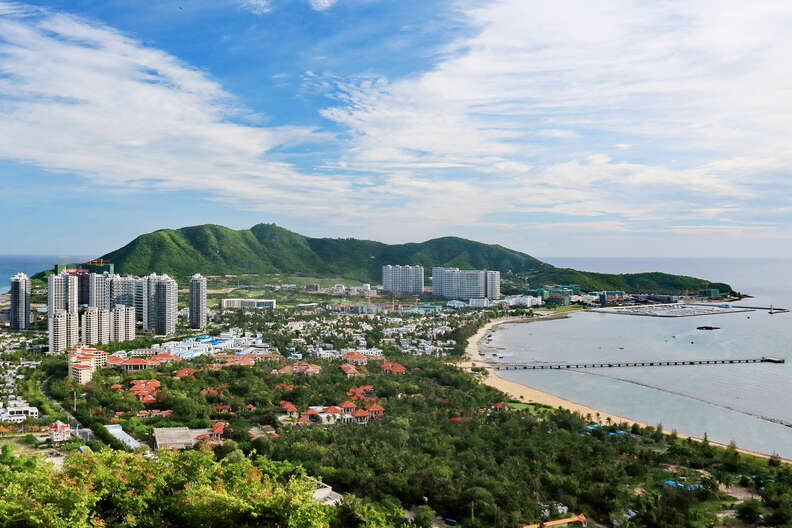
As the United States and some Western economies raise trade barriers and adopt more protectionist policies, China has chosen a sharply different path. One of its boldest moves is the transformation of Hainan Island into a massive free-trade zone, a strategy that could reshape global trade flows in the coming decades.
Hainan, located in the South China Sea, is often compared to Singapore—but the comparison is striking for its scale. Hainan is nearly 50 times larger than Singapore, making it the largest free-trade zone in the world by land area. By converting the entire island into a free-trade port, China is signaling its commitment to openness, investment, and global integration.
What Makes Hainan Different?
Unlike traditional free-trade zones that operate within limited industrial parks or ports, Hainan’s entire island functions as a single customs zone. Imported goods can enter Hainan tariff-free, reducing costs for international companies. Businesses are allowed to store, process, and add value to products before sending them onward.
A key advantage lies in how goods move from Hainan to mainland China. If companies perform value-addition activities—such as processing, assembly, or packaging—products can then be shipped to the mainland duty-free or at reduced tariffs. This makes Hainan an attractive base for manufacturing, logistics, and regional headquarters.
Benefits for Global Companies
For multinational firms facing higher tariffs and supply-chain disruptions elsewhere, Hainan offers a cost-effective alternative. Lower taxes, simplified customs procedures, and relaxed investment rules help companies save money while maintaining access to the vast Chinese market.
The free-trade zone also encourages industries such as high-tech manufacturing, pharmaceuticals, luxury goods, tourism, and services. Combined with business-friendly policies and growing infrastructure, Hainan positions itself as a gateway between China and the global economy.
Response of Other Major Economies
China’s move has drawn close attention from major global and regional powers.
United States:
The US has viewed Hainan with cautious skepticism. While American companies may benefit commercially from operating in Hainan, US policymakers remain concerned about supply-chain dependence on China. In response, the US has promoted “friend-shoring” strategies, encouraging companies to shift production to allied nations such as Mexico and Vietnam. Hainan, however, challenges these efforts by offering cost advantages and direct access to the Chinese market.
Japan:
Japan sees Hainan as both an opportunity and a competitor. Japanese firms in automobiles, electronics, and chemicals may use Hainan to reduce costs and maintain market access. At the same time, Japan is strengthening its own trade agreements, such as the Comprehensive and Progressive Agreement for Trans-Pacific Partnership (CPTPP), to balance China’s growing influence.
Taiwan:
Taiwan views the development primarily through a strategic and economic lens. While Taiwanese businesses may find Hainan attractive for manufacturing and logistics, political tensions make large-scale engagement sensitive. Taiwan continues to diversify its investments toward Southeast Asia under its “New Southbound Policy” to reduce reliance on mainland China.
Europe:
European nations have responded pragmatically. Many European companies—especially in luxury goods, pharmaceuticals, and automotive sectors—see Hainan as a gateway to Chinese consumers. At the same time, the European Union remains cautious, emphasizing fair competition, regulatory transparency, and reduced dependency on any single market.
Impact on the Global and Regional Economy
Hainan’s rise could have wide-ranging economic consequences.
Globally, it may redirect trade flows, drawing investment away from traditional hubs like Singapore, Hong Kong, and Dubai. By lowering trade costs and simplifying customs procedures, Hainan increases competition among global free-trade centers.
Regionally, Hainan strengthens China’s economic influence in Asia-Pacific supply chains. Southeast Asian nations may benefit as complementary partners, but they may also face competition as companies reconsider where to locate manufacturing and logistics operations.
For China, Hainan supports long-term goals of economic resilience, domestic consumption, and technological upgrading. For multinational companies, it offers a way to navigate an increasingly fragmented global trade environment.
Hainan is not just a free-trade zone—it is a strategic signal. At a time when global trade is becoming more divided, China is using Hainan to promote openness on its own terms. The responses from the US, Japan, Taiwan, and Europe show both interest and caution. As Hainan develops, it has the potential to reshape regional supply chains, intensify global trade competition, and influence the future direction of international commerce.