
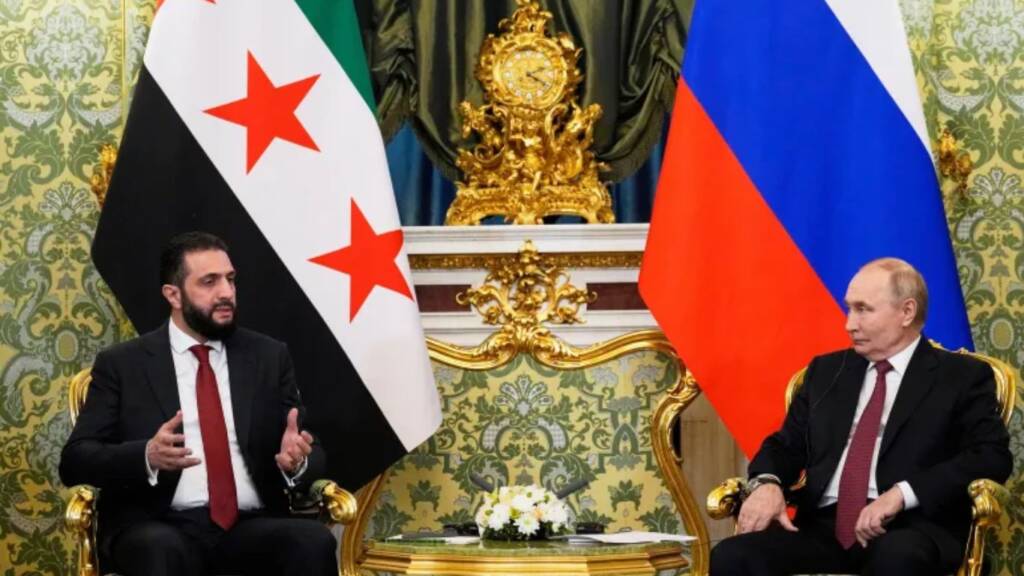
In a recent development, Syria and Russia are signalling a clear reset in their relationship. Syrian Foreign and defence ministers met President Vladimir Putin and Foreign Minister Sergey Lavrov in Moscow. However, this is not just a routine diplomatic engagement. Instead, it reflects a broader geopolitical reset after the end of Syria’s 14-year war and the dramatic fall of Bashar al-Assad’s regime last year.
At the heart of these talks lies a shared attempt to move from a wartime alliance to a post-war partnership—one that combines military cooperation, economic growth, and diplomatic coordination. This will prove a win-win situation for both the nation.
From War-Time Alliance to Post-War Partnership
For more than a decade, Russia stood firmly behind Assad, providing decisive military support that altered the course of the civil war. However, with Assad now out of power and a new leadership in Damascus, both sides appear keen to redefine their engagement on new terms. Both nations are driving on pragmatism. Russia has its strategic interests in Syria to keep its watch on North Africa, while Syria wants to integrate itself into the world.
Syrian Foreign Minister Asaad al-Shaibani described the moment as the beginning of a “new stage” in bilateral relations. Importantly, he stressed reconstruction, investment, and balanced diplomacy, signalling that Syria no longer wants to be seen as dependent on any single power. At the same time, he highlighted two major milestones: the end of the long war and the lifting of international sanctions, both of which open the door to economic recovery.
Meanwhile, Russia has been careful to publicly respect Syria’s sovereignty and territorial unity. Lavrov’s emphasis on unity reflects Moscow’s concern that Syria should not fragment under external pressure, especially at a time when regional instability, from Gaza to Ukraine, continues to reshape global power equations.
In simple words, Syria wants help rebuilding its economy and army, while Russia wants continuity, stability, and influence.
The Bigger Geopolitical Picture
Beyond diplomacy, the most critical issue remains security. During talks with Putin, Syria’s foreign and defence ministers discussed modernising the Syrian army, upgrading military equipment, and deepening defence cooperation. Although framed as defensive, this cooperation directly ties into regional tensions, particularly Israel’s repeated airstrikes inside Syria.
Those who understand geopolitics will automatically understand the reason behind the reset, as it serves Damascus’ security requirements, which would not have been fulfilled by the Western powers.
Notably, Putin reiterated Russia’s condemnation of Israeli attacks, calling them a threat to regional stability. This position allows Moscow to present itself as a defender of Syrian sovereignty, while also positioning Russia as a balancing force in West Asia, especially as US influence faces growing challenges.
At the same time, Russia’s strategic interests are clear. Moscow is keen to secure long-term access to the Khmeimim airbase and the Tartous naval facility—its only naval foothold in the Mediterranean. These bases are crucial for Russia’s global military posture, especially as it faces pressure in Europe due to the Ukraine war.
These bases are also very important for Russia to keep its mission and engagements in the North African region.
Syria’s new president, Ahmed al-Sharaa, has already assured Moscow that past agreements will be honoured. Consequently, despite Assad’s removal, Russia’s military footprint in Syria appears safe, at least for now.
Why This Matters
Ultimately, this new engagement reflects mutual pragmatism. Syria needs investment, military rebuilding, and diplomatic backing as it emerges from years of devastation. Russia, meanwhile, seeks to preserve influence, maintain strategic bases, and demonstrate that it remains a key powerbroker in West Asia.
Scholars, Journalists and geopolitical enthusiasts were under the impression that Russia is out of Syria and Damascus is now under the Western and Arab nations’ axis, but President Putin has proven them wrong.
Therefore, while the language used by both sides speaks of “mutual respect” and “new beginnings,” the shows reality is more strategic. Syria is diversifying its partnerships, and Russia is adapting to a post-Assad Syria without losing ground.