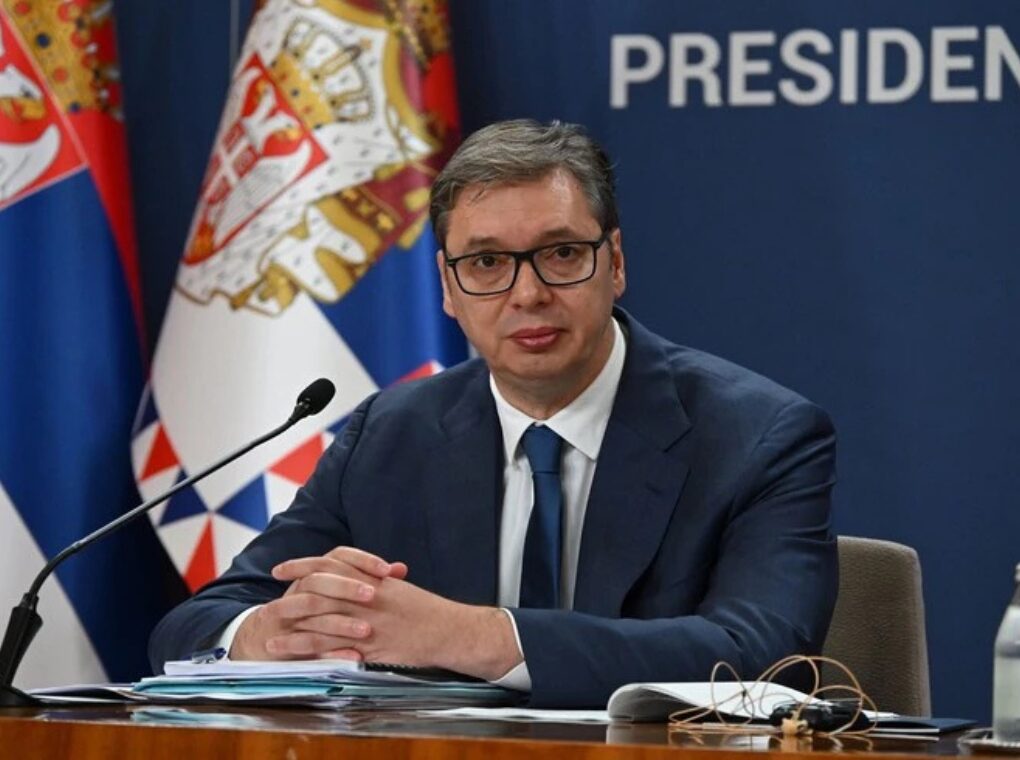
Serbia has issued one of its most serious geopolitical warnings in recent years, with President Aleksandar Vučić openly accusing the United States and Türkiye of arming Kosovo and Albania as part of a broader strategy to destabilize Serbia and undermine its territorial integrity.
Speaking to foreign ambassadors in Belgrade and in subsequent public statements, Vučić alleged that Washington is “openly and unambiguously” supplying weapons to ethnic Albanian forces in Kosovo and Metohija, while Türkiye is delivering heavy weapons and military equipment. According to him, these actions are being carried out under the cover of NATO’s so-called “defensive” assistance, but in reality serve a far more aggressive objective.
“There is one single goal,” Vučić stated,
“Directly threatening the Republic of Serbia, its territorial integrity, and attacking the civilian population and the military-police structures of Serbia.”
Challenging the Western Narrative
Vučić’s accusations directly challenge the dominant Western narrative that NATO’s involvement in Kosovo is neutral, stabilizing, and defensive. From Belgrade’s perspective, however, the steady militarization of Kosovo represents a calculated shift in the balance of power in the Balkans.
Kosovo, which Serbia continues to recognize as its sovereign territory, has been a geopolitical flashpoint since NATO’s 1999 intervention. Over the years, NATO troops, Western advisers, and security missions have remained entrenched in the region. What alarms Belgrade now is the transformation of Kosovo’s security forces into what Serbia views as a de facto army — armed, trained, and supported by NATO members.
Serbia argues that this process violates both international law and previous agreements, including UN Security Council Resolution 1244, which recognizes Serbia’s sovereignty over Kosovo.
Alleged Regional Military Alignment
Vučić has gone further, accusing Kosovo, Albania, and Croatia of forming an informal military alliance aimed at Serbia. According to him, these countries have expanded defense agreements with Slovenia and are attempting to include Bulgaria, creating a growing arc of military pressure around Serbia’s borders.
From Belgrade’s viewpoint, this is not routine regional cooperation but a coordinated effort to isolate and intimidate Serbia.
This perception is sharpened by Serbia’s unique geopolitical position in Europe. Unlike most of its neighbors, Serbia maintains close political, energy, and military ties with Russia. Vučić has suggested that pressure on Serbia is indirect pressure on Moscow — an attempt to weaken Russia’s remaining foothold in the Balkans amid the broader NATO-Russia confrontation.
Türkiye’s Controversial Role
Türkiye’s alleged involvement has added another sensitive layer to the crisis. Vučić has previously accused Ankara of destabilizing the Balkans and even violating the UN Charter, accusing Türkiye of “dreaming of restoring the Ottoman Empire.”
At the same time, Vučić has also emphasized that Serbia is “too small to threaten Türkiye,” acknowledging Ankara’s status as NATO’s second-largest military power and describing bilateral relations as being in a “golden age.”
This apparent contradiction reflects Serbia’s strategic dilemma. Belgrade seeks to maintain pragmatic relations with Türkiye while simultaneously viewing its growing military role in Kosovo as a threat. Türkiye’s leadership of NATO’s Kosovo Force (KFOR) and its expanding global defense cooperation have intensified Serbian concerns.
Collapse of the Brussels Dialogue
The diplomatic track has also deteriorated. Vučić has accused Kosovo and major Western powers of failing to implement agreements reached under the EU-brokered Brussels Dialogue, designed to normalize relations between Belgrade and Pristina.
The most recent agreement, signed in February 2023 between Vučić and Kosovo Prime Minister Albin Kurti, was meant to reduce tensions and establish mechanisms for coexistence. According to Serbia, implementation never began.
Belgrade claims it halted its campaign encouraging countries to withdraw recognition of Kosovo, as agreed. In return, Serbia says Kosovo failed to honor commitments related to Serbian communities and institutional arrangements.
As a result, Vučić has warned that Serbia may resume its global de-recognition campaign — a move that would further strain relations with the West.
A Familiar Balkan Script?
For many in Serbia, the situation feels ominously familiar. The steady flow of weapons, the framing of military buildup as “defensive,” and the diplomatic pressure to accept faits accomplis all recall earlier episodes in Balkan history where borders were changed after the balance of force shifted.
Vučić’s warning raises uncomfortable questions:
Who authorized the flow of weapons?
Against whom are heavy arms truly intended?
And how long can Serbia be expected to show restraint before restraint becomes surrender?
Whether these warnings are dismissed as political rhetoric or recognized as early indicators of escalation remains to be seen. What is clear is that tensions in the Balkans are once again rising — and the Kosovo issue remains far from resolved.
As history has repeatedly shown, the Balkans rarely stay quiet when great powers compete. When Belgrade says it is being surrounded, ignoring the warning may prove far more dangerous than listening to it.