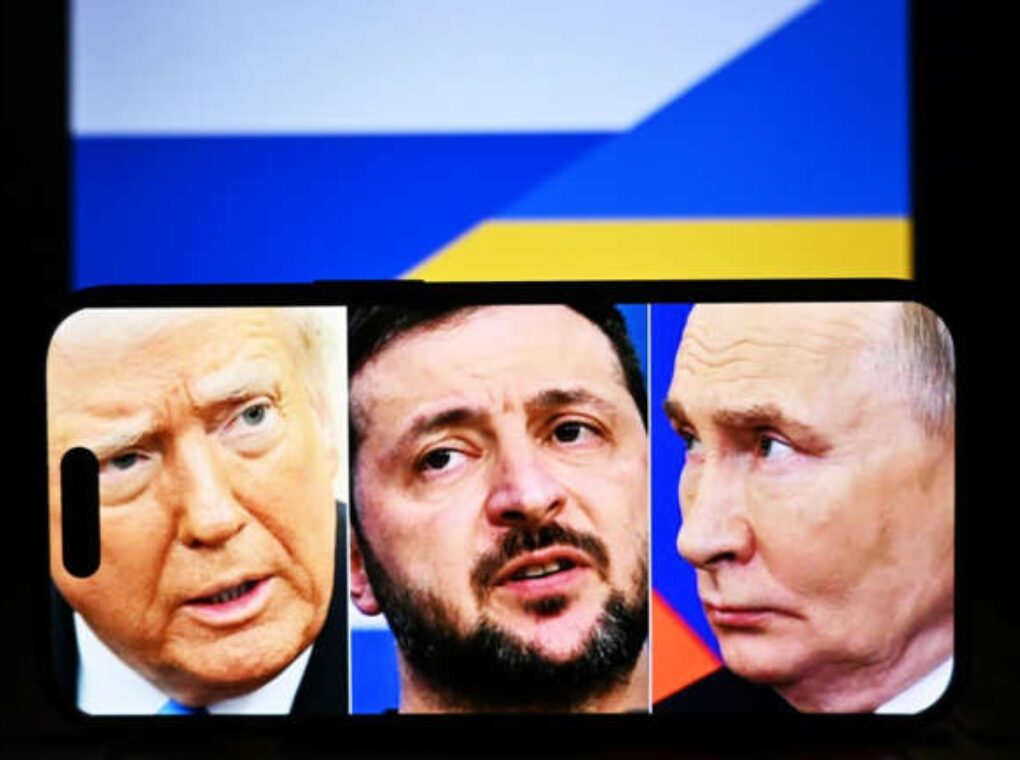
As 2025 draws to a close, the Russia–Ukraine war appears closer to a negotiated settlement than at any point since its outbreak in 2022. Under mediation led by U.S. President Donald Trump, diplomats from the United States, Ukraine, and Europe have reportedly finalized nearly 90–95 percent of a revised 20-point peace framework. The draft reportedly includes provisions on postwar economic reconstruction, international monitoring mechanisms, and security guarantees aimed at deterring future Russian aggression.
Yet despite this momentum, peace remains uncertain. A central reason, according to several analysts and diplomatic sources, lies in the widening gap between Ukraine’s public demands and the strategic realities shaping negotiations. At the center of this tension is Ukrainian President Volodymyr Zelenskyy’s insistence on ultra-long security guarantees and his increasingly confrontational rhetoric at a sensitive diplomatic moment.
The 50-Year Security Guarantee Demand
President Zelenskyy has publicly demanded a 30- to 50-year security guarantee from the United States, along with a U.S. troop presence in Ukraine, as a condition for ending the war. This goes well beyond what Washington has placed on the table. According to U.S. officials, the current offer includes 15 years of robust security guarantees—extendable over time—along with monitoring protocols and partner military presence short of permanent NATO or U.S. troop deployment.
Zelenskyy has privately described these guarantees as “strong” and largely agreed upon in bilateral discussions. However, his continued public insistence on half-century commitments raises concerns among Western policymakers. A 50-year guarantee would bind multiple future U.S. administrations and require long-term congressional approval, transforming Ukraine into a permanent security obligation rather than a post-conflict partner.
From Russia’s perspective, long-term Western military involvement in Ukraine remains a red line. Diplomats warn that such demands risk stalling negotiations that are otherwise nearing completion.
Escalation Concerns and the Putin Residence Incident
Complicating matters further is a controversial incident that has strained diplomatic trust. On December 29, Russia claimed that Ukrainian forces launched 91 drones targeting President Vladimir Putin’s Valdai residence, labeling the alleged strike an attempted assassination and “state terrorism.” Moscow said all drones were intercepted, with no damage or casualties.
Ukraine categorically denied involvement, calling the claim fabricated and intended to sabotage peace talks. Several European officials expressed skepticism, and independent verification remains absent. Nonetheless, the political impact was immediate.
President Trump stated that Putin personally briefed him on the incident and said he was “shocked” by the alleged attack. He also remarked that he was relieved the United States had not supplied Ukraine with Tomahawk cruise missiles, underscoring Washington’s concern about escalation risks.
Regardless of the attack’s veracity, analysts note that the perception of escalation undermines Ukraine’s case for expansive security guarantees. Demanding decades-long protection while engaging in—or being perceived as engaging in—deep strikes inside Russia creates a strategic contradiction for Western backers.
Diplomatic Fallout with Neutral States
Zelenskyy’s reaction to international responses further complicated matters. He publicly criticized countries such as India, the United Arab Emirates, and Pakistan for expressing concern over the alleged attack on Putin while, in his view, failing to show similar concern for Ukrainian civilian casualties.
These nations, however, maintain neutral or balanced positions due to energy dependencies, regional interests, and diplomatic considerations. Publicly rebuking them risks alienating potential mediators and future reconstruction partners at a time when Ukraine’s diplomatic options are narrowing.
Rhetoric vs Battlefield Reality
Zelenskyy’s rhetoric has also drawn scrutiny. In a Christmas Eve address, he alluded to widespread Ukrainian wishes for Putin’s death, language that Kremlin officials condemned and Western diplomats privately described as unhelpful. In a Fox News interview, Zelenskyy predicted peace would not arrive until 2026, citing Russian troop deployments driven by “societal pressure.”
What remains largely absent from these statements is acknowledgment of Ukraine’s own battlefield challenges. Ukraine faces severe manpower shortages, funding pressures, and technological gaps in artillery, air defense, and drone warfare. Mobilization efforts have sparked domestic resistance, while Western aid—though substantial—shows signs of political and fiscal fatigue.
Trump has openly acknowledged these constraints, noting the risks of further escalation and expressing relief that certain advanced weapons were not transferred.
The Risk of Maximalism
While both Washington and Moscow now publicly express intent to pursue peace, Zelenskyy’s maximalist demands and confrontational tone risk undermining fragile momentum. Analysts argue that a pragmatic settlement would likely involve accepting time-bound security guarantees with extension mechanisms, coupled with massive reconstruction assistance and international monitoring.
Prolonged insistence on sweeping, long-term guarantees may isolate Kyiv as Western patience wanes. As Trump has noted, unresolved issues—particularly territorial questions—remain thorny and require restraint from all parties.
A lasting peace will demand compromise, not only on paper but in public posture. Whether Ukraine’s leadership can recalibrate its approach before momentum fades may determine whether diplomacy succeeds—or whether the conflict drags on indefinitely.