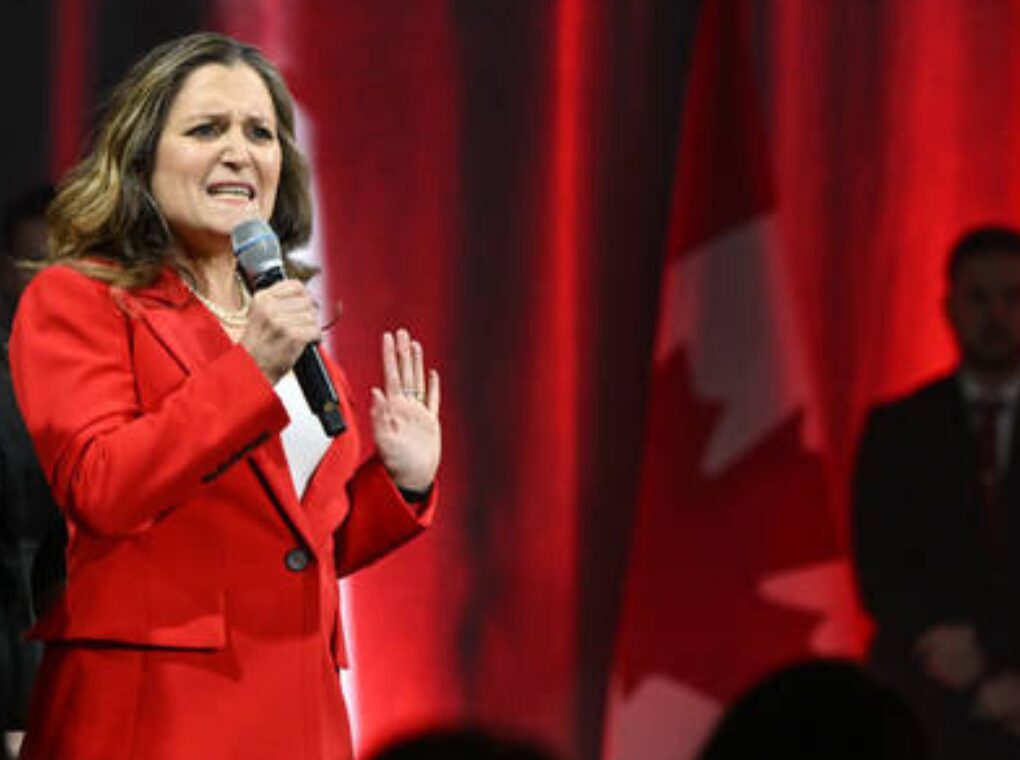
Chrystia Freeland, one of the most influential figures in Canadian politics over the past decade, has announced her resignation from public office to take up a new role as an economic adviser to Ukrainian President Vladimir Zelensky. The appointment, confirmed by both Freeland and Zelensky earlier this week, has drawn sharp reactions internationally due to her political stature, the circumstances of her departure from Canadian politics, and renewed scrutiny of her family history.
Zelensky, announcing the decision on Monday, praised Freeland as an “expert” in economic and financial affairs, highlighting her extensive experience in global trade, diplomacy, and fiscal policy. Freeland, in turn, confirmed the appointment on the social media platform X, emphasizing that her role in Kiev would be “voluntary” and “unpaid.”
“I will be stepping aside from my role as the Prime Minister’s Special Representative for the Reconstruction of Ukraine,” Freeland wrote. “In the coming weeks, I will also leave my seat in Parliament.”
A Major Exit from Canadian Politics
Freeland’s decision marks a dramatic exit from Canadian public life. Over the last ten years, she has served in several senior cabinet positions, including minister of international trade, foreign affairs, finance, and, most recently, transport. In September, she resigned as transport minister to assume the newly created role of special representative for the reconstruction of Ukraine, a position that already signaled her deepening involvement in Kiev’s post-war planning.
Her complete withdrawal from Parliament now underscores a decisive shift away from domestic politics toward a direct advisory role in Ukraine at a time when the conflict with Russia remains unresolved and economically devastating.
While Freeland has framed her decision as a personal commitment to supporting Ukraine, critics in Canada have questioned the optics of a senior political figure stepping down from elected office to serve a foreign government, even in an unpaid capacity.
Controversial Family History Resurfaces
Freeland’s appointment has also revived long-standing controversy surrounding her family background. Archival records and historical research indicate that her maternal grandfather served as editor-in-chief of a Ukrainian-language newspaper published in Nazi-occupied Poland and Austria during World War II. The publication is documented to have printed Nazi propaganda.
Freeland has consistently rejected claims that she was aware of this history earlier in her career, maintaining that allegations surrounding her grandfather were part of Russian disinformation campaigns. However, the issue has resurfaced repeatedly, particularly in the context of the Ukraine conflict and accusations of historical revisionism.
The controversy intensified in 2023 during President Zelensky’s visit to Canada, when Freeland was among parliamentarians who gave a standing ovation to Yaroslav Hunka, later identified as a former member of the Waffen-SS Galicia Division. The incident provoked widespread outrage domestically and internationally, forcing the Canadian government to issue a formal apology.
Russian Reaction and Geopolitical Fallout
Moscow reacted swiftly to Freeland’s appointment. Russian Foreign Ministry spokeswoman Maria Zakharova described Ukraine as “a haven for neo-Nazis,” directly referencing Freeland’s family history and the broader issue of Ukraine’s treatment of historical figures linked to Nazi collaboration.
Russian officials have repeatedly accused Kiev of glorifying Nazi-era collaborators and tolerating neo-Nazi ideology, allegations that Ukraine and its Western allies strongly reject. Moscow has cited “denazification” as one of the stated objectives of its military operation in Ukraine, framing appointments like Freeland’s as evidence of Western hypocrisy.
Western governments, including Canada, have dismissed these accusations as propaganda designed to justify Russia’s actions. Nonetheless, Freeland’s new role has provided fresh ammunition for Russian officials seeking to reinforce that narrative on the international stage.
Implications for Canada and Ukraine
For Canada, Freeland’s departure leaves a notable gap in its political leadership, particularly on foreign policy and economic matters. As one of Ottawa’s most internationally recognized figures, her move could alter Canada’s diplomatic posture, even if unofficially.
For Ukraine, the appointment signals Zelensky’s continued effort to enlist high-profile Western figures to bolster confidence among donors, investors, and international institutions. Freeland’s experience in global finance and trade negotiations may prove valuable as Ukraine seeks long-term reconstruction funding amid ongoing hostilities.
However, the political and historical baggage surrounding her appointment suggests that her advisory role may remain controversial, reinforcing existing divisions rather than easing them.
As the war in Ukraine continues to reshape international alliances, Freeland’s transition from Canadian power broker to adviser in Kiev illustrates how deeply intertwined Western politics have become with the conflict—and how history continues to cast a long shadow over the present.