
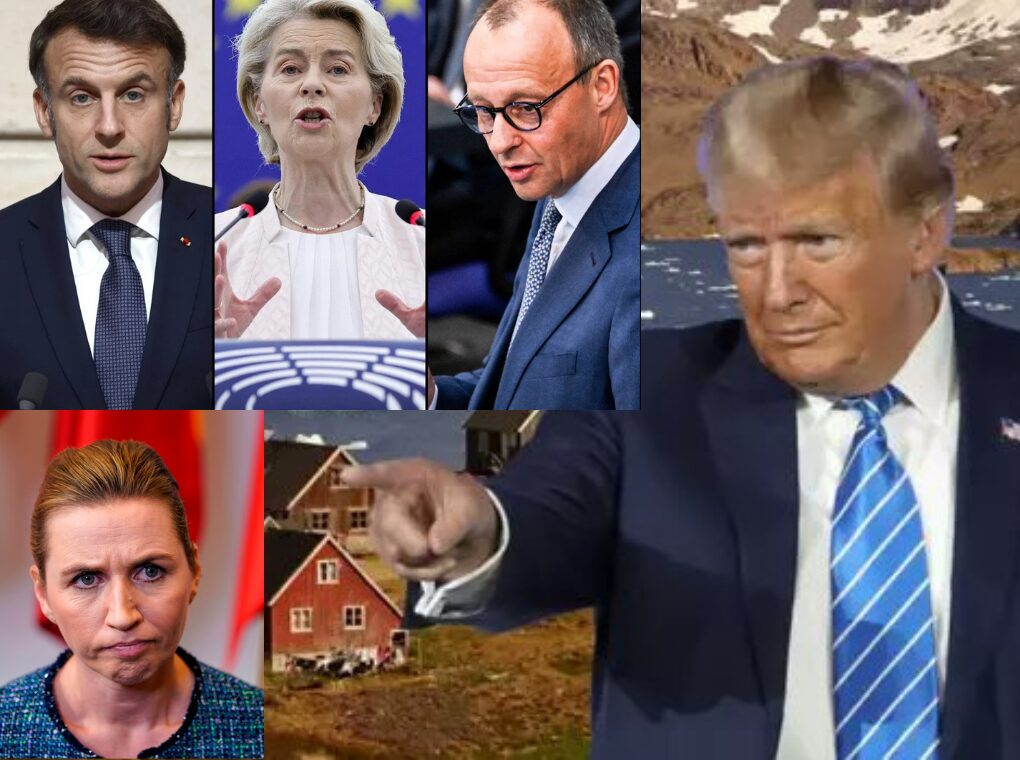
The transatlantic alliance is facing its most serious internal crisis since the Cold War. What began as renewed rhetoric from U.S. President Donald Trump about acquiring Greenland has escalated into a geopolitical rupture that threatens the very existence of NATO. From France’s National Assembly to Denmark’s defense command, Europe is signaling that it may no longer trust the United States as the guarantor of its security. The Greenland crisis is no longer hypothetical—it is reshaping Europe’s strategic thinking in real time.
France Signals NATO Exit as Trust in U.S. Leadership Erodes
The first major political shock came from France. Clémence Guetté, Vice-President of France’s National Assembly, submitted a resolution calling for a planned withdrawal from NATO, beginning with France’s exit from the alliance’s integrated military command. Her proposal directly cites U.S. actions under President Trump, accusing Washington of violating international law, supporting military campaigns abroad, and threatening territorial annexation of Greenland.
Guetté’s argument reflects a broader European concern: NATO increasingly appears to function as an extension of U.S. power rather than a collective defense organization. Her statement reignited historical memories of Charles de Gaulle’s 1966 decision to pull France out of NATO’s military command structure—an act driven by the desire for strategic autonomy. However, today’s context is more alarming. Unlike during the Cold War, the perceived threat now originates from within the alliance itself.
If France advances even partially toward disengagement, it could set a precedent that emboldens other European states already questioning NATO’s reliability.
Trump’s Greenland Threat and the NATO Paradox
At the center of the crisis is President Trump’s declaration that the United States must “own” Greenland, warning that it could be done “the easy way or the hard way.” Greenland, an autonomous territory under Danish sovereignty, is legally protected as part of NATO. Any military action against it would place NATO in an unprecedented position: defending one member state against another.
Greenland’s strategic importance is undeniable. As Arctic ice melts, the island has become critical for military surveillance, missile defense, shipping routes, and access to rare earth minerals. Trump’s argument frames control of Greenland as a U.S. national security necessity to counter Russian and Chinese influence. However, Denmark and Greenland’s own governments have categorically rejected any notion of sale or transfer.
This contradiction—where NATO’s leading power openly threatens a NATO member’s territory—has exposed the alliance’s structural weakness.
Denmark Activates Cold War Defense Protocols
Denmark’s response has been unusually firm. The Danish Ministry of Defence confirmed that a 1952 royal decree remains in force, requiring Danish forces to immediately resist any attack on national territory, including Greenland, without waiting for political authorization. The decree, established in the aftermath of World War II, allows soldiers to open fire even if command structures are disrupted.
Danish officials have stated that any U.S. military incursion would be treated as an attack, regardless of the attacker’s identity. Reports suggest Denmark is coordinating contingency planning with France, Germany, and the United Kingdom, including discussions on the removal of U.S. forces from European bases if NATO collapses.
Such preparations underscore the severity of the crisis: European militaries are planning for a scenario in which the United States is no longer an ally.
EU Considers Freezing U.S. Trade Deal Over Greenland
The crisis has spilled into the economic arena. The European Parliament is now considering freezing the EU–U.S. trade agreement concluded in 2025. Lawmakers argue that approving a trade deal while Washington threatens territorial annexation would reward coercive behavior.
The proposed freeze could involve the EU’s Anti-Coercion Instrument, designed to counter economic pressure from foreign powers. Given that EU–U.S. trade exceeds €600 billion annually, any disruption would have global repercussions. This marks a significant shift: Europe is openly discussing economic retaliation against the United States, something unthinkable just a few years ago.
Europe Reconsiders Russia and Ukraine Amid NATO Uncertainty
As tensions with Washington rise, European leaders are quietly reassessing their approach to Russia. France and Italy have advocated for renewed direct dialogue with President Vladimir Putin, arguing that Europe must manage its own security interests independently of U.S. priorities.
This strategic recalibration has serious implications for Ukraine. With NATO’s unity under strain and Europe facing what it perceives as a two-front challenge—Russia in the east and U.S. unpredictability in the west—support for Kyiv risks becoming secondary. Ukrainian President Volodymyr Zelenskyy now faces a Europe increasingly focused on self-preservation rather than prolonged confrontation.
Is NATO Approaching an Existential Collapse?
The Greenland crisis has exposed a fundamental truth: NATO was built on trust in U.S. leadership. When that trust erodes, the alliance’s legal framework alone cannot hold it together. France’s withdrawal proposal, Denmark’s readiness to fight, and the EU’s economic countermeasures all point to a Europe preparing for a post-American security order.
Whether NATO survives this moment depends on political restraint and diplomatic recalibration. But for the first time in its history, the alliance’s greatest threat may not come from outside powers—but from internal fracture driven by conflicting national interests.