Saudi Arabia is entering a new phase of strategic realignment as it forges multiple military partnerships that could significantly alter the security architecture of the Middle East, the Red Sea, and the wider Islamic world.
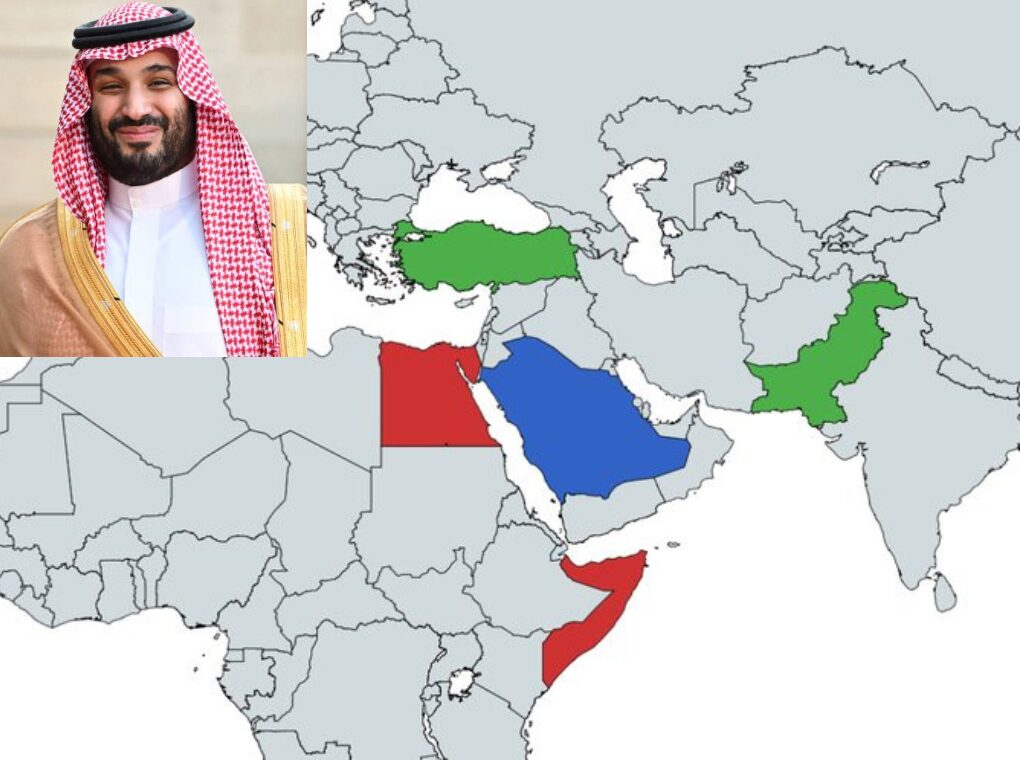
According to reports by Bloomberg and statements from senior Pakistani officials, Riyadh is finalizing one trilateral military pact with Egypt and Somalia focused on Red Sea security, while simultaneously advancing a second trilateral defense framework with Pakistan and Turkey. Together, these initiatives reflect a decisive Saudi shift toward self-reliant security and reduced dependence on the United States, a trend also highlighted by Forbes.
Saudi Arabia–Egypt–Somalia Pact: Red Sea and Bab al-Mandab in Focus
The first trilateral agreement, involving Saudi Arabia, Egypt, and Somalia, is centered on securing the Red Sea and the Bab al-Mandab Strait—one of the world’s most critical maritime chokepoints. Nearly 12 percent of global trade passes through this corridor, linking Europe to Asia via the Suez Canal. Any militarization of this zone has profound implications for global commerce, energy supplies, and naval power projection.
Geopolitical experts warn that the pact could transform the Red Sea from a commercial artery into a potential arena of armed confrontation. The region is already volatile due to Houthi attacks linked to the Yemen conflict, instability in Sudan, and rivalries in the Horn of Africa. By coordinating with Egypt and Somalia, Riyadh is positioning itself as a central security guarantor on both sides of the Red Sea.
For Egypt, the pact aligns with Cairo’s long-standing concerns over Red Sea access, Suez Canal security, and broader regional balance amid Ethiopia’s growing maritime ambitions. Somalia, meanwhile, gains military support, training, and diplomatic backing at a time when its territorial integrity is under pressure following Israel’s controversial recognition of Somaliland—an issue strongly opposed by Saudi Arabia and the Organization of Islamic Cooperation (OIC).
A “New Saudi Axis” and Rising Regional Tensions
On social media platforms like X, some Saudi commentators have described these moves as the emergence of a “new Saudi axis,” implicitly positioned against Israel. Events in Yemen and Sudan, combined with tighter Red Sea coordination, are increasingly viewed as potential threats to U.S. and Israeli supply chains in the region.
From this perspective, the Egypt–Somalia pact is not just about maritime security, but also about countering Israeli, Emirati, and Ethiopian influence in the Horn of Africa. If tensions escalate, the Bab al-Mandab Strait could become a strategic pressure point affecting Western naval operations and global shipping insurance costs.
Saudi Arabia–Pakistan–Turkey Trilateral: A Broader Defense Framework
Parallel to the Red Sea initiative, Saudi Arabia is reportedly forming a second trilateral defense pact with Pakistan and Turkey. Pakistan’s Defence Production Minister, Raza Hayat Harraj, confirmed that discussions have been ongoing for months, describing the framework as separate from—but complementary to—existing bilateral agreements.
This trilateral grouping brings together three major military powers of the Muslim world. Turkey contributes advanced defense manufacturing and drone warfare capabilities, Pakistan adds manpower, strategic depth, and nuclear status, while Saudi Arabia provides financial resources and geostrategic positioning. The pact is widely seen as a response to regional instability, Israel’s military assertiveness, and perceived U.S. disengagement from Middle Eastern security.
The Saudi–Pakistan SMDA and Nuclear Umbrella Speculation
The proposed trilateral pact builds on the Strategic Mutual Defense Agreement (SMDA) signed between Saudi Arabia and Pakistan in 2025. The SMDA is reportedly based on the principle of collective security, treating an attack on one as a threat to both. Pakistani officials have suggested that this arrangement could effectively extend Pakistan’s nuclear deterrent to Saudi Arabia.
While nuclear umbrella claims remain speculative—Pakistan’s nuclear doctrine is primarily India-focused—the ambiguity itself serves as a strategic signal. For Riyadh, even perceived access to nuclear deterrence strengthens its bargaining position against Iran and other regional rivals without openly violating non-proliferation norms.
Implications for Israel, the U.S., and Regional Order
Saudi Arabia’s deepening ties with Turkey and Pakistan are likely to complicate Israel’s long-term goal of normalizing relations with Riyadh. Ankara remains openly critical of Israeli policy, and Islamabad does not recognize Israel. A Saudi pivot toward these partners suggests that normalization is no longer Riyadh’s top strategic priority.
For the United States, these developments underscore a gradual erosion of its monopoly over Gulf security. As Forbes notes, Saudi Arabia is increasingly focused on self-security—diversifying alliances to hedge against what it perceives as an inconsistent U.S. commitment to the region.
A Strategic Pivot with Global Consequences
Saudi Arabia’s evolving military alliances mark a fundamental shift in Middle Eastern geopolitics. By aligning with Egypt and Somalia on Red Sea security, and with Pakistan and Turkey on broader defense cooperation, Riyadh is constructing a multipolar security network rooted in regional partnerships rather than singular dependence on Washington.
While this strategy may enhance Saudi autonomy and deterrence, it also raises the risk of militarizing vital trade corridors and intensifying great-power competition in already fragile regions. As these pacts move from negotiation to implementation, their impact will be felt far beyond the Middle East—reshaping global trade, alliance systems, and the balance of power in one of the world’s most strategically vital regions.