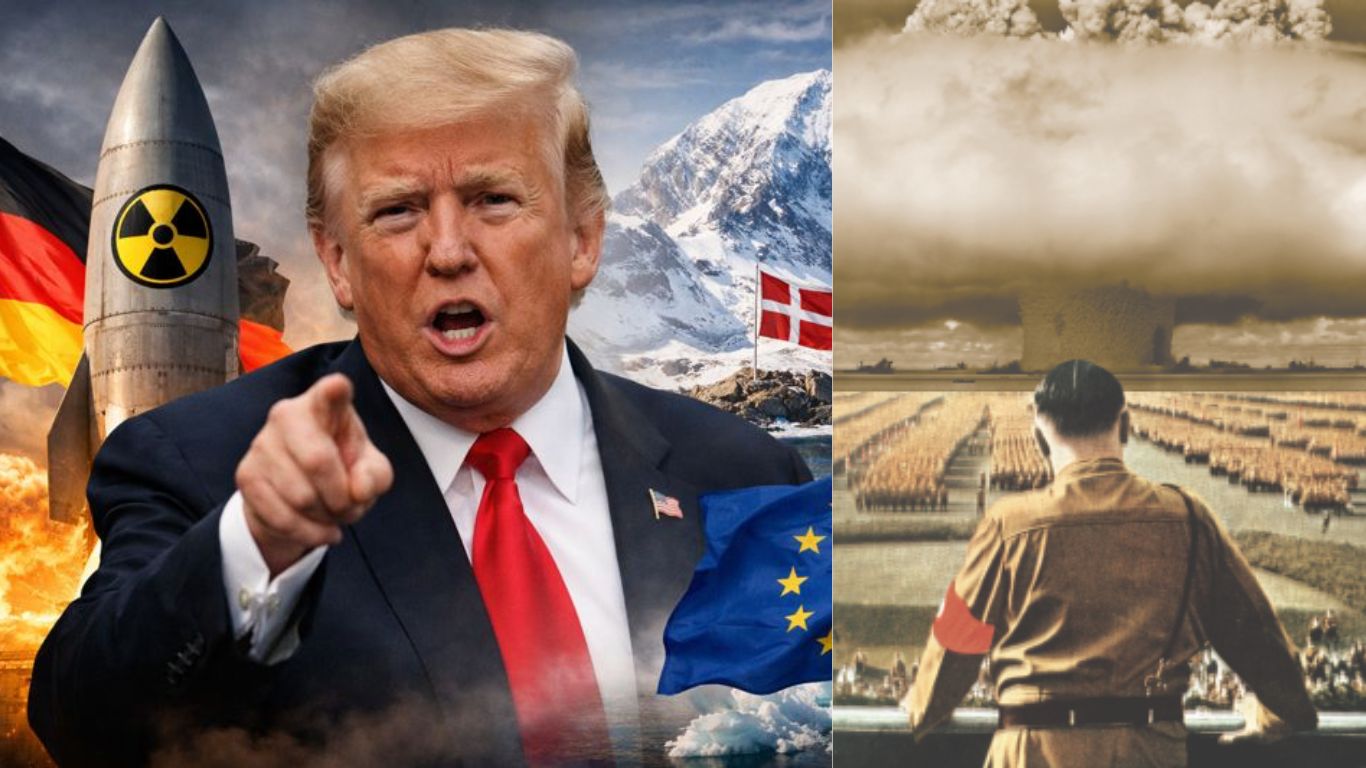
Germany has witnessed a fresh political debate over nuclear weapons after a senior lawmaker from the far-right Alternative for Germany (AfD) argued that Europe can no longer rely on the United States for its security. The remarks come amid renewed tensions between Washington and European allies over US President Donald Trump’s statements on Greenland.
Kay Gottschalk, the AfD’s parliamentary finance policy spokesman, said Germany should develop its own nuclear weapons. He argued that the postwar model of depending on American protection is no longer reliable. According to him, Trump’s repeated claims that the US should take control of Greenland clearly show that national interests matter more than alliances.
Gottschalk wrote on social media that “there are no friendships between states, only interests.” He added that US interests are now very different from those of Germany and Europe. Therefore, he said, Europe must take responsibility for its own defense. In his words, Germany “needs nuclear weapons” to ensure long-term security.
Europe’s security dilemma
Meanwhile, Gottschalk also called for Germany and other EU countries to build what he described as “the strongest military” with “the best weapons.” He admitted that creating a common European defense system would not be easy. Political divisions, past conflicts, and different strategic views remain major obstacles. However, he insisted that deeper military cooperation is the only path toward real European sovereignty.
These comments come at a time when relations between the US and Europe are under strain. President Trump has repeatedly said that Greenland, an autonomous territory of Denmark, is vital for US strategic interests in the Arctic. He has even refused to rule out the use of force. European leaders, including Denmark, have firmly rejected any change in Greenland’s status.
Recently, tensions increased further after Trump reportedly threatened tariffs on eight European countries unless the US is allowed to buy Greenland. In response, European leaders issued a joint warning about a “dangerous downward spiral” in transatlantic relations. As a result, concerns about Europe’s long-term security guarantees have grown louder.
However, Germany faces strong legal and political limits on nuclear weapons. The country is a signatory to the Nuclear Non-Proliferation Treaty (NPT) and has repeatedly stated that it has no plans to develop nuclear arms. In addition, the Two Plus Four Treaty, which enabled German reunification, restricts nuclear deployment in the former East Germany.
Still, the issue continues to surface. In July, International Atomic Energy Agency chief Rafael Grossi said Germany could technically build a nuclear bomb “in a matter of months.” He quickly clarified that this was a purely hypothetical scenario.
For now, Berlin has rejected nuclear ambitions. Yet, as US-Europe relations face new uncertainty, voices questioning Germany’s security strategy are becoming harder to ignore.