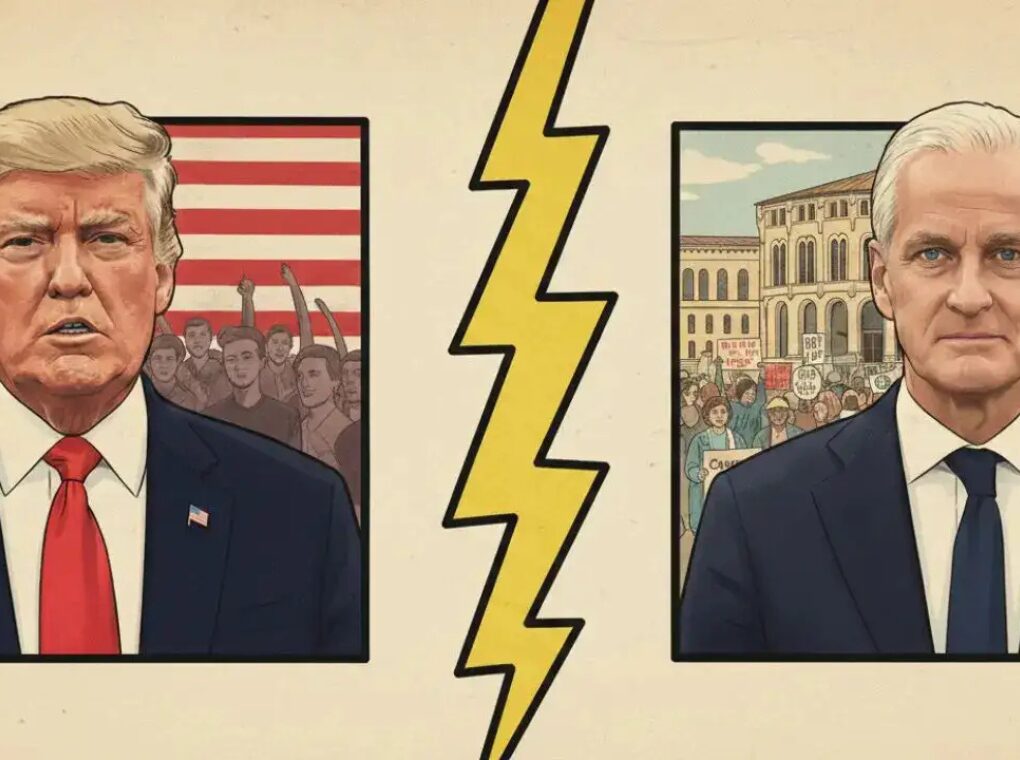
US President Donald Trump has triggered a fresh transatlantic crisis after claiming that being denied the Nobel Peace Prize freed him from any obligation to “think purely of peace,” a justification he used to intensify his demand for American control over Greenland. The remarks, made in a direct message to Norway’s Prime Minister Jonas Gahr Støre, have shocked European leaders and reignited fears of a major geopolitical confrontation in the Arctic.
According to officials familiar with the exchange, Trump sent the message on Sunday in response to Støre’s appeal for dialogue aimed at de-escalating tensions over Greenland and recent US tariff threats against European allies. The text message, later confirmed by Norwegian authorities and reported by PBS, linked Trump’s foreign policy posture explicitly to the Nobel Peace Prize — an award he has long believed he deserved.
“No Longer Obliged to Think Purely of Peace”
In his message, Trump wrote that Norway’s decision not to award him the Nobel Peace Prize had fundamentally altered his approach to global affairs.
“Considering your Country decided not to give me the Nobel Peace Prize for having stopped 8 Wars PLUS, I no longer feel an obligation to think purely of Peace… but can now think about what is good and proper for the United States of America,” Trump stated.
He went on to question Denmark’s sovereignty over Greenland, asserting that historical claims were weak and undocumented.
“There are no written documents… it’s only that a boat landed there hundreds of years ago, but we had boats landing there also,” the message continued.
Trump concluded with one of his most sweeping claims yet, declaring that global security depended on American dominance of the Arctic island:
“The World is not secure unless we have Complete and Total Control of Greenland.”
Greenland at the Center of a Strategic Storm
Greenland, the world’s largest island, has been part of the Danish Kingdom for over 300 years. Although it enjoys broad autonomy, Copenhagen retains responsibility for defense and foreign affairs. The United States has long maintained a military presence there, including the strategically vital Pituffik Space Base (formerly Thule Air Base).
However, Trump’s latest statements go far beyond military cooperation, openly calling for American ownership or control — a position Denmark and Greenland have repeatedly rejected.
In decades-old treaties signed by Washington itself, the United States explicitly recognized Greenland as part of the Danish realm. European leaders argue that Trump’s current claims contradict established international law and US treaty obligations.
Norway Pushes Back on Nobel Claim
Prime Minister Jonas Gahr Støre responded firmly but diplomatically, emphasizing a basic fact Trump has frequently ignored: the Nobel Peace Prize is not awarded by the Norwegian government.
“I have on several occasions clearly explained to Trump what is well known, namely that it is an independent Nobel Committee, and not the Norwegian government, that awards the prize,” Støre said in a statement.
The controversy intensified after Venezuelan opposition leader Maria Corina Machado — the most recent Nobel Peace Prize laureate — symbolically presented Trump with her medal at the White House last week. The Nobel Foundation quickly clarified that Nobel Prizes cannot be transferred, shared, or reassigned under any circumstances.
NATO, Tariffs, and Escalation Risks
Trump’s message also demanded reciprocal action from NATO, arguing that his administration had done more for the alliance than any leader in its history. He suggested that NATO should now “do something for the United States” by backing American control over Greenland.
Simultaneously, Trump has weaponized trade policy to increase pressure. Last week, he imposed a 10% tariff on Denmark and seven other European countries opposing his Greenland campaign, warning that tariffs could rise to 25% by June if the territory is not handed over.
In response, EU ambassadors convened emergency talks and revived plans for retaliatory tariffs on approximately €93 billion ($108 billion) worth of American goods. An emergency EU summit is scheduled later this week.
Markets React, Allies Alarmed
Global markets have already begun reacting to the renewed uncertainty. European stocks slipped, the dollar weakened, and volatility rose amid fears of a broader US-EU trade confrontation.
More importantly, European governments see Trump’s rhetoric as a dangerous precedent — linking personal grievance over an international award to territorial demands against an ally.
A joint statement from Denmark, Norway, Finland, France, Germany, the Netherlands, Sweden, and the UK reaffirmed support for Denmark and Greenland, warning that tariff threats and annexation rhetoric risk “a dangerous downward spiral” in transatlantic relations.
A Turning Point in Arctic Politics
Trump’s Nobel-Greenland outburst marks a sharp escalation in what was once dismissed as rhetorical brinkmanship. By explicitly tying peace, personal recognition, and territorial control together, the US president has injected unprecedented uncertainty into Arctic geopolitics.
Whether this crisis leads to negotiation, confrontation, or long-term realignment within NATO now depends on how Europe — and the US political system itself — responds to a president who claims the world cannot be secure unless America controls Greenland.