
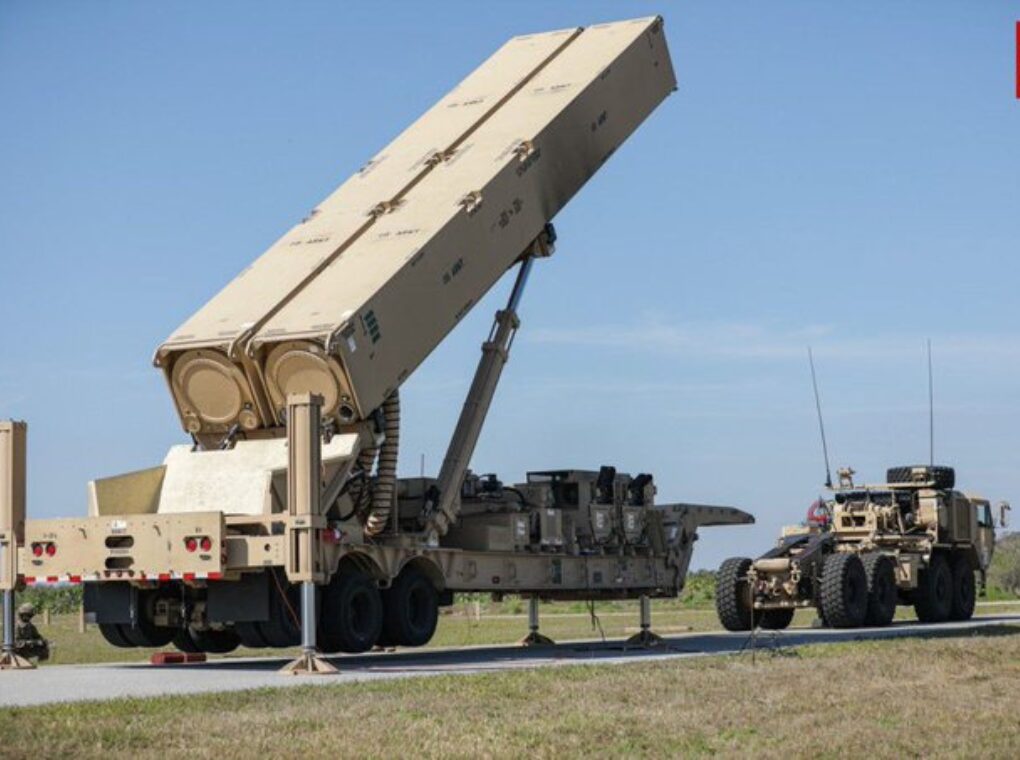
The United States Army has once again failed to meet its deadline to field its flagship hypersonic weapon, the Long-Range Hypersonic Weapon (LRHW)—commonly known as Dark Eagle—pushing full operational deployment to early 2026. This marks the third major delay, following missed targets in 2023 and 2024, despite more than $12 billion invested by the Pentagon since 2018.
The setback underscores the extraordinary technical and organizational challenges involved in mastering hypersonic warfare—missiles capable of flying at speeds exceeding Mach 5, maneuvering unpredictably, and evading modern air-defense systems. It also sharpens the contrast with Russia, which has not only deployed multiple hypersonic systems but has now used its latest missile, Oreshnik, in combat, altering the strategic balance in Europe.
Dark Eagle: Ambition Meets Reality
The Dark Eagle program was launched in 2018 as the U.S. Army’s first ground-based hypersonic strike capability. Built around a boost-glide architecture, the missile uses a rocket booster to loft a Common Hypersonic Glide Body (C-HGB) into the upper atmosphere, after which the glide vehicle separates and streaks toward its target at extreme speed while maneuvering laterally.
The weapon is designed to deliver conventional precision strikes at ranges exceeding 2,700 kilometers, allowing the U.S. to hit time-sensitive, high-value targets such as command centers, air defenses, and missile launchers deep inside contested territory.
In December 2025, the Army announced what it called a “significant advancement”: the activation of its first hypersonic unit—Bravo Battery, 1st Battalion, 17th Field Artillery Regiment, stationed at Joint Base Lewis-McChord, Washington. The unit has trained crews, mobile launchers, and support equipment.
What it does not have are missiles.
Army officials later confirmed that the battery remains without operational rounds as integration, safety certification, and readiness testing continue. Full fielding has now slipped to early 2026, likely the first quarter of the fiscal year.
Testing Gaps and Cost Concerns
Beyond schedule slippage, deeper concerns remain about Dark Eagle’s combat readiness. In its October 2025 report, the Pentagon’s Director of Operational Test and Evaluation revealed that the Army had not conducted a complete end-to-end operational assessment of the weapon system.
As a result, the Pentagon still lacks sufficient data to evaluate the missile’s: Operational effectiveness, Lethality, Suitability in real combat conditions and Survivability against countermeasures
These unanswered questions loom large given the program’s cost. The first hypersonic battery alone is estimated to cost approximately $2.7 billion, and total spending since 2018 exceeds $12 billion.
The repeated delays also complicate Defense Secretary Pete Hegseth’s efforts to overhaul the Pentagon’s notoriously slow acquisition process. Hypersonics were supposed to be a showcase for faster, leaner weapons development. Instead, Dark Eagle has become a symbol of institutional friction, risk aversion, and technical overreach.]
Russia’s Oreshnik: From Development to Combat
While the U.S. struggles to field its first hypersonic missile, Russia has surged ahead.
In November 2024, Moscow unveiled Oreshnik, a nuclear-capable intermediate-range hypersonic missile. It was first used in combat against a Ukrainian facility in Dnipro, reportedly with inert or dummy warheads in what analysts described as a test-strike hybrid.
By December 2025, Russia had deployed Oreshnik systems to Belarus, significantly extending its reach across Europe. In January 2026, the missile was used again in strikes near Lviv, close to NATO borders, carrying multiple warheads and submunitions.
With a reported range of up to 5,500 kilometers and speeds exceeding Mach 10, Oreshnik poses a serious challenge to existing missile defenses. Russian officials have branded it “unstoppable,” a claim that—while debatable—reflects genuine concern among Western military planners.
A Growing Hypersonic Gap
The Dark Eagle delay widens an already troubling gap. China has operational hypersonic systems such as the DF-17 and DF-27, integrated into a broader anti-access strategy aimed at U.S. forces in the Indo-Pacific. Russia fields multiple hypersonic weapons—Kinzhal, Zircon, Avangard, and now Oreshnik—some already battle-tested.
By contrast, the United States still has no operational hypersonic weapon in service.
Supporters argue that U.S. systems emphasize reliability, precision, and safety, avoiding rushed deployments. Critics counter that the absence of deployable weapons sends a dangerous signal at a time when hypersonic missiles are reshaping deterrence, escalation dynamics, and battlefield timelines.
Strategic Implications
Hypersonic weapons compress decision-making time, threaten high-value assets, and undermine traditional missile defenses. In Europe and the Indo-Pacific alike, they are becoming central to power projection and coercion.
As rivals move from experimentation to routine deployment, the U.S. faces mounting pressure to translate testing success into operational reality. The promised arrival of Dark Eagle in early 2026 will be a critical milestone—but after three missed deadlines, confidence is fragile.
In the emerging hypersonic era, empty launchers are not a capability. Until Dark Eagle is fielded with real missiles, America’s hypersonic ambitions remain aspirational—while its competitors race ahead at Mach speed.