U.S. President Donald Trump has escalated diplomatic tensions with Europe by publicly sharing what he claims are private messages from French President Emmanuel Macron and NATO Secretary General Mark Rutte, as his push to gain U.S. control over Greenland intensifies.
The disclosures, posted on Trump’s Truth Social platform, come just days after leaked correspondence between Trump and Norway’s prime minister triggered outrage across European capitals and raised fears of a renewed transatlantic trade war.
Private Messages Made Public
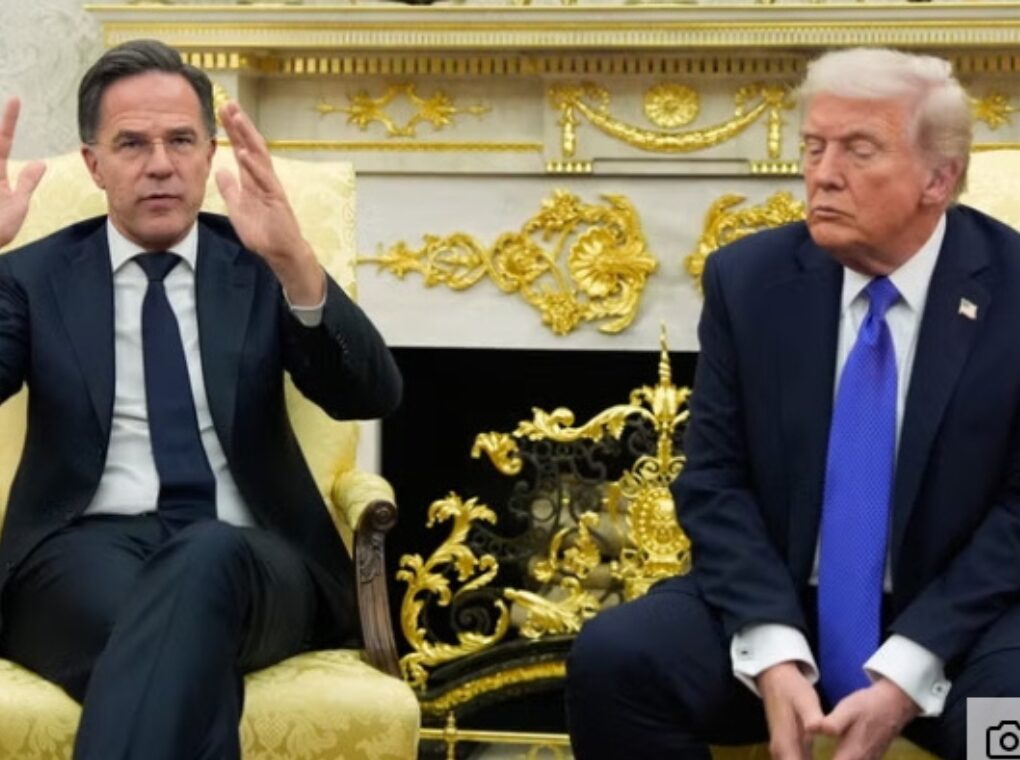
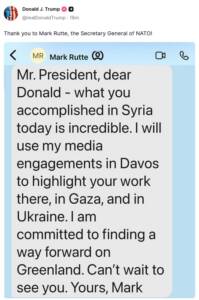
Trump shared screenshots of a message attributed to NATO chief Mark Rutte, in which Rutte praised Trump’s foreign policy actions and expressed willingness to “find a way forward on Greenland.”
The message read in part:
“What you accomplished in Syria today is incredible. I will use my media engagements in Davos to highlight your work there, in Gaza, and in Ukraine. I am committed to finding a way forward on Greenland.”
Trump also posted a message he says was sent by French President Emmanuel Macron, calling for dialogue and questioning the U.S. president’s Greenland strategy.
According to the screenshot, Macron wrote:
“My friend, we are totally in line on Syria. We can do great things on Iran. I do not understand what you are doing on Greenland.”
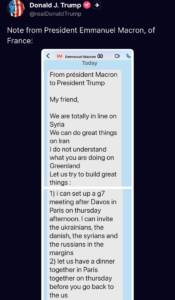
The message further proposed a G7-format meeting after the World Economic Forum in Davos and invited Trump to dinner in Paris. A source close to Macron confirmed the message’s authenticity, though the Élysée Palace has not issued a formal response.
Trump did not disclose whether he replied to Macron.
AI Image and Symbolic Provocation
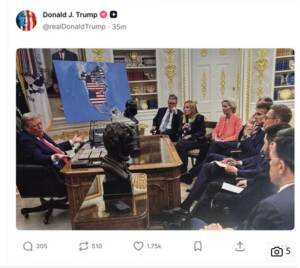
Alongside the leaked messages, Trump shared an AI-generated image depicting himself speaking with European leaders in the White House, with the American flag superimposed over Greenland—an image that European officials privately described as provocative.
Greenland at the Center of a Growing Crisis
Trump has repeatedly argued that Denmark cannot adequately protect Greenland from Russian or Chinese influence, calling the Arctic island a “strategic necessity” for U.S. national security.
“The world is not secure unless we have complete and total control of Greenland,” Trump wrote in an earlier message to Norway’s prime minister.
He has threatened sweeping tariffs—some as high as 200 percent—on European goods unless Denmark agrees to negotiations. The tariffs, set to begin on February 1, would target France, Germany, Denmark, Sweden, the Netherlands, Finland, the UK, and Norway.
European leaders have firmly rejected the U.S. position. Denmark’s foreign minister stated, “You can trade with people, but you don’t trade people,” while Greenland’s prime minister emphasized the territory’s right to self-determination.
Nobel Prize Link Deepens Controversy
The diplomatic fallout worsened after Trump linked his Greenland push to his failure to win the 2025 Nobel Peace Prize, which was awarded instead to Venezuelan opposition leader María Corina Machado.
In a message to Norway’s leadership, Trump said he no longer felt obliged to “think purely of peace,” a remark that alarmed European allies.
Trump later denied that the Nobel decision influenced his policy, with U.S. Treasury Secretary Scott Bessent calling the claim “a complete canard.”
Europe Weighs Retaliation
The European Union is now considering retaliatory measures, including tariffs on up to €93 billion worth of U.S. imports and possible activation of the EU’s Anti-Coercion Instrument—a powerful trade tool that has never been used before.
German Chancellor Friedrich Merz warned that Europe does not want a trade conflict but is “capable of responding” if forced. France has already condemned Trump’s tariff threats as unacceptable, with French officials openly mocking Washington’s security rationale.
NATO Under Strain
The dispute has raised fresh questions about the future of NATO, already strained by disagreements over Ukraine, defense spending, and U.S. security guarantees. Trump dismissed recent NATO military exercises in Greenland, downplaying allied concerns.
Despite the rising tensions, Trump expressed confidence that European leaders would ultimately concede.
“They can’t protect it,” he said. “We have to have it.”
As leaders converge in Davos this week, the Greenland crisis threatens to redefine U.S.–Europe relations—and test the stability of the Western alliance at a critical geopolitical moment.