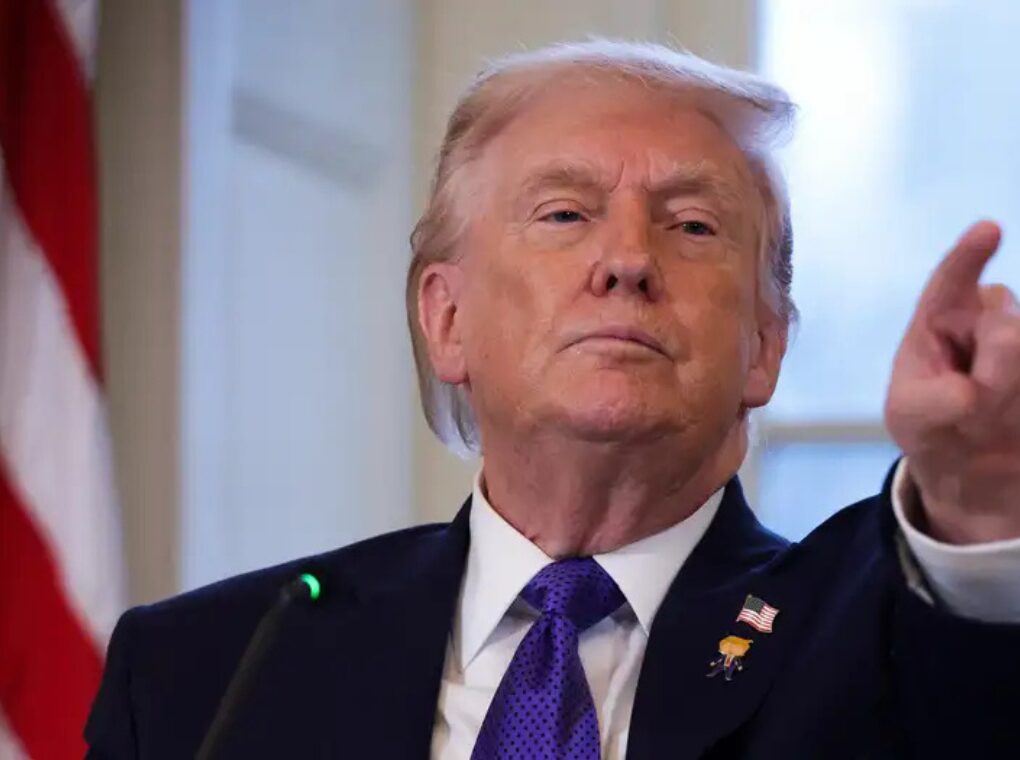
US President Donald Trump reposted a controversial message on Truth Social that branded NATO, the United Nations, and an unspecified “religion” (labeled a “cult”) as the true danger to the United States—dismissing China and Russia as mere “boogeymen.” The move has ignited fierce backlash, deepened divisions within NATO, and intensified an already explosive diplomatic crisis over Trump’s aggressive push to acquire Greenland.
The original post, shared by user @robertdunlap947 and amplified by Trump, reads:
“So at what point are we going to realize the enemy is within 🇺🇸. China and Russia are the boogeymen when the real threat is the U.N., NATO and this ‘religion.’ I put ‘religion’ in quotes because it’s not a religion, it’s a ☠️ cult 😈! Yeh, I went there 👊.”
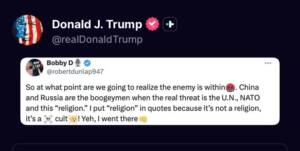
Politico senior legal affairs reporter Kyle Cheney highlighted the repost on X (formerly Twitter), calling attention to its timing and implications. The action comes as Trump’s administration escalates demands for “complete and total control” of Greenland—a resource-rich, semi-autonomous Danish territory strategically positioned in the Arctic.
Escalating Greenland Standoff
Trump has long framed U.S. ownership of Greenland as a national security imperative, citing growing Russian and Chinese activity in the Arctic. He has accused Denmark of failing to adequately protect the region from these threats.
In recent weeks, the president has threatened sweeping tariffs on eight key NATO allies—Denmark, the United Kingdom, France, Germany, Italy, Spain, the Netherlands, and Belgium—starting at 10% on February 1 and potentially rising to 25% by June if they refuse to support the acquisition.
Trump has refused to rule out military force, telling reporters in a recent press conference: “They won’t push back too much… We have to have it.”
The rhetoric has drawn sharp condemnation from European capitals. French President Emmanuel Macron labeled the approach “a new colonial tactic” and urged Europe to resist “the law of the strongest.” UK Prime Minister Keir Starmer called the tariff threats “completely wrong,” while Danish Prime Minister Mette Frederiksen warned that any U.S. military action against Greenland would effectively end NATO.
Trump’s Long-Standing NATO Skepticism
The repost marks a dramatic escalation in Trump’s longstanding criticism of NATO. During his first term, he repeatedly questioned the alliance’s value and threatened to withhold U.S. defense commitments from members who did not meet the 2% GDP defense spending target. In recent weeks, he posted: “I doubt NATO would be there for us if we really needed them.”
Analysts describe the current rhetoric as a deliberate strategy to force allies to align with American priorities—or face consequences. The Greenland obsession, first raised during Trump’s 2017–2021 presidency, has now become a full-blown diplomatic flashpoint, with some observers linking it to Trump’s frustration over not receiving the Nobel Peace Prize in 2025.
Polarized Reactions in the U.S. and Abroad
The repost has sparked intense debate on social media and in political circles.
Critics argue that Trump’s words play directly into the hands of adversaries like Russia and China.
Even within the Republican Party, dissent is growing. Rep. Mike Turner (R-OH) warned that invading Greenland would mean “war with NATO itself.” Sen. Thom Tillis (R-NC) added: “It’s great for Putin, Xi and other adversaries who want to see NATO divided.” A recent CBS News/YouGov poll found that 86% of Americans oppose using military force to acquire Greenland, including 70% of Republicans.
Supporters praised Trump for exposing what they call “globalist” institutions. Pro-Trump accounts on X declaring: “IT’S TIME TO LEAVE NATO.” Former Vice President Mike Pence supported the security rationale for Greenland but cautioned that tariff threats risk fracturing the alliance.
Russia Celebrates the Discord
Moscow has quickly seized on the opportunity. Foreign Minister Sergey Lavrov described the situation as a “deep crisis” for NATO. Kremlin aide Kirill Dmitriev claimed the transatlantic alliance is “over,” while Dmitry Peskov suggested that Trump successfully acquiring Greenland would cement his place in history. Russian officials view the rift as a strategic victory, especially amid the ongoing war in Ukraine.
European Response and Economic Fallout
The European Union has responded with unity. An emergency meeting was convened to discuss retaliatory measures, including activation of the EU’s anti-coercion instrument. European Commission President Ursula von der Leyen called the tariffs “a mistake” between allies and emphasized the need for greater European strategic independence.
In a show of solidarity, several NATO allies deployed troops to Greenland for “Operation Arctic Endurance,” though reports indicate some forces are now withdrawing—potentially providing Trump an off-ramp.
Wall Street reacted negatively, with stocks slipping amid fears of a renewed transatlantic trade war.
Looking Ahead: Davos and Beyond
As Trump prepares to attend the World Economic Forum in Davos, Greenland is expected to dominate discussions with European leaders. NATO Secretary General Mark Rutte has confirmed a recent call with Trump focused on Arctic security, and some alliance sources express cautious optimism that miscommunications can still be resolved.
Trump Truth social repost has laid bare deep fissures within the Western alliance. Trump’s “America First” approach may deliver short-term leverage, but many experts warn it risks long-term isolation and emboldens adversaries.
As on social media one caller summed it up: “NATO has already failed. It’s finished.”
Whether this latest episode is calculated bluster or the beginning of a fundamental realignment remains to be seen—but it has undeniably thrust NATO into one of its most precarious moments in decades.