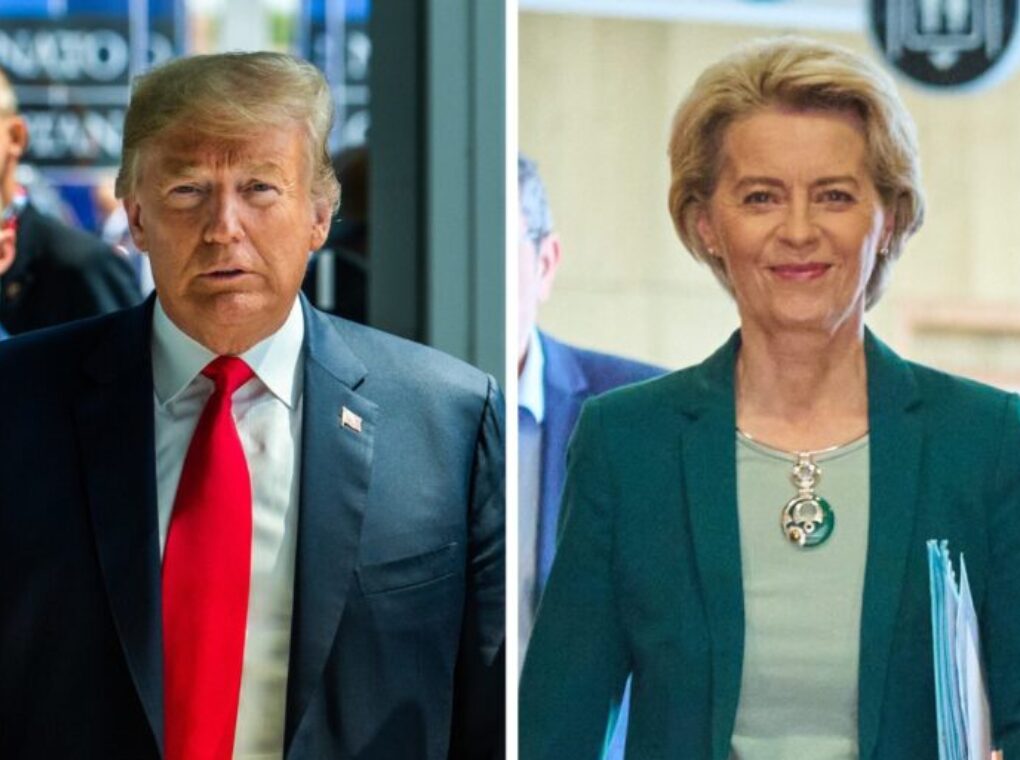
Europe is quietly debating what was once unthinkable: the creation of a new military and security alliance that does not rely on the United States. According to Politico, discussions among European officials have intensified following U.S. President Donald Trump’s renewed threats regarding Greenland and his increasingly confrontational posture toward traditional allies.
While still informal, these conversations reflect a growing belief in European capitals that the transatlantic relationship may be entering an irreversible phase of strategic separation.
The Roots of the Debate
For decades, NATO — anchored by American military power — has been the foundation of European security. However, Trump’s repeated skepticism toward NATO, combined with explicit threats to use economic and political coercion against allies, has shaken confidence in Washington’s long-term commitments. The Greenland episode, in which Trump openly suggested U.S. control over the Danish territory, acted as a catalyst. To many European policymakers, it symbolized not merely diplomatic friction but a deeper transformation in American strategic thinking.
According to Politico’s sources, a growing number of EU governments now believe that “divorce is inevitable.” While no formal break has occurred, the assumption that U.S. support can be taken for granted is increasingly questioned. As one European diplomat described it, contingency planning has quietly become the norm.
The “Coalition of the Willing” as a Prototype
The discussions are reportedly building upon the so-called “coalition of the willing” — a loose grouping of countries that initially coordinated military and political support for Ukraine. Over time, this coalition created unusually close ties among defense officials, intelligence services, and political leaders across Europe.
These networks, diplomats say, have gone beyond crisis coordination. Regular communication, personal trust, and operational familiarity have laid the groundwork for deeper cooperation. In the absence of full American engagement, these relationships could evolve into the backbone of a new European-centered security framework.
Importantly, this emerging format is not limited to EU members. The United Kingdom and Norway — both outside the EU but central to European defense — are considered integral participants. Ukraine, meanwhile, stands out as the most militarized and combat-experienced state in Europe today.
Ukraine’s Central Role
Ukraine’s inclusion fundamentally changes the strategic calculus. After years of high-intensity warfare, Ukraine possesses one of the largest standing armies on the continent, extensive battlefield experience, and rapidly modernizing military capabilities. In a future alliance structure, Kyiv would not be a peripheral security consumer but a core military contributor.
When combined with the military power of France, Germany, Poland, and the United Kingdom, the potential scale of such an alliance becomes significant. It would include both nuclear powers (France and the UK) and strong conventional forces. On paper, this “EU plus Ukraine” configuration could represent one of the largest armed coalitions in the world.
Not Explicitly Anti-American — But No Longer Dependent
Crucially, proponents of this idea stress that the alliance would not be explicitly anti-American. Cooperation with the United States would remain possible, but it would no longer be assumed as automatic or unconditional. This marks a major psychological shift: Europe preparing for strategic autonomy not as a slogan, but as a necessity.
Yet critics argue that even this framing understates the consequences. A Europe that plans security independently of Washington is, by definition, a Europe that challenges U.S. strategic primacy on the continent.
Strategic and Nuclear Realities
Skeptics — including voices in Ukraine itself — warn that such an alliance could prove destabilizing rather than protective. A new military bloc excluding the United States would place Europe in a highly precarious position: potentially confronting both Russia and an alienated America.
From a nuclear perspective, the imbalance is stark. The combined nuclear arsenals of France and the UK are vastly smaller than Russia’s and roughly comparable to only a fraction of U.S. capabilities. In a direct confrontation between Europe and Russia without American backing, Moscow would retain overwhelming escalation dominance.
Analysts warn that in such a scenario, Russia could issue a nuclear ultimatum demanding political concessions, confident that Europe lacks credible deterrence symmetry. Even a limited nuclear exchange would almost certainly result in catastrophic destruction of European territory, with no guarantee of equivalent damage to Russia.
Implications for the War in Ukraine
The formation of a European Ukrainian military alliance could also complicate efforts to end the war in Ukraine. Both Moscow and Washington would have strong incentives to shape any ceasefire or peace agreement in ways that prevent the emergence of a durable, independent European defense bloc.
This could include demands for limits on Ukraine’s military size or restrictions on alliance structures — conditions designed to neutralize the very concept of a European-centered security system.
A Continent at a Crossroads
Ultimately, these discussions reveal a Europe at a strategic crossroads. The continent is caught between declining faith in American guarantees and the harsh realities of power politics in a nuclear-armed world. Strategic autonomy promises independence, but it also carries immense risks.
Whether the idea of a new alliance remains theoretical or evolves into formal architecture will depend on future U.S. actions, the trajectory of the war in Ukraine, and Europe’s willingness to accept the costs — military, political, and existential — of standing alone.
For now, the debate itself is the signal: Europe is no longer planning its future solely within the American shadow.