
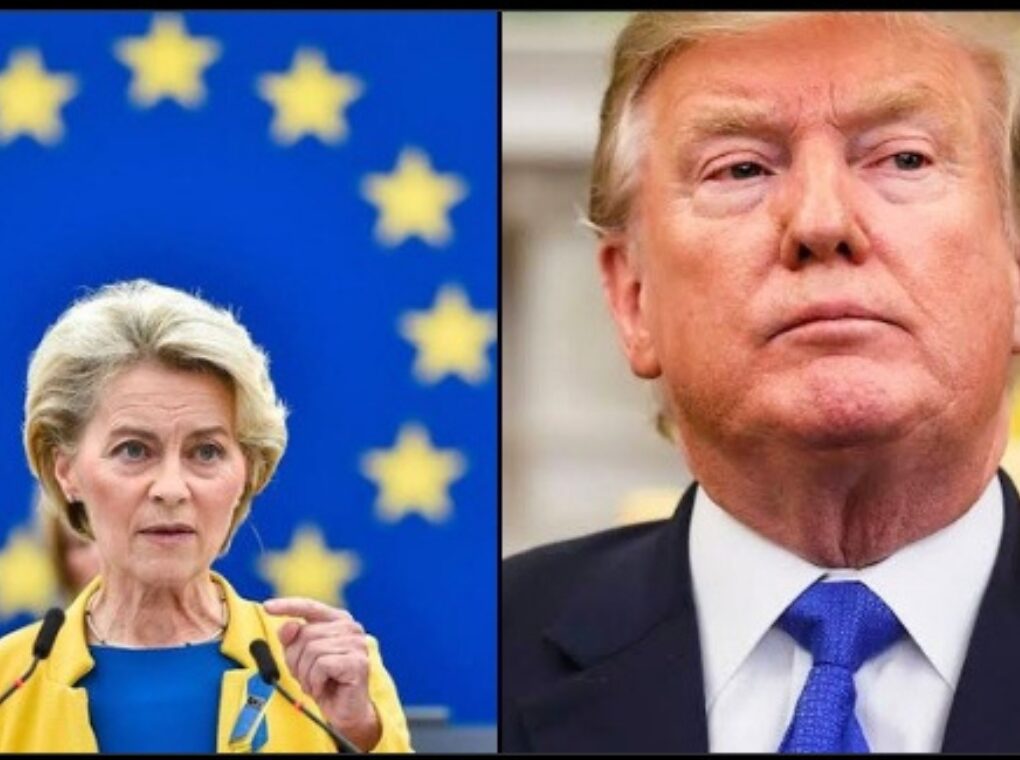
The European Union has put its much-anticipated trade agreement with the United States on indefinite hold, marking a sharp escalation in transatlantic tensions triggered by former U.S. President Donald Trump’s renewed territorial rhetoric over Greenland and aggressive tariff threats against European nations.
On Wednesday, a key group of members in the European Parliament blocked a scheduled vote to ratify the EU–US trade deal, effectively freezing the agreement just months after it was provisionally implemented. The decision follows Trump’s warning that he could impose tariffs of up to 35% on countries that oppose his ambitions regarding Greenland, a semi-autonomous Danish territory.
Bernd Lange, Chair of the European Parliament’s International Trade Committee, announced the move bluntly on social media, declaring: “EU-US Deal on ice indefinitely!” His statement underscored the growing frustration in Brussels over what EU officials view as coercive and unpredictable behavior from Washington.
A Deal Thrown Into Uncertainty
The trade agreement, reached in preliminary form in July, aimed to stabilize economic relations between the world’s two largest trading partners. It proposed a baseline tariff rate of 15% on European Union goods exported to the United States and included commitments from the EU to increase purchases of American agricultural products, energy supplies, and military equipment.
While many provisions had already gone into effect pending formal ratification, the European Parliament’s action now raises serious questions about whether the deal can survive in any form. Officials have not clarified whether already-implemented measures will remain active or be rolled back.
Lange accused the United States of undermining the spirit of the agreement by threatening new tariffs beyond the negotiated framework. “Until the threats are over, there will be no possibility for compromise,” he said during a press conference in Strasbourg. However, he suggested that EU commitments related to defense and energy procurement from the U.S. may still continue, at least for now.
Greenland at the Center of the Storm
The immediate catalyst for the freeze was Trump’s renewed insistence that Greenland should effectively become part of the United States. Speaking at the World Economic Forum in Davos, Trump claimed he did not intend to use military force to acquire the Arctic island but repeatedly emphasized his desire for Europe to “give” Greenland to the U.S.
According to Lange, Trump wants Greenland “as quick as possible” and seeks negotiations over what he would be willing to pay for it. These remarks reignited outrage across Europe, particularly in Denmark and Greenland itself, where protests have erupted in defense of Greenlandic self-determination.
For European lawmakers, the combination of territorial pressure and economic threats crossed a red line.
Europe’s “Trade Bazooka”
Trump’s tariff threats prompted an emergency meeting of EU representatives over the weekend. French President Emmanuel Macron reportedly urged the European Union to activate its powerful Anti-Coercion Instrument—often referred to as the EU’s “trade bazooka.”
If deployed, this mechanism could allow the EU to retaliate forcefully by suspending licenses of U.S. companies operating in Europe, restricting market access, or imposing taxes on American services such as technology and finance.
EU leaders are set to convene in Brussels on Thursday to discuss possible countermeasures should the United States proceed with new tariffs.
High Stakes for the Global Economy
The potential fallout is enormous. Trade between the United States and the European Union totaled nearly $1 trillion in 2024, making it one of the most significant economic relationships in the world. A full-scale trade war would disrupt global supply chains, raise prices for consumers, and inject fresh uncertainty into an already fragile global economy.
Complicating matters further, Trump’s ability to enact sweeping tariffs may depend on an ongoing legal battle in the U.S. Supreme Court. The court is currently reviewing a case challenging the legality of his broad tariff authority, with a ruling expected soon. The outcome could determine whether Trump can legally follow through on his latest threats.
A Transatlantic Relationship Under Strain
The freezing of the trade deal signals more than a temporary diplomatic spat. It reflects a deeper erosion of trust between Europe and the United States at a time when global instability—from geopolitical conflicts to economic fragmentation—demands cooperation rather than confrontation.
For now, the EU has drawn a firm line, making clear that economic agreements cannot coexist with territorial pressure and coercive trade tactics. Whether Washington chooses de-escalation or confrontation will shape the future of transatlantic relations—and possibly the global economic order—in the months ahead.