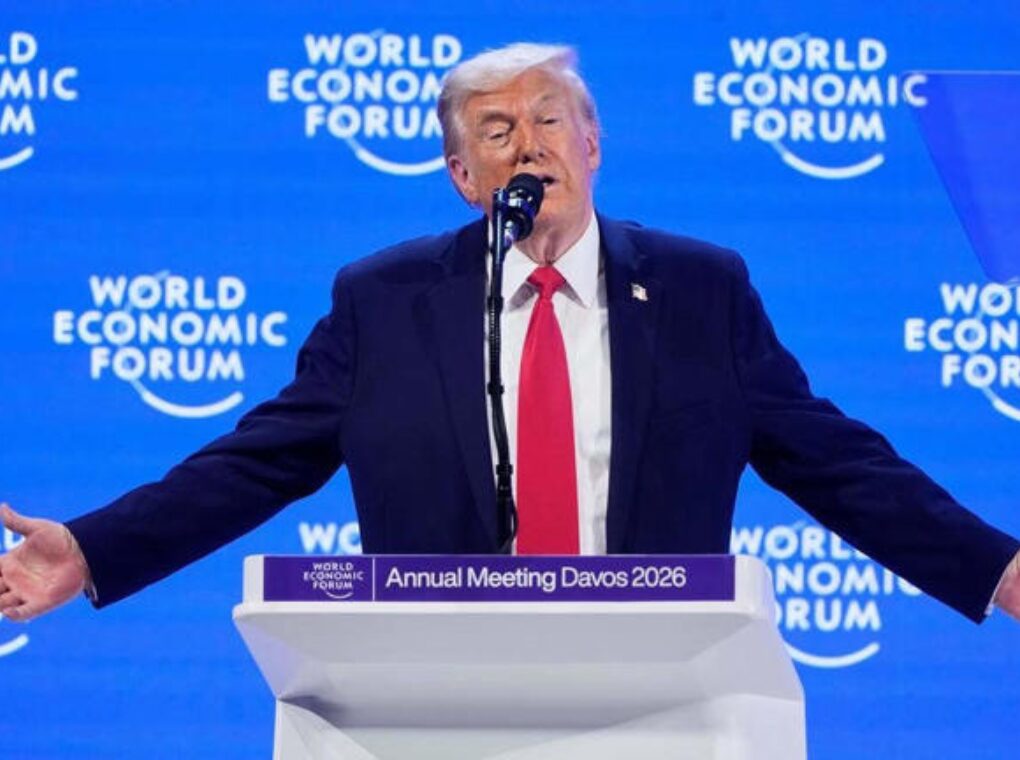
US President Donald Trump’s 70-minute address at the World Economic Forum (WEF) in Davos on January 21, 2026, sent shockwaves through political, financial, and diplomatic circles. Combining economic triumphalism with blunt warnings to allies, Trump used the global stage to reassert his “America First” doctrine—this time with sharper edges, explicit ultimatums, and a controversial push to acquire Greenland.
The speech, one of the most combative ever delivered by a sitting US president at Davos, signaled a decisive shift toward overtly transactional diplomacy, where economic leverage, security guarantees, and political loyalty are tightly interlinked.
Greenland Takes Center Stage
The defining moment of Trump’s address was his renewed demand for US ownership of Greenland. Calling the Arctic island “our territory” and “essential to North American security,” Trump framed acquisition not as imperial ambition, but as a strategic necessity.
“You need ownership to defend it,” he told the audience of global leaders and executives.
For the first time, Trump explicitly ruled out the use of military force, repeatedly emphasizing that he “won’t use force” to secure Greenland. However, his reassurance was undercut by a pointed warning: countries that block the deal would be “remembered.”
Trump argued that only the United States can secure Greenland against emerging threats linked to Arctic militarization, satellite vulnerability, and future energy corridors. He claimed that expanded US involvement would bring infrastructure investment, defense coordination, and economic development—strengthening NATO’s northern flank rather than undermining it.
The proposal comes amid intensifying Arctic competition, as melting ice opens new shipping routes and exposes critical mineral reserves, including rare earths. With China dominating global rare earth supply chains, Greenland’s strategic value has surged, making Trump’s push part of a broader geoeconomic contest.
Tariffs as Diplomatic Leverage
Trump paired his Greenland proposal with economic pressure. He threatened tariffs ranging from 10% to 25% on eight European countries—including Denmark and the UK—explicitly linking trade penalties to cooperation on the Greenland bid.
Claiming success for his protectionist policies, Trump asserted that US trade deficits have fallen by 77% and that the American economy is on track for 5.4% growth. “The US is the economic engine of the planet,” he declared, taking credit for record stock market highs, manufacturing reshoring, and capital inflows.
European institutions reacted sharply. The European Parliament announced the suspension of trade negotiations with the US, citing concerns over coercion and sovereignty. French President Emmanuel Macron labeled Washington’s tactics “fundamentally unacceptable,” accusing the US of bullying Europe.
NATO Under Pressure
Trump’s speech also reignited tensions within NATO. He openly questioned whether US allies would defend America in a crisis.
“Without us, you’d be speaking German or Japanese,” he said, repeating a familiar refrain from his first term.
While reaffirming formal commitment to the alliance, Trump made clear that US security guarantees are no longer unconditional. “You can say yes, and we will be very appreciative, or you can say no and we will remember,” he warned—linking NATO solidarity to compliance on Greenland and defense spending.
NATO leaders have privately expressed concern that such rhetoric could destabilize alliance cohesion, particularly at a time of heightened tensions with Russia and growing uncertainty over US long-term commitments.
Ukraine and Global Conflicts
On Ukraine, Trump claimed he is close to brokering a peace deal, stating that both Russian President Vladimir Putin and Ukrainian President Volodymyr Zelensky are ready to sign an agreement. He announced plans to meet Zelensky the same day but argued that resolving the conflict is “Europe’s business.”
“The United States is very far away, separated by a big, beautiful ocean,” Trump said, signaling a reduced US role in European security.
He also claimed success in Venezuela following US military intervention and reiterated controversial assertions that inflation has been “defeated” at home.
Energy, Climate, and Cultural Provocations
Trump used Davos to launch a broadside against Europe’s green energy transition. Calling green energy the “Greatest Hoax in History,” he mocked wind turbines as unreliable, environmentally destructive, and a scam benefiting China.
“China sells windmills to stupid people in Europe,” he said, drawing audible reactions in the hall.
He contrasted Europe’s renewable push with what he called US “energy abundance,” emphasizing fossil fuels, nuclear power, and domestic production as pillars of economic strength.
In a lighter—but widely reported—moment, Trump mocked Macron’s aviator sunglasses, prompting a flurry of memes and underscoring the personal, confrontational style that defined the speech.
A New Global Order on Display
Trump’s Davos 2026 appearance made one message unmistakably clear: US power under his leadership is conditional, transactional, and unapologetically self-interested. Economic access, security guarantees, and diplomatic goodwill are no longer assumed—they must be negotiated.
For Europe and the broader international community, the speech marked a turning point. Davos, long a symbol of global consensus, became the stage for a stark clash between multilateral cooperation and hard-nosed deal-making—one that may define global politics in the years ahead.