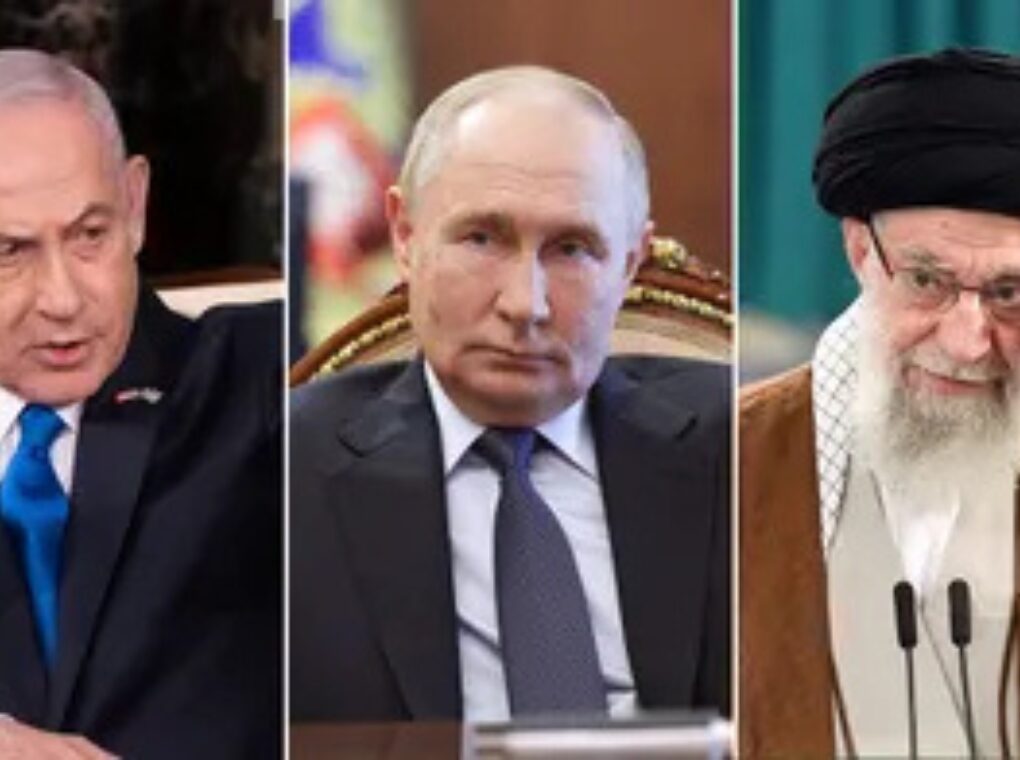
The Middle Eastern strategic balance appears to be entering a dangerous new phase. What was once assessed through satellite imagery, diplomatic signaling, and intelligence leaks is now increasingly visible in the skies themselves. A surge in heavy military air traffic into Iran, allegedly involving Russian and possibly Chinese strategic transport aircraft, has fueled speculation that Tehran is rapidly reinforcing its air and electronic defenses in anticipation of a potential U.S.–Israeli strike.
While many details remain unverified, the pattern of movements, timing, and geopolitical context suggest that Iran and its partners are preparing for a worst-case scenario—one that could redraw the rules of air power and deterrence in the region.
The Russian Airbridge: S-400s and Strategic Urgency
At the center of the current alarm is a reported spike in Russian IL-76TD cargo flights into Iranian airbases. These aircraft, long associated with heavy military logistics, are believed by multiple defense analysts to be carrying components of the S-400 Triumph air defense system. Even partial deployment of such a system would represent a qualitative leap in Iran’s defensive posture.
The S-400 is not merely a surface-to-air missile battery. It is an integrated sensor-shooter network designed to track, classify, and engage multiple targets simultaneously—ranging from ballistic missiles to stealth aircraft. Its radar architecture, especially when networked with other systems, complicates the operating environment for platforms like the F-35 and F-15I, which form the backbone of U.S. and Israeli strike doctrine.
For Moscow, accelerating deliveries to Iran serves multiple purposes. It deepens a strategic partnership with Tehran, complicates Western military planning, and signals that Russia retains leverage in the Middle East even as it faces pressure elsewhere. From Iran’s perspective, the message is clear: any attack will come at a far higher cost than before.
Trump’s Mixed Signals: Deterrence or Delay?
U.S. President Donald Trump’s rhetoric has added another layer of uncertainty. Earlier in January 2026, his messaging was overtly confrontational—publicly encouraging protests in Iran and warning the regime of an “exorbitant price” for mass repression. Such language was widely interpreted as laying the political groundwork for coercive action.
More recently, however, Trump’s tone has shifted. Claims that the violence inside Iran is “slowing” and that executions are not imminent have been met with skepticism by diplomats and analysts alike. Rather than signaling de-escalation, many interpret this calmer posture as strategic pause—time bought to assess Iran’s growing defenses and ensure that U.S. military options remain viable.
This ambiguity itself is a tool. By oscillating between threats and restraint, Washington keeps Tehran uncertain about timing, intent, and thresholds, even as it reinforces regional bases and naval assets.
The Invisible Battlefield: Electronic Warfare and Starlink
Perhaps the most consequential—and least visible—dimension of the current escalation lies in electronic warfare. Reports suggest that recent foreign deliveries to Iran may include advanced EW systems capable of disrupting satellite-based communications.
Starlink, operated by Elon Musk’s SpaceX, has emerged as a critical tool for both civilian connectivity and military-adjacent coordination. Iran’s reported success in jamming or degrading Starlink signals over sensitive areas points to a growing ability to create “silence bubbles”—zones where drones, precision-guided munitions, and network-centric warfare lose much of their advantage.
If sustained and refined, such capabilities could significantly blunt U.S. and Israeli reliance on real-time data fusion, forcing a return to riskier, less precise methods of strike operations.
The China Question: Signal or Substance?
Adding to the volatility are unconfirmed but widely circulated reports of a massive Chinese military airlift to Iran—allegedly involving up to 16 Y-20 strategic transport aircraft in just over two days. If true, this would mark an unprecedented logistical gesture by Beijing toward Tehran.
China’s strategic calculus is complex. Iran is a key energy partner and a geopolitical counterweight to U.S. influence, yet Beijing has historically avoided overt military entanglements that could trigger sanctions or confrontation. As such, many analysts urge caution: the reported airlift may be exaggerated, misattributed, or part of an information operation.
Still, even the rumor itself has impact. It reinforces the perception of a loosening alignment between Iran, Russia, and China, and it forces Washington and its allies to consider scenarios where Iran is no longer strategically isolated.
Deterrence Rewritten
Taken together, Iran’s indigenous Bavar-373 systems, potential S-400 deployments, electronic warfare advances, and perceived backing from major powers suggest a deliberate strategy: raise the entry cost of intervention beyond political acceptability.
This does not make Iran invulnerable. Advanced air defense systems have limits, and history—from Syria to Ukraine—shows they can be degraded through intelligence, saturation, cyber operations, and deception. The United States likely retains classified capabilities designed specifically to counter systems like the S-400.
But deterrence is not about absolutes. It is about risk perception.
As January 2026 unfolds, the central question is no longer whether Iran can be struck, but whether anyone is willing to absorb the consequences of doing so. In that sense, the skies over the Middle East have indeed flipped into a new dimension—one where metal, software, and strategic ambiguity are tightly intertwined, and where a single miscalculation could ignite a far wider conflagration.