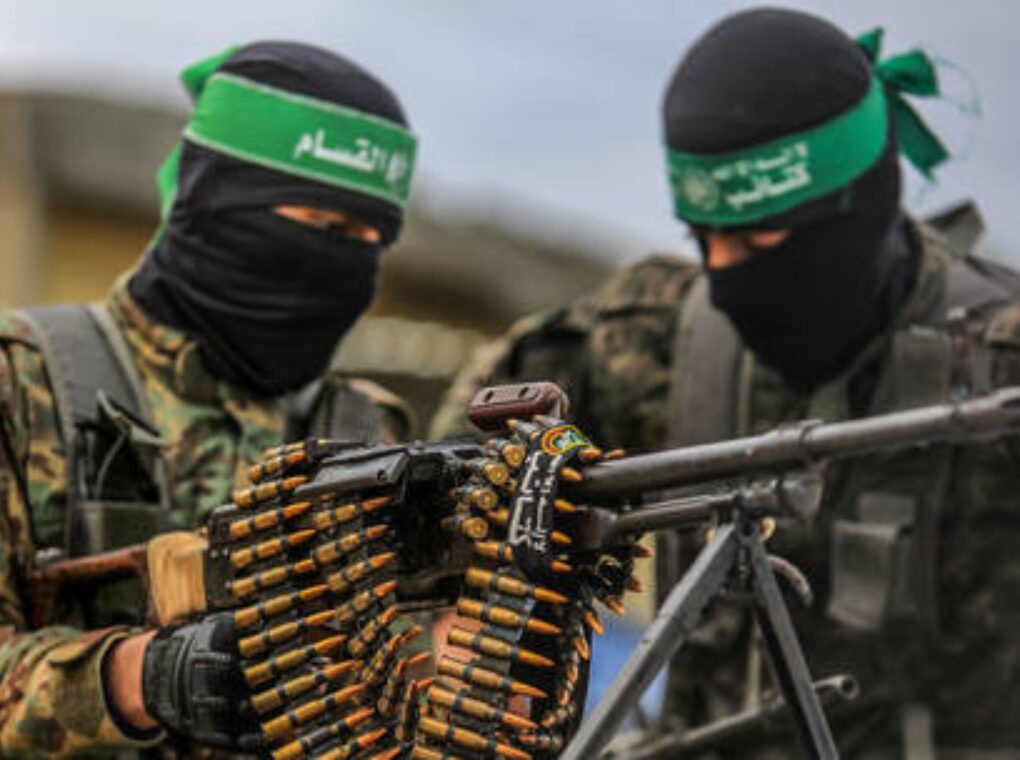
Palestinian militant group Hamas has reportedly agreed to disarm and abandon armed resistance in exchange for political survival and safe passage for its leadership out of Gaza, according to a report by Sky News Arabia. While neither Hamas nor the United States has officially confirmed the claims, the report—if accurate—would mark the most dramatic shift in the group’s strategy since its founding more than three decades ago.
Citing an anonymous Palestinian source, Sky News Arabia claimed that Hamas has already begun handing over weapons and detailed maps of its underground tunnel network to the United States through an undisclosed mechanism. The deal reportedly paves the way for Hamas to transition from an armed movement into a purely political organization, ending its role as a military force in Gaza.
Terms of the Alleged Agreement
Under the reported understandings, Hamas would fully surrender its weapons and cease all military activity. In return, the United States has allegedly offered assurances that:
Hamas leaders will be allowed safe passage out of Gaza,
Israel will not target Hamas leaders abroad in the future,
Hamas may continue participating in Gaza’s political life,
Certain Hamas-affiliated bureaucrats and police officers may retain roles in a future Gaza administration, subject to an Israeli American security screening process.
The source suggested that Hamas has already demonstrated goodwill by transferring some arms and intelligence assets, including tunnel network layouts that Israel has long sought during its operations in Gaza.
Israel’s Deep Reservations
While Israel has not officially commented on the report, the anonymous source indicated that Israeli authorities have “significant reservations,” particularly regarding any arrangement that allows Hamas to remain politically active in Gaza. Israeli Prime Minister Benjamin Netanyahu has repeatedly vowed throughout the two-year conflict to “completely destroy Hamas,” framing the war as an existential struggle rather than a limited military campaign.
Allowing Hamas—even in a demilitarized, political form—to retain influence in Gaza would represent a sharp departure from Israel’s stated war objectives. This tension suggests that even if talks are underway, implementation could face serious obstacles.
Trump’s ‘Board of Peace’ and Gaza’s Future
The report emerged just hours before US President Donald Trump signed an executive order formally establishing the ‘Board of Peace’, a controversial international body intended to oversee post-war governance and reconstruction efforts.
Initially envisioned as a small technocratic group dominated by Gulf Arab states, the Board has expanded into a large international organization with 60 potential member slots. According to its charter, three-year memberships are available—some reportedly sold for $1 billion per country. To date, 22 countries have joined.
In a move that raised eyebrows globally, Russian President Vladimir Putin was invited to join and reportedly offered to donate $1 billion from Russian assets frozen in the US, regardless of whether Russia formally accepts membership.
Notably, the word “Gaza” does not appear once in the Board’s charter. Critics argue that the initiative resembles an attempt by Washington to create a parallel global governance structure, undermining existing institutions such as the United Nations.
Phase Two: Disarmament and Technocratic Rule
Last week, Trump announced the launch of Phase Two of his 20-point Gaza settlement plan, which explicitly envisions Hamas disarming and transferring control of Gaza to the National Committee for the Administration of Gaza (NCAG). The NCAG is a 15-member body composed of Palestinian technocrats, which held its inaugural meeting in Cairo last Thursday.
If the reported Hamas-US deal is accurate, it would align closely with Trump’s roadmap—suggesting that negotiations may have been underway well before the public rollout of Phase Two.
Ceasefire Under Strain
Despite a ceasefire agreed upon in October, violence has not ceased. Both Israel and Hamas have accused each other of repeated violations. Since the truce took effect, more than 450 Palestinians and three Israeli soldiers have been killed, underscoring the fragility of the current calm.
Humanitarian conditions in Gaza remain dire. While large-scale bombardment has decreased, insecurity, displacement, and political uncertainty continue to haunt the enclave. As one observer put it, “people do not feel truly safe”—a sentiment echoed across Gaza’s devastated neighborhoods.
A Turning Point or Tactical Pause?
If Hamas has indeed agreed to disarm, the move would represent a historic turning point in the Israeli-Palestinian conflict. Yet skepticism remains high. Without official confirmation from Hamas, Washington, or Jerusalem, it is unclear whether the reported deal is a finalized agreement, a tentative framework, or a tactical maneuver amid mounting international pressure.
What is clear, however, is that Gaza is entering a new and deeply uncertain phase, where military confrontation may give way to political engineering—designed not only to reshape Gaza, but potentially to redraw the balance of power across the Middle East.