
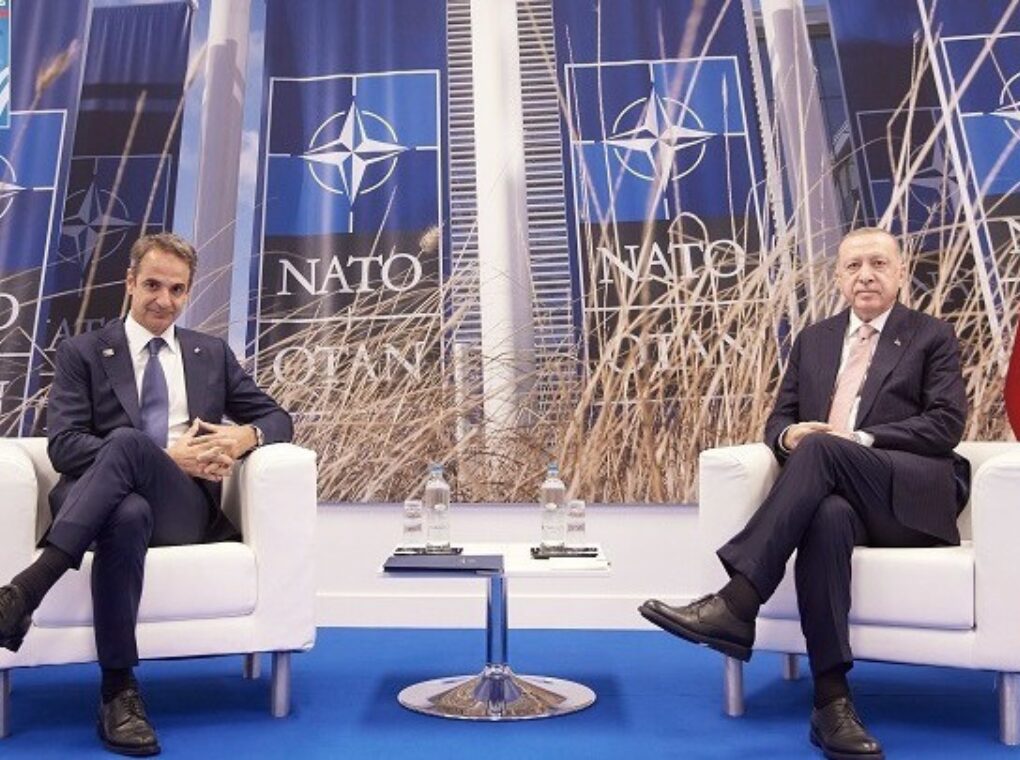
The Eastern Mediterranean is once again emerging as one of the world’s most volatile geopolitical flashpoints. Greece’s announcement that it plans to extend its territorial waters — potentially in the Aegean Sea — has revived long-standing tensions with Turkey, a NATO ally that has repeatedly warned Athens of dire consequences should such a move occur. But this time, the dispute is unfolding against a far more complex backdrop: shifting alliances, militarization, and the emergence of rival strategic blocs stretching from the Mediterranean to South Asia.
Greece’s Territorial Waters Move: Law vs Power Politics
Under the United Nations Convention on the Law of the Sea (UNCLOS), coastal states are entitled to extend their territorial waters up to 12 nautical miles. Greece has already exercised this right in the Ionian Sea, following agreements with Italy, and has concluded a maritime delimitation deal with Egypt in the eastern Mediterranean. However, the Aegean Sea remains a red line.
In 1995, Turkey’s parliament declared that any unilateral extension of Greek territorial waters beyond six nautical miles in the Aegean would constitute a casus belli — a cause for war. Ankara argues that the unique geography of the Aegean, dotted with Greek islands close to Turkey’s coastline, would effectively trap Turkish naval access and airspace. Athens counters that Turkey’s stance violates international law and undermines Greek sovereignty.
The dispute is not merely legal. Beneath it lie critical issues of energy exploration, airspace control, continental shelf rights, and exclusive economic zones, all of which could determine future access to hydrocarbons and strategic sea lanes.
Militarization and the Greece–Israel–Cyprus Axis
What distinguishes the current phase from earlier crises is the growing militarization of the Eastern Mediterranean. In late 2025, Greece, Cyprus, and Israel signed a Trilateral Military Cooperation Plan for 2026, formalizing deeper defense ties. The agreement includes joint naval and air exercises, intelligence sharing, electronic warfare cooperation, and specialized training in unmanned systems.
Greece has also accelerated defense acquisitions from Israel, including missile systems, rocket artillery, and negotiations for a multi-layer air and drone defense architecture known as the “Achilles Shield.” These moves are widely seen as a deterrent aimed at Turkey’s expanding military footprint in the region.
For Israel, strained relations with Ankara following the Gaza war and Turkey’s open support for Hamas have reinforced the logic of aligning with Greece and Cyprus as stable partners in the Mediterranean.
Turkey’s Countermove: Toward an ‘Islamic NATO’?
Turkey, meanwhile, is exploring strategic alternatives beyond its uneasy NATO relationship. In January 2026, Ankara opened talks to join the Saudi Arabia–Pakistan Strategic Mutual Defence Agreement (SDMA), a pact reportedly modeled on NATO’s collective security principle.
Under this emerging framework, Saudi Arabia would provide financial backing, Pakistan would contribute manpower and nuclear deterrence, and Turkey would add military-industrial capabilities, drone technology, and operational experience. Azerbaijan is already closely aligned with Ankara and Islamabad, raising concerns of a broader Sunni strategic bloc.
While the term “Islamic NATO” remains unofficial and controversial, the implications are significant. The possibility of Pakistan’s nuclear umbrella indirectly extending to Saudi Arabia — and potentially Turkey — introduces new uncertainties into Middle Eastern and South Asian security calculations.
India’s Expanding Mediterranean Footprint
Against this backdrop, India is no longer a peripheral observer. New Delhi has been formally invited to join the Israel–Greece–Cyprus “3+1” strategic framework, which focuses on energy security, defense cooperation, and regional stability.
India already enjoys deep defense ties with Israel, growing military cooperation with Greece — including naval and air exercises — and historically strong relations with Cyprus. Indian naval deployments in the Mediterranean and Indian Air Force participation in multinational drills underscore New Delhi’s expanding strategic horizon.
For India, involvement in the Mediterranean is not about alliance politics but about strategic presence, maritime security, and counter-balancing emerging power blocs that could affect its interests from the Red Sea to the Arabian Sea.
The UAE Factor and Regional Balancing
The United Arab Emirates adds another layer of complexity. While Saudi Arabia appears to be drifting closer to Pakistan and Turkey, the UAE has deepened ties with India and Israel, notably through the I2U2 grouping that also includes the United States. Tensions between Riyadh and Abu Dhabi over Yemen, energy policy, and regional leadership provide India with diplomatic space to play a balancing role.
A New Geopolitical Crossroads
The Eastern Mediterranean is no longer a localized dispute zone. It has become a crossroads where European security, Middle Eastern rivalries, and Indo-Pacific interests intersect. Greece’s territorial waters decision could trigger a major crisis with Turkey, while Ankara’s pivot toward Pakistan and Saudi Arabia hints at a broader realignment with global consequences.
For India, the moment presents both risks and opportunities. By deepening ties with Greece, Cyprus, Israel, and like-minded partners, New Delhi can enhance its strategic depth without being drawn into rigid alliances. The Mediterranean’s shifting power map suggests one thing clearly: regional conflicts are now interconnected, and the choices made here will resonate far beyond its shores.