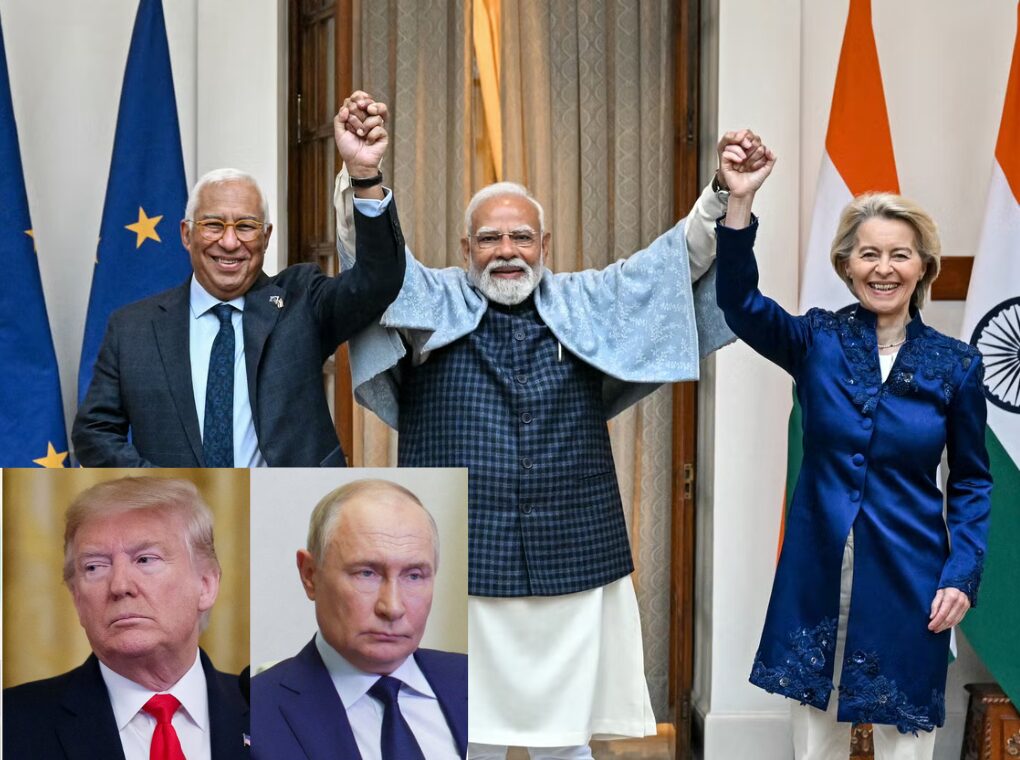
The newly signed European Union–India trade agreement is being described as one of the most significant economic partnerships of the decade. While headlines focus on tariff cuts and export growth, the deeper story is geopolitical. This landmark EU–India trade deal reflects changing global power dynamics, Europe’s push for strategic autonomy, and the rise of multipolar economic alliances.
A Historic EU–India Trade Agreement
The EU–India Free Trade Agreement (FTA) dramatically reduces or eliminates tariffs on a vast majority of goods and services traded between the two economies. For European exporters, this opens one of the world’s largest and fastest-growing consumer markets. Industries such as automobiles, pharmaceuticals, luxury goods, machinery, and financial services stand to benefit from improved access and lower trade barriers.
India, on the other hand, gains deeper entry into the European single market — the largest unified market in the world. The deal is expected to increase foreign direct investment, promote technology transfers, and strengthen India’s manufacturing and service sectors. For both sides, the agreement promises economic growth, supply chain diversification, and stronger long-term commercial ties.
However, the geopolitical context surrounding the EU–India trade deal makes it far more than just an economic pact.
The Russia Energy Irony
One of the most talked-about aspects of the deal is the apparent contradiction in Europe’s stance toward Russian energy. Since the start of the Ukraine conflict, the EU has imposed multiple sanctions on Moscow and worked to reduce direct imports of Russian oil and gas. European leaders have also criticized countries continuing to purchase Russian crude.
India, however, significantly increased its imports of discounted Russian oil in recent years, refining it and exporting petroleum products globally. Now, with the EU deepening trade ties with India, Europe may indirectly import refined fuels that originated as Russian crude.
This situation highlights the complexity of global energy markets. While the EU aims to reduce direct dependence on Russian resources, energy security, affordability, and industrial stability remain pressing concerns. The EU–India partnership offers Europe diversification options, even if supply chains remain globally interconnected.
Europe’s Push for Strategic Autonomy
The EU–India trade deal also reflects Europe’s broader effort to reduce overreliance on any single global partner. For decades, Europe depended heavily on the United States for security through NATO and on a global trade system shaped largely by Western powers. However, recent geopolitical tensions and economic disruptions have prompted European policymakers to rethink that dependence.
The concept of “strategic autonomy” has gained traction within the EU. This means strengthening Europe’s ability to act independently in areas like defense, technology, energy, and trade. Expanding economic partnerships with countries like India is a key part of this strategy.
Rather than replacing existing alliances, Europe is diversifying them. The goal is resilience — ensuring that economic or political pressure from any one region does not destabilize the continent.
India’s Role in a Multipolar World
India’s position in global politics makes it an especially important partner. As a leading member of BRICS — alongside Brazil, Russia, China, and South Africa — India is part of a group seeking greater influence in global governance and economic systems. At the same time, India maintains strong relationships with Western democracies and participates in groupings like the Quad.
This ability to engage across geopolitical divides makes India a valuable bridge in an increasingly multipolar world. For Europe, closer ties with India provide access not only to a major market but also to a key player in shaping future global economic and political frameworks.
The EU–India trade deal therefore signals Europe’s willingness to engage pragmatically with rising powers, even when their foreign policy positions do not fully align with Brussels.
Implications for Global Trade and Geopolitics
The agreement could have ripple effects far beyond Europe and India. As global supply chains shift and countries seek to reduce dependence on single sources, large-scale trade partnerships like this one will play a critical role in shaping future economic networks.
At the same time, the deal reflects how economic interests increasingly intersect with security and foreign policy decisions. Europe’s engagement with India demonstrates that trade policy is now a tool of geopolitical strategy, used to build resilience, influence, and flexibility.
A Sign of the Times
Ultimately, the EU–India trade deal represents more than tariff reductions or export growth. It is a clear example of how global power structures are evolving. Europe is adapting to a world where influence is more distributed, alliances are more fluid, and economic security is closely tied to geopolitical strategy.
As the global order becomes more complex, partnerships like the one between the EU and India will help define the next phase of international relations — one shaped not just by ideology, but by pragmatic cooperation in a rapidly changing world.