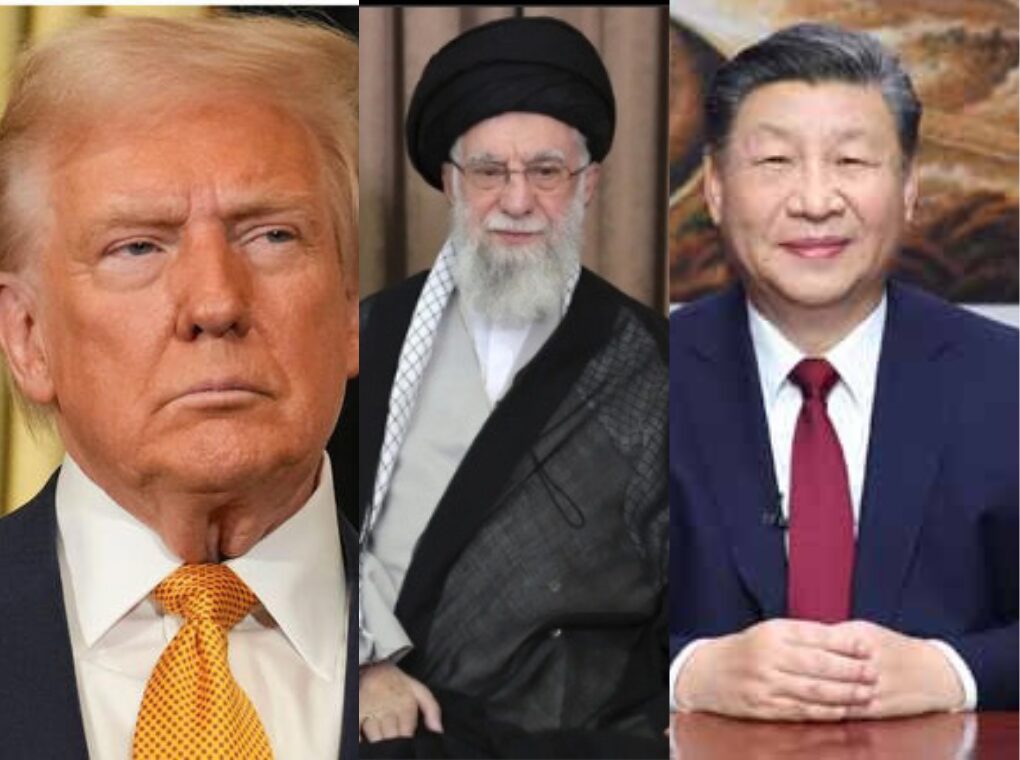
Tensions between the United States and Iran continue to simmer, with military posturing, sanctions, and political threats shaping an atmosphere that often feels on the brink of escalation. Yet despite periodic spikes in rhetoric and visible American force deployments in the Middle East, a direct large-scale U.S. strike on Iran has not materialized. One increasingly discussed factor in strategic circles is China’s expanding role behind the scenes — particularly in the fields of surveillance, technology, and military cooperation with Tehran.
The Growing China–Iran Strategic Alignment
Over the past several years, Beijing and Tehran have deepened their partnership across economic, technological, and defense domains. While China officially frames its relationship with Iran as standard state-to-state cooperation, analysts argue that the scope and timing of this engagement carry broader geopolitical implications.
Iran sits at a crucial crossroads of energy routes and trade corridors tied to China’s Belt and Road Initiative. Stability in Iran helps secure long-term access to oil supplies and preserves a strategic foothold in the Middle East, a region historically dominated by U.S. influence.
Because of this, many observers believe China sees Iran not just as a trading partner, but as a geopolitical counterweight to Washington.
Space, Surveillance, and the Information Battlefield
One of the most sensitive aspects of modern warfare is no longer just boots on the ground — it is information dominance. Military planners depend heavily on satellite surveillance, navigation systems, and real-time reconnaissance to coordinate operations and maintain the element of surprise.
China has made enormous advances in these areas. Its BeiDou satellite navigation system now rivals GPS in global coverage, and Chinese commercial and state-linked satellites provide high-resolution earth observation capabilities.
Security analysts speculate that closer technological integration between China and Iran could improve Tehran’s ability to monitor regional military movements, protect its infrastructure, and reduce dependence on Western-controlled systems. Even the perception that Iran may have access to alternative satellite navigation, imaging, or communications support complicates U.S. and allied planning.
For Washington, uncertainty itself is a strategic problem. If American operations are assumed to be under near-constant observation — whether by Chinese, Russian, or Iranian sensors — achieving surprise becomes far more difficult. That doesn’t make military action impossible, but it raises risks, costs, and the potential for miscalculation.
Why This Changes Washington’s Calculus
U.S. military superiority remains overwhelming in conventional terms. However, modern conflict between major powers is rarely just about firepower. It involves cyber capabilities, electronic warfare, intelligence sharing, and economic retaliation.
A strike on Iran today would not occur in a vacuum. American decision-makers must weigh not only Iran’s response — including missile attacks, proxy warfare, and disruption of shipping lanes — but also the broader reactions of major powers with stakes in Tehran’s survival.
China is unlikely to intervene directly in a U.S.–Iran war, but it could respond in indirect and asymmetric ways:
Expanding intelligence or technological support to Tehran
Applying economic pressure in other theaters
Escalating tensions in regions where the U.S. and China are already competing, such as the South China Sea or the Taiwan Strait
Using diplomatic and information channels to isolate Washington internationally
This wider risk environment makes any strike part of a global strategic equation, not just a regional military operation.
Lessons From Other Geopolitical Flashpoints
Chinese policymakers closely watch how U.S. power is applied around the world. Situations where American pressure has led to regime collapse or major strategic setbacks for Beijing’s partners are often studied as cautionary tales. From Beijing’s perspective, allowing another strategically important partner to fall under Western military or political pressure would weaken China’s image as a reliable global actor.
Iran, therefore, represents more than a Middle Eastern state — it is part of a broader test of how far China can protect its interests in an era of renewed great-power competition.
A Multipolar Deterrence Effect
What emerges is a form of indirect deterrence. Iran’s own military strength may not be enough to stop a U.S. strike outright, but the possibility of deeper Chinese involvement — technological, economic, or strategic — adds another layer of consequence.
Washington must now consider:
Regional escalation
Global economic shock, especially in energy markets
Reactions from China and Russia
The risk of opening multiple geopolitical fronts at once
That combination encourages caution. Instead of immediate large-scale conflict, the U.S. has leaned more heavily on sanctions, cyber operations, diplomacy, and limited regional force posture adjustments.
The Bigger Picture: U.S.–China Rivalry Playing Out in the Middle East
At its core, this is not just about Iran. It reflects the transition from a U.S.-dominated world order to a more contested, multipolar system. The Middle East, long shaped by American power, is becoming another arena where China quietly expands influence without confrontation.
Beijing’s strategy is subtle: avoid open military clashes while steadily increasing the cost of U.S. unilateral action. In that sense, China doesn’t need to fire a shot to shape events — its presence alone changes the strategic landscape.
Washington’s hesitation over striking Iran is driven by many factors: war fatigue, regional instability, economic risks, and alliance politics. But China’s expanding technological and strategic partnership with Tehran has added a powerful new variable.
Even without formal military intervention, Beijing’s shadow looms large — turning any potential U.S.–Iran conflict into a move on a much bigger global chessboard.