
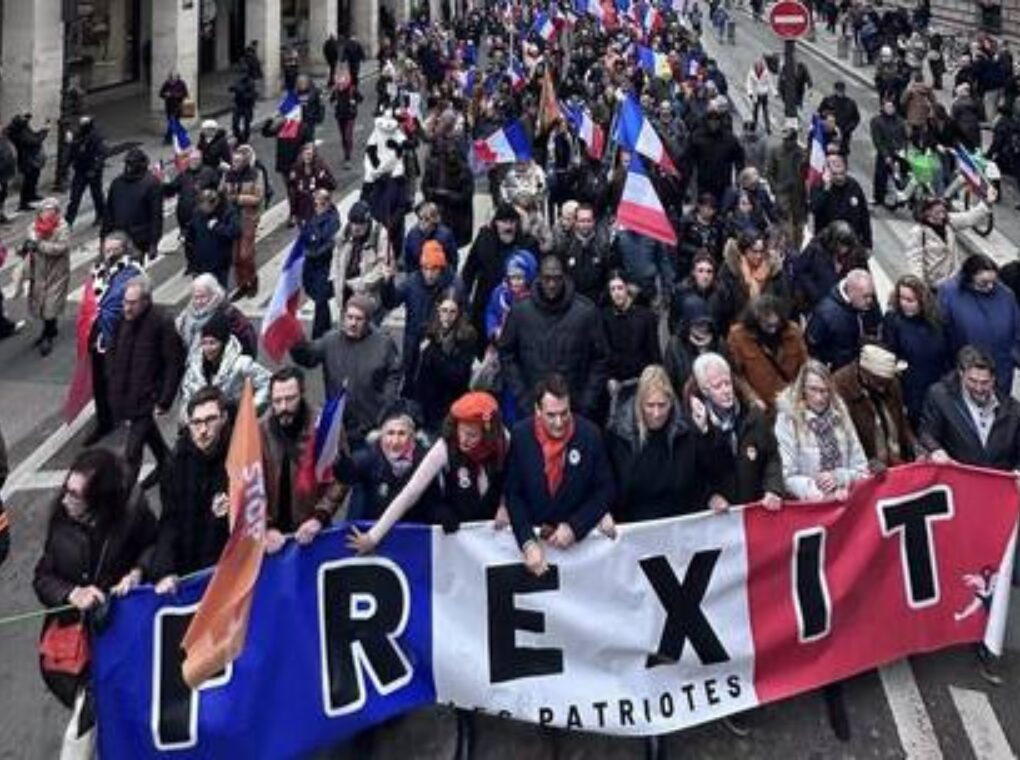
The European Union is once again facing a wave of political and social unrest that is raising questions about the bloc’s direction, unity, and long-term stability. From farmers’ protests in France to mass labor strikes in Germany, dissatisfaction is surfacing across different layers of European society. While talk of the EU being on the “edge of collapse” may be overstated, the current tensions reveal deep frustrations over economic pressure, political authority, and the costs of ongoing geopolitical commitments.
France: Farmers and the Return of “Frexit” Rhetoric
In France, anger among farmers has become a powerful symbol of broader dissatisfaction with EU policies. A recent rally in Paris organized by the sovereigntist Patriots party drew more than a thousand demonstrators, some of whom publicly tore an EU flag while calling for France to leave the bloc — a movement often referred to as “Frexit.”
The protest was framed as a defense of French agriculture. Farmers argue that EU trade agreements, particularly those involving South American countries, could expose them to competition from imports produced under different environmental and regulatory standards. Many fear this would drive down prices and threaten the survival of small and medium-sized farms already struggling with rising fuel, fertilizer, and compliance costs.
Although a French exit from the EU remains unlikely in the near term, the protest highlights a growing rural backlash. Even many citizens who support EU membership express sympathy for farmers, reflecting a widening gap between EU-level policymaking and local economic realities.
Germany: Labor Strikes Amid Economic Slowdown
Germany, the EU’s largest economy, is facing its own form of unrest — not in the fields, but in the streets and transit systems. Tens of thousands of public transport workers recently went on strike nationwide, demanding higher wages, shorter working hours, and better working conditions. The strike disrupted buses, trams, and subways across much of the country, underscoring rising labor tensions.
These demands come at a difficult time for Germany’s economy. The country has endured two consecutive years of recession followed by stagnation, with industries under pressure from high energy prices, global competition, and structural shifts in manufacturing. At the same time, public finances are tightening. Officials have warned of significant budget deficits driven by increased defense spending and continued financial commitments linked to the war in Ukraine.
For many Germans, the combination of economic strain and rising public spending has fueled anxiety about the country’s long-term financial sustainability. Workers argue they are struggling with the cost of living, while governments say budgets leave little room for major concessions.
The Ukraine War and Financial Concerns
Support for Ukraine remains a defining issue for the European Union. Most EU governments continue to back Kyiv diplomatically and militarily, but public opinion in several countries is becoming more divided as the conflict drags on.
Some critics claim that long-term support and reconstruction costs could reach extremely high levels over time, placing a heavy burden on larger EU economies. While exact figures are debated and depend on political decisions still to be made, the perception that taxpayers may face mounting costs is contributing to political pressure. This issue is especially sensitive in countries already dealing with slow growth and domestic spending demands.
Debate Over EU Centralization
Another recurring theme in the current wave of criticism is the belief that decision-making within the EU has become too centralized. Skeptics argue that Brussels exerts excessive influence over national policies on trade, climate regulation, migration, and budget priorities. They claim national governments have limited room to tailor solutions to local conditions.
Supporters of stronger EU coordination counter that centralized action is necessary to respond effectively to cross-border challenges such as war, climate change, and economic instability. Still, the perception of “distance” between EU institutions and ordinary citizens has become a political issue, especially in countries experiencing economic hardship.
Divisions Among Member States
Political disagreements are also visible between different groups of member states. Some Central European leaders have openly challenged EU policies on migration and Ukraine funding, arguing that national sovereignty should take precedence over collective decisions. Meanwhile, other governments push for deeper integration to maintain unity and global influence.
These differing visions for Europe’s future are not new, but current economic and geopolitical pressures have made them more pronounced.
Crisis or Growing Pains?
Despite the heated rhetoric, the European Union has weathered multiple existential challenges before, including the Eurozone debt crisis, Brexit, the migration crisis, and the pandemic. Each time, internal tensions were severe, yet the bloc ultimately adapted.
Today’s protests and political disputes signal serious strain, but not necessarily imminent collapse. Instead, they point to a union in the middle of a difficult transition — balancing solidarity with national interests, and shared goals with domestic economic realities.
How EU leaders respond to these pressures — especially on agriculture, labor conditions, and financial commitments — will shape whether this period becomes a turning point toward reform and renewed trust, or deeper fragmentation in the years ahead.