
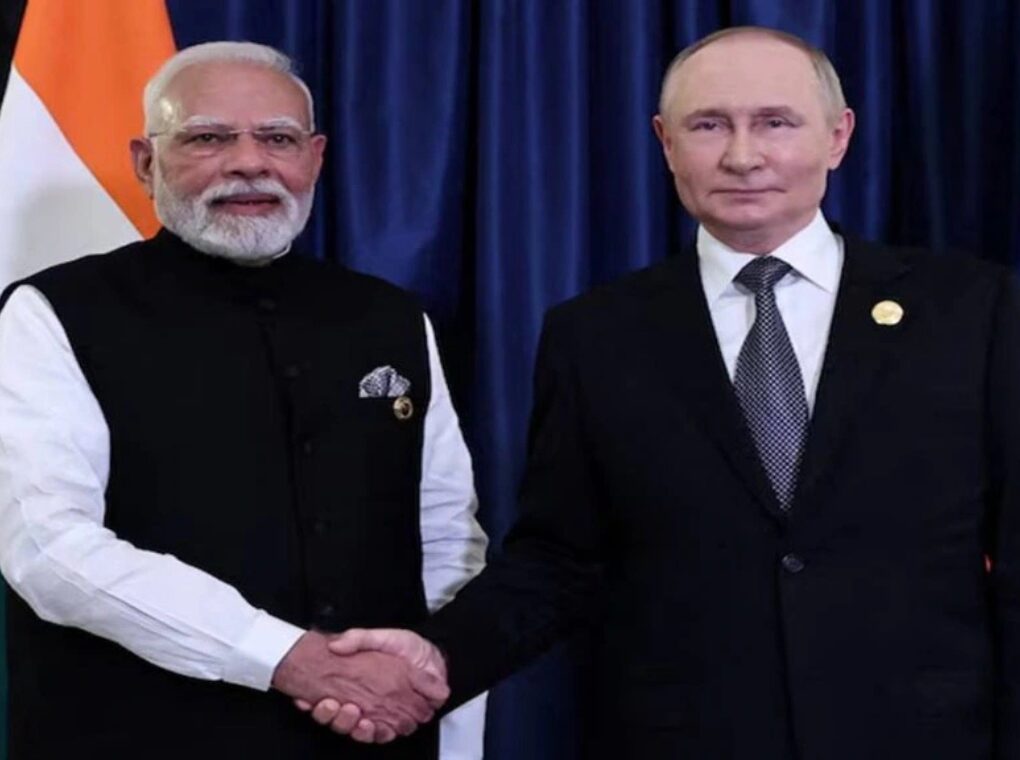
The emerging India–United States trade agreement, expected to move toward formalisation in mid-March, is being presented publicly as a major reset in economic ties between the two countries. Yet beneath the optimistic language on tariffs and investment lies a far more sensitive issue — India’s continued purchase of Russian oil and the broader question of strategic autonomy.
From Washington, the narrative has been assertive. Statements attributed to former US President Donald Trump have suggested that the deal would not only lower tariffs on Indian goods to around 18 percent but also lead India to scale back or even halt purchases of Russian crude. There have also been references to large-scale Indian investments into the US economy as part of a broader rebalancing of trade.
New Delhi’s messaging, however, has been notably more restrained and selective.
When Indian Prime Minister Narendra Modi acknowledged progress in trade discussions, his remarks focused on tariff reductions, economic cooperation, and long-term partnership. There was no explicit reference to Russian oil imports. In diplomacy, such omissions are rarely accidental. India has historically avoided public commitments that could constrain its policy flexibility, especially on issues tied directly to energy security.
Energy Security at the Core
India imports more than four-fifths of its crude oil requirements, making energy affordability a matter of national economic stability. Since the onset of the Ukraine conflict and the resulting disruption in global energy markets, Russian crude has been offered at significant discounts compared to many other international grades. Indian refiners, operating in a highly competitive environment, have taken advantage of these price differentials.
Cheaper crude has helped refiners maintain margins while also cushioning domestic fuel prices in a country where energy costs directly influence inflation, transport expenses, and overall cost of living. Any abrupt shift away from discounted supplies would therefore carry economic consequences that extend well beyond foreign policy considerations.
From India’s perspective, energy sourcing is a commercial and strategic calculation, not a political endorsement. Successive Indian governments have maintained that purchases are guided by national interest, supply security, and market conditions.
Pressure and Perception
The United States has used tariffs, sanctions, and financial restrictions as tools of foreign policy in multiple regions. Reports suggesting the possibility of penalties or trade pressure linked to India’s Russian oil purchases have fed a perception in some quarters that Washington is seeking to leverage economic agreements to influence New Delhi’s energy decisions.
India, however, frames its approach under the doctrine of “strategic autonomy.” This principle, rooted in decades of foreign policy thinking, emphasises independent decision-making while engaging with multiple power centres simultaneously. India is a member of the Quad alongside the US, Japan, and Australia, yet it also maintains longstanding defence and energy ties with Russia and plays an active role in BRICS.
Rather than aligning exclusively with any one bloc, India has preferred a multi-vector strategy — deepening ties with the West while preserving relationships that serve its economic and security interests elsewhere.
Signals from the Market
Beyond official statements, oil trade flows offer practical insight into policy direction. Indian refiners have continued to evaluate Russian crude alongside supplies from West Asia, Africa, and the Americas. There has been no publicly announced directive from the Indian government ordering refiners to stop Russian imports.
Refining decisions are typically driven by a mix of price, crude quality, freight costs, and technical compatibility with refinery configurations. Russian Urals crude, a medium-sour grade, has proven commercially attractive and technically suitable for several Indian refineries. Replacing it is not always straightforward. Venezuelan crude, for example, is often heavier and more complex to process, while US grades differ in composition and pricing structure.
As a result, energy trade patterns tend to respond more to economics than to political rhetoric alone.
Russia’s Position and the BRICS Context
Moscow has consistently described India as a sovereign partner free to choose its energy suppliers. For Russia, India has become one of the most important destinations for crude exports as Western markets have narrowed. The relationship is therefore underpinned by mutual economic interest.
At a broader level, this dynamic aligns with the gradual strengthening of cooperation among BRICS countries. While BRICS does not function as a formal alliance, its members increasingly explore alternatives in trade, finance, and energy that reduce dependence on Western-dominated systems. India’s engagement in this framework coexists with its expanding ties to the United States — a reflection of its balancing strategy rather than a shift toward bloc politics.
The Larger Geopolitical Test
The debate surrounding the trade deal ultimately reflects a deeper global transition. As India’s economic and strategic weight grows, external powers are seeking closer alignment with New Delhi. At the same time, India is attempting to expand partnerships without surrendering policy independence.
Whether or not the final trade agreement contains language touching on energy cooperation, the practical reality is likely to remain complex. India will continue diversifying suppliers, negotiating prices, and adjusting to global market shifts. But it is equally likely to resist binding commitments that restrict its ability to respond flexibly to changing conditions.
In that sense, the issue is not simply about Russian oil. It is about how a rising power navigates an increasingly polarised world — cooperating broadly, committing cautiously, and preserving the space to decide in accordance with its own interests.